INSCYD the Numbers: Running Economy Part 2
Sebastian Weber explains how focusing on and improving running economy can save runners and triathletes time on their marathon and half marathon.

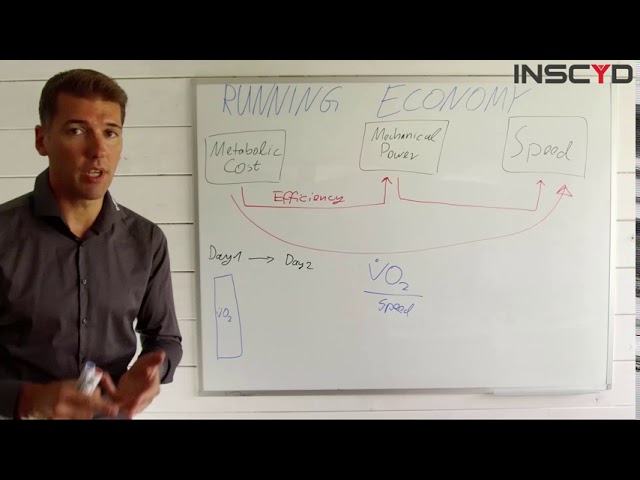
Running economy is a measure of the metabolic cost of running at a given speed. It is typically expressed as the oxygen cost per unit distance, or as the energy cost per kilogram per kilometer. Improving running economy means the athlete uses less oxygen and less energy to run at the same pace, which translates directly into faster race times at the same effort level.
In part 2 of this series, we look at the interaction between running economy and metabolic profile. Running economy is affected by biomechanical factors, but it is also strongly influenced by body composition and substrate utilization. An athlete who is efficiently burning fat at race pace will have better effective running economy than an athlete who is burning mostly carbohydrates, because they are not depleting their limited glycogen stores as rapidly.
This is why improving fat oxidation through metabolic training can improve race performance even without any change in mechanical running economy. INSCYD allows coaches to track both running economy and metabolic metrics across training cycles, giving a complete picture of how training is affecting performance capacity from multiple angles.
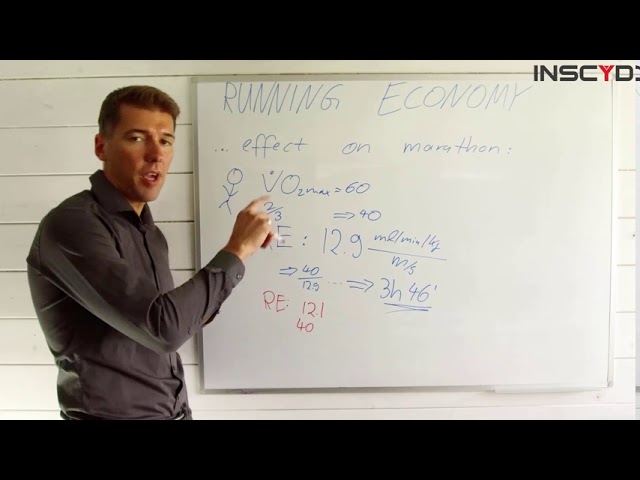
So now let's look at what it actually does to your performance. I'm pretty sure you will be impressed. So what we're going to look at is the effect on running economy, in this example on the performance in your marathon. Okay, so let's come up with a typical amateur athlete or runner. Let's assume VO2max is approximately 60 milliliters, and let's assume in a marathon he's able to use two thirds of that. So this then equals using 40 milliliters during the marathon.
To put this in perspective, if this athlete would weigh 70 kilograms, this 40 milliliters equals approximately 250 watts on the bike for example, 240, somewhere in this ballpark, right? So also if you are running this running power meter, you can compare the number and say, okay, it might be a decent example here. Okay, so let's assume this is a marathon performance. And now let's assume the running economy, often used as RE, okay, is a typical value of 12.9.
This is milliliters per minute per kg, so oxygen per meters per second. There are different ways you can express it, in per kilometer per hour, whatsoever. Okay, but let's for this example stick with this one. Okay, so what this means, as a result the marathon time is going to be defined by 40 milliliters divided by 12.9, and then this gives you a certain speed, and so on and so forth, and long story short, it ends up at a marathon time of three hours and 46 minutes.
It's a little bit more than three meters per second and ends up at this time. Okay, so what's about if you would change the running economy just a little bit? Not a lot, not even ten percent. Okay, so ten percent for example, VO2max 10 would obviously be going from 60 to 66. Let's say we change the running economy only a few percentages: from 12.9 in this example we go down to 12.1 milliliters per minute per kg per meters per second.
So that's, I don't know, what is it, seven, eight percent or something? So now the math goes like this. Nothing changes: the physiology, FatMax stays the same, carbohydrate combustion, VO2, VLamax, everything stays the same. Now we are looking at 40 milliliters divided by those 12.1, and now this ends up 3.3 something meters per second. Basically you end up at a marathon time of 3 hours and 31 minutes. So we have just shaved off 15 minutes of your marathon time by changing the running economy only a couple of percent.
And the truth is that it is one of the most overlooked and untapped metrics for performance improvement. You can see, to give you a ballpark number, you'll be able to see amateur athletes at values of like 14 milliliters per meters per second, so this would be significantly above four hours. And you can see better trained athletes, especially professionals, below 12, in the range of 10 to 11. And this is then how you're able to run much, much faster, again without changing your basic physiology.
So not talking about training harder, training more, just finding a smart coach who is helping you to improve your running economy, monitor it, and shaving off double-digit times from your marathon. And this is what running economy can do for you.




![[Tutorial] Training Zone Builder Update](https://cdn.prod.website-files.com/69fb420749df096c7fb865ef/69fdf1e0d26c1f6fe0d4c945_maxresdefault.jpeg)


![[Tutorial] Virtual Test & Performance Projection: Compare Training Outcomes in INSCYD](https://cdn.prod.website-files.com/69fb420749df096c7fb865ef/69fdf1e2a6495029773d8211_maxresdefault.jpeg)


![Create Training Plans Like Top Coaches [5 Steps]](https://cdn.prod.website-files.com/69fb420749df096c7fb865ef/69fdf1e491172a8381d183ad_maxresdefault.jpeg)