Science

research projects & peer-reviewed studies with INSCYD

Delving deep into the heart of sports science, INSCYD is at the forefront of both current research projects and peer-reviewed studies. Discover our ongoing initiatives, understand our scientific foundation, and explore the vast body of work that validates and utilizes our platform.

From validating our methodologies to collaborating on groundbreaking case studies, we’re committed to the continuous evolution of sports science. Join us on this journey of discovery and innovation.

Internal Research Projects

INSCYD's Ongoing Research

Dive into the latest research projects we’re involved in. Each project provides insights into various aspects of sports science, showcasing INSCYD’s commitment to advancing the field.

Research project

Influence of the settings of the cycling ergometer in all out sprints on power output and calculated glycolytic rate

Collaborating organisations: Zuyd University of Applied Sciences, Maastricht, Netherlands KU Leuven, Leuven, Belgium, Reinout van Schuylenbergh, PhD University Hildesheim, Hildesheim Germany, Faculty Sport Science Prof. Dr. Sebastian Gehlert, Ergometer settings impact on power profile during 20s isokinetic sprint on Cyclus II ergometer. Cyclus II ergometer Short description: Weber (2003) described a specific test protocol for cycling to assess the maximal glycolytic rate (Vlamax). This protocol was specifically designed for an SRM ergometer and consisted of a 15s isokinetic seated sprint (120 rpm). The ergometer settings were adjusted based on body mass. Until now, it remains unclear to what extend the ergometer settings of a cyclus II ergometer (one of the most used high-end ergometers in research and athlete monitoring) impact…
Read the project
Research project

Substrate Utilisation During Interval and Stochastic Load Patterns

Short description: From cycling races to football matches: sparing carbohydrates and utilising fat as a fuel is of pinnacle importance in many sports competitions. Especially in competitions with non steady load patterns (cycling, basketball, soccer, olympic triathlon, XC skiing) the race decisive moments depend highly on anaerobic energy supply and therefore on the availability of glucose as a fuel. In contrast the assessment of substrate utilisation using coventional testing methods such as a metabolic cart is limited to quasi steady state and submaximum load patterns. Hence the typical laboratory assessment of fat and carbohydrate utilisation cannot be applied to analyse substrate utilisation in may sporting events. Long description: Experiments Fifteen healthy trained males were recruited for this project. Each of…

Read the project
Research project

Development & Validation of a Model of Cardiopulmonary VS. Muscular Oxygen Uptake Kinetics

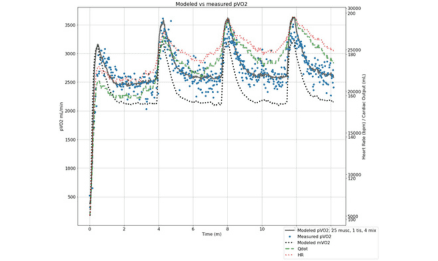
Collaborating organisations: Advisor: Prof. Dr. Aaron Baggish, Institute of Sport Sciences, University de Lausanne, Switzerland Research collaboration: Dr. Philippe Hellard, Creps Aquitaine, Bordeaux France Short description: Oxygen Kinetics at the on and offset of exercise has had researchers puzzling for decades. In practical application such as in vivo tests using a metabolic cart or VO2 analyzer, only whole body pulmonary oxygen uptake (pVO2) is accessible. Pulmonary VO2 is influence not only by muscle VO2 but also by cardiac output, blood volume, oxygenation amongst other factors. The aim of this project is to build and validate a model that discloses those factors influencing pVO2 in a quantitaive way, hence open a clearer view on pVO2 data. Long description: Experiments Twelve healthy…

Read the project
Peer-Reviewed Science

Scientific Research and Validation

Studies that validate the accuracy and reliability of INSCYD, as well as research that leverages INSCYD to uncover groundbreaking insights in the field.

Peer-reviewed study

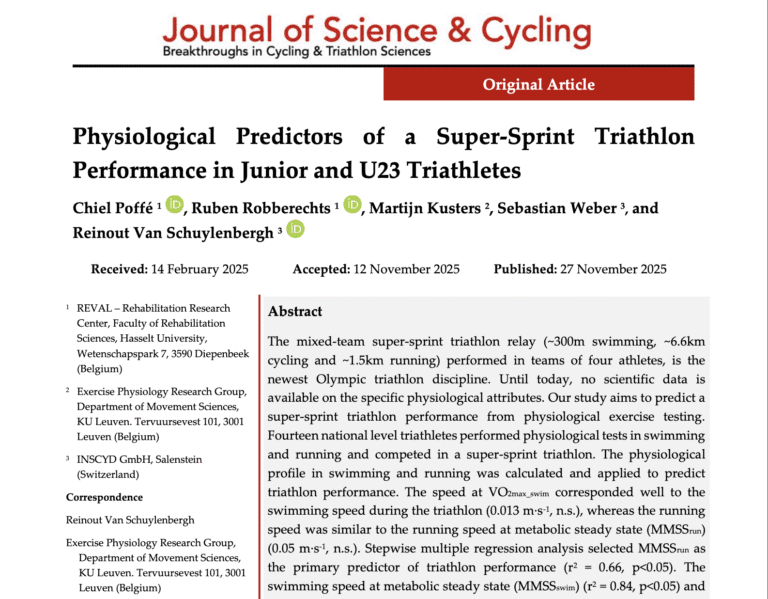
Physiological Predictors of a super-sprint Triathlon Performance in junior and U23 Triathletes

The mixed-team super-sprint triathlon relay (~300m swimming, ~6.6km cycling and ~1.5km running) performed in teams of four athletes, is the newest Olympic triathlon discipline. Until today, no scientific data is available on the specific physiological attributes. Our study aims to predict a super-sprint triathlon performance from physiological exercise testing. Fourteen…

Read the study
Peer-reviewed study

Can a world class junior cyclist beat a multiple Tour de France winner?

Three-week cycling Grand Tours (Giro d’Italia, Vuelta a Espagna, Tour de France) are one of the most physically demanding and iconic events in sports competition. Stages within the Grand Tours are classified into individual time trials, flat, semi-mountainous and mountain stages. The general classification in Grand Tours is typically won…

Read the study
Peer-reviewed study

INSCYD physiological performance software is valid to determine the maximal lactate steady state in male and female cyclists

The maximal lactate steady state (MLSS) is defined as the highest workload that can be maintained without blood lactate accumulation over time. The power output at MLSS (PMLSS) is regularly implemented to define training zones, quantify training progress, or predict race performance. The gold standard methodology for MLSS determination requires…

Read the study
Peer-reviewed study

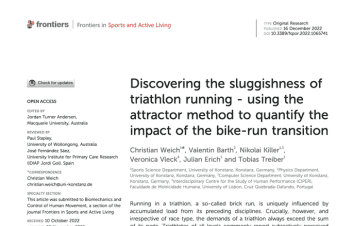
Discovering the sluggishness of triathlon running – using the attractor method to quantify the impact of the bike-run transition

Running in a triathlon, a so-called brick run, is uniquely influenced by accumulated load from its preceding disciplines. Crucially, however, and irrespective of race type, the demands of a triathlon always exceed the sum of its parts. Triathletes of all levels commonly report subjectively perceived incoordination within the initial stages…

Read the study
Peer-reviewed study

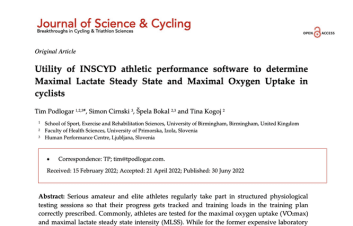
Utility of INSCYD athletic performance software to determine Maximal Lactate Steady State and Maximal Oxygen Uptake in cyclists

Serious amateur and elite athletes regularly take part in structured physiological testing sessions so that their progress gets tracked and training loads in the training plan correctly prescribed. Commonly, athletes are tested for the maximal oxygen uptake (V̇O2max) and maximal lactate steady state intensity (MLSS). While for the former expensive…

Read the study
Peer-reviewed study

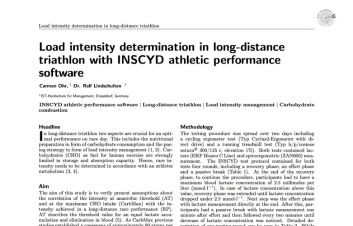
Load intensity determination in long-distance triathlon with INSCYD athletic performance software

This study evaluates the utility of anaerobic threshold (AT) and maximum carbohydrate (CHO) intake (CarbMax) for predicting intensity in long-distance triathlons. Using INSCYD diagnostic tests on 22 participants, the findings indicate that CarbMax and race performance CHO combustion (CHORP) are better estimators for optimal racing intensity than AT. Average CHO…

Read the study
Join the Research Revolution

Use INSCYD in Your Own Research

Harness the power of INSCYD’s scientifically-backed platform in your own studies. Dive deep into human physiology, explore interconnected metrics, and contribute to the next wave of sports science discoveries.

If you have questions, ideas, or are looking to collaborate on unique projects, we’re here to support and partner with you. Let’s advance sports science together.

Work with us

Research Inquiry Form

Please fill out the form below with details about your research project. Our team will review your submission and contact you shortly.

Our science team reads every submission.

Every metric that matters

One assessment. The complete picture of your athlete’s physiology.

VO₂max, VLamax, FatMax, thresholds, fuel use and training zones, from a single test in the lab, in the field or fully remote.