
Metric · Available Glycogen

Glycogen. Available Glycogen.

Glycogen is the storage form of glucose in the body. Instead of storing large amounts of glucose directly, skeletal muscle stores glucose in the form of glycogen, which can then be broken down and used to provide energy during exercise.

Available Glycogen describes the amount of glycogen that is available for exercise in the muscles actively involved in that exercise, such as leg muscles in cycling or legs and arms in swimming.

Available Glycogen counts only the muscles doing the work: not total-body glycogen, and not liver glycogen.

Available Glycogen
Absolute : 486 gRelative : 6.81 g/kg

Trusted by the teams and federations behind the best in sport

From national federations and Olympic programmes to WorldTour teams and professional clubs worldwide.

Glycogen, a precious fuel.

Muscle glycogen is a precious fuel because its storage is limited and its utilization increases rapidly as exercise intensity rises.

How long glycogen stores last depends on starting glycogen concentration, exercise intensity, carbohydrate intake during exercise and the muscles involved.

Once glycogen stores have been substantially depleted, rebuilding them takes approximately 3 days in most common training and fueling scenarios.

Because of rather rapid depletion during intense exercise and several days to restore it, the amount of glycogen an athlete can store is an important performance marker.

Depletion in hours, replenishment in days

muscle glycogenexercise
exercisedepletedrebuilt0255075100startday 1day 2day 3muscle glycogen, % of fulltime
Drawn schematically: the store empties during an intense exercise block and is rebuilt progressively afterwards. How fast it empties and how long the rebuild takes are not fixed numbers; both depend on the starting concentration, exercise intensity and duration, carbohydrate intake, training status and the exercise that follows (Burke, van Loon & Hawley, 2017; Areta & Hopkins, 2018; Bergström et al., 1967; Hermansen, Hultman & Saltin, 1967).

Glycogen in training. Maximizing specific training outcomes.

Glycogen availability is not only something to maximize. It can also be deliberately manipulated according to the goal of a training session.

For low-intensity endurance sessions, reduced carbohydrate and muscle glycogen availability increases fat oxidation and amplifies cellular signals for a higher aerobic adaptation.

The opposite applies when the objective is to perform high-intensity work. Threshold intervals, HIIT, repeated high-intensity efforts and sprint training require high rates of carbohydrate-derived energy production, and insufficient glycogen will reduce the power or speed and therefore training quality that the athlete can achieve.

The practical goal is therefore not simply to train with high or low glycogen, but to fuel for the work required.

The session objective sets the glycogen target

Selected low-intensity sessionsLower glycogenendurance ridelong runbase session
glycogen availability
  • ↑fat oxidation
  • ↑adaptation signals, amplified
Fuel for thework required
High-intensity workHigh glycogenthreshold intervalsHIITrepeated effortssprints
glycogen availability
  • ↑carbohydrate-derived energy
  • ↑training quality, power and speed

Combining Available Glycogen with carbohydrate-combustion rates allows training and nutrition to be matched to the objective of specific training sessions.

Lower carbohydrate availability in selected endurance sessions can amplify the molecular signals of adaptation, but a performance benefit is not guaranteed (Impey et al., 2018; Hawley & Burke, 2010; Gejl & Nybo, 2021; Diaz-Lara et al., 2025), and high-intensity work needs high carbohydrate availability or its quality falls. The framework is periodization: carbohydrate availability set to the objective of the session.

Available Glycogen in every INSCYD assessment.

Because of its importance for both training and competing, the available Glycogen is included as a standard metric in INSCYD assessments. It is evaluated as part of any testing protocol or procedure and does not require a separate glycogen-specific laboratory test.

The glycogen storage metric is based on a physiological model derived from peer-reviewed research describing skeletal-muscle glycogen in relation to factors including muscle mass, training status, carbohydrate availability, exercise mode and the muscles involved in the activity. It has been used globally across practitioners and shown to provide precise prediction of race performances in endurance sport events.
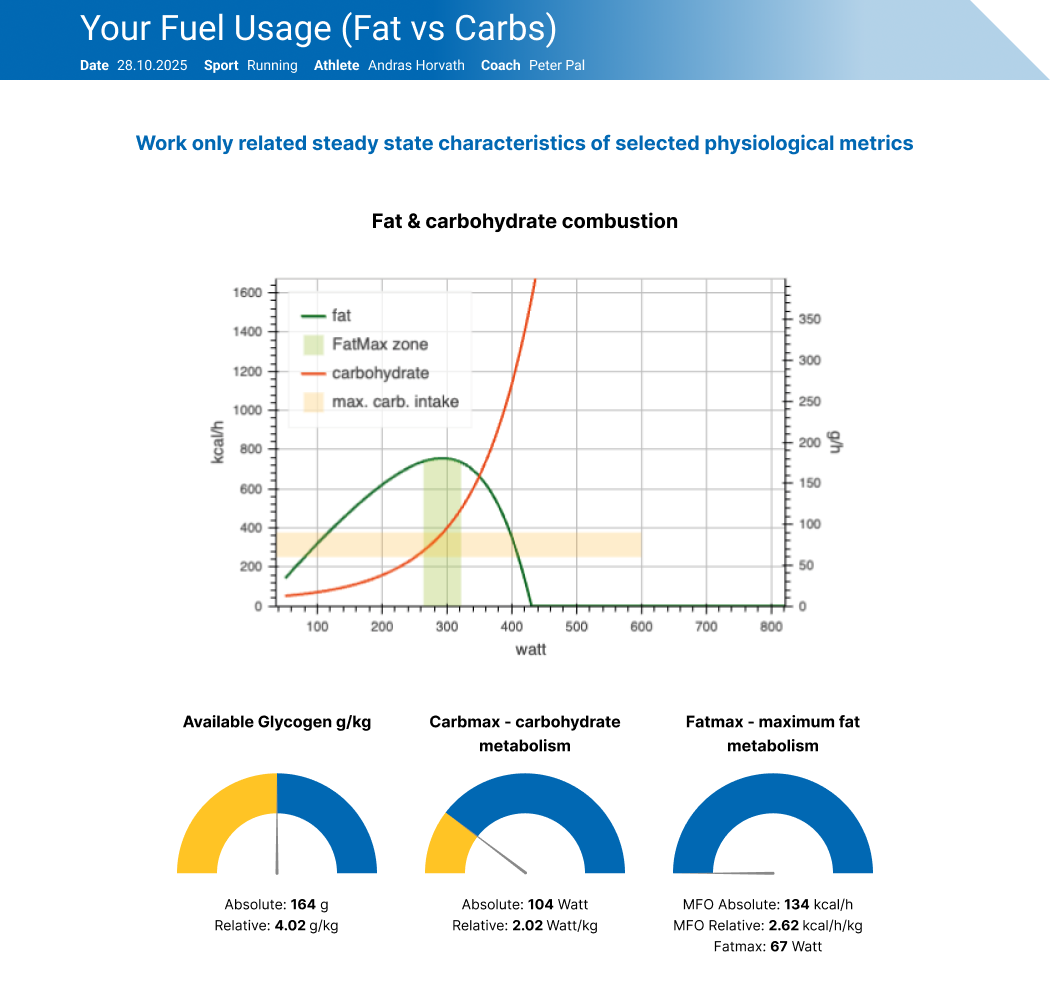
A page of the INSCYD report: the fat and carbohydrate combustion chart with the Available Glycogen, CarbMax and FatMax meters beneath it, the Available Glycogen meter highlighted
The report’s fuel-usage page: the modelled Available Glycogen sits next to CarbMax and FatMax, from the same test that produced the combustion curves above it. The model rests on the literature describing muscle glycogen in relation to fitness, carbohydrate availability, exercise duration and intensity, exercise mode and muscle type (Areta & Hopkins, 2018) and on the heterogeneous distribution of glycogen within muscle (Ørtenblad et al., 2015). It is an estimate, not a biopsy or 13C-MRS measurement (Shiose et al., 2022).
Every metric that matters

One assessment. The complete picture of your athlete’s physiology.

VO₂max, VLamax, FatMax, thresholds, fuel use and training zones, from a single test in the lab, in the field or fully remote.