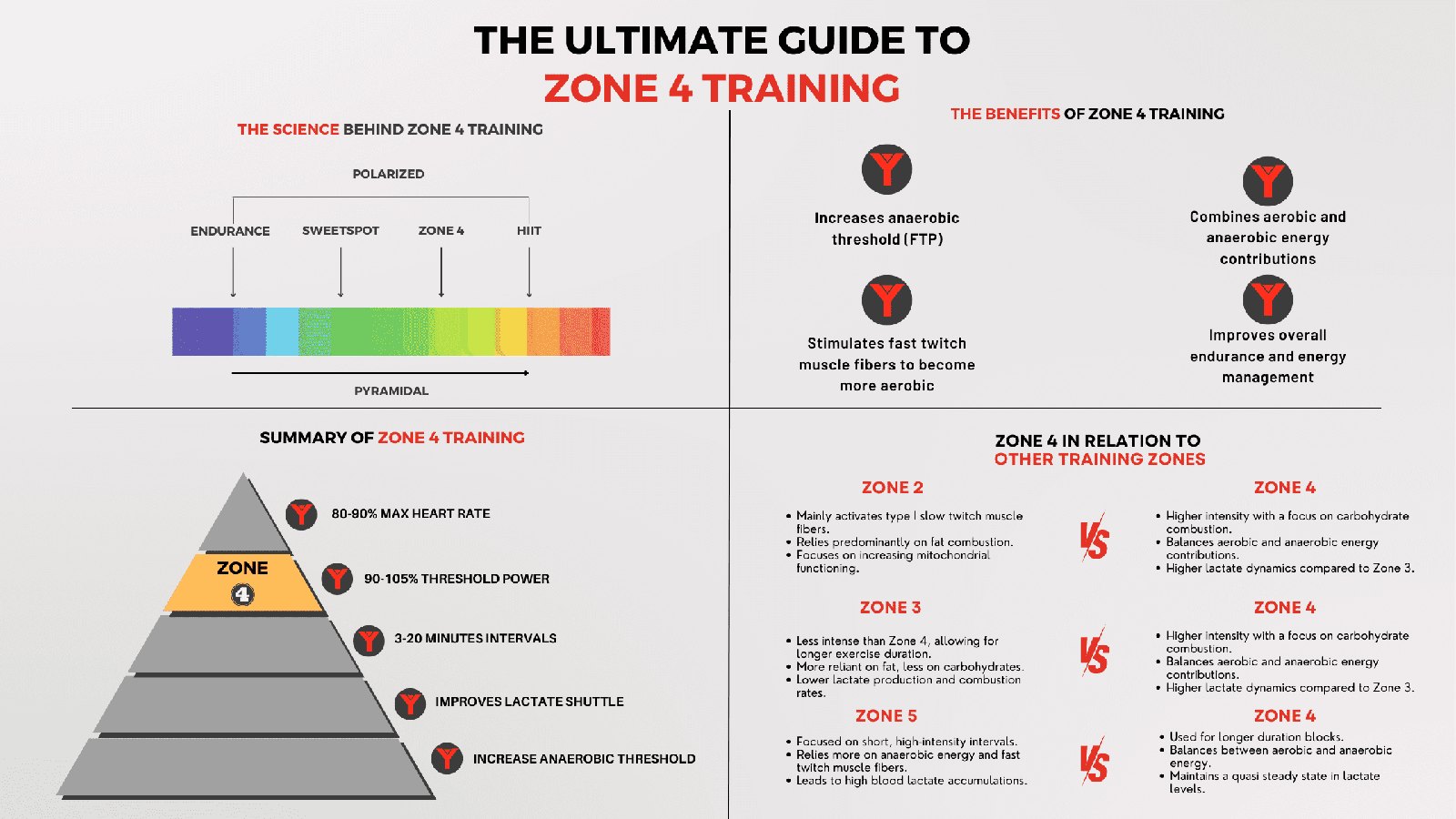
Zone 4 threshold training is widely used but frequently misapplied. This guide covers the physiological definition, how individual VO2max and VLamax determine effective threshold intensity, and how to prescribe it correctly.
Zone 4 training, also known as threshold training, is used by the world’s best triathletes and marathon runners. But the true training effect of zone 4 training is not as straightforward as many coaches and athletes think. This article covers the science and practical applications of zone 4 training.
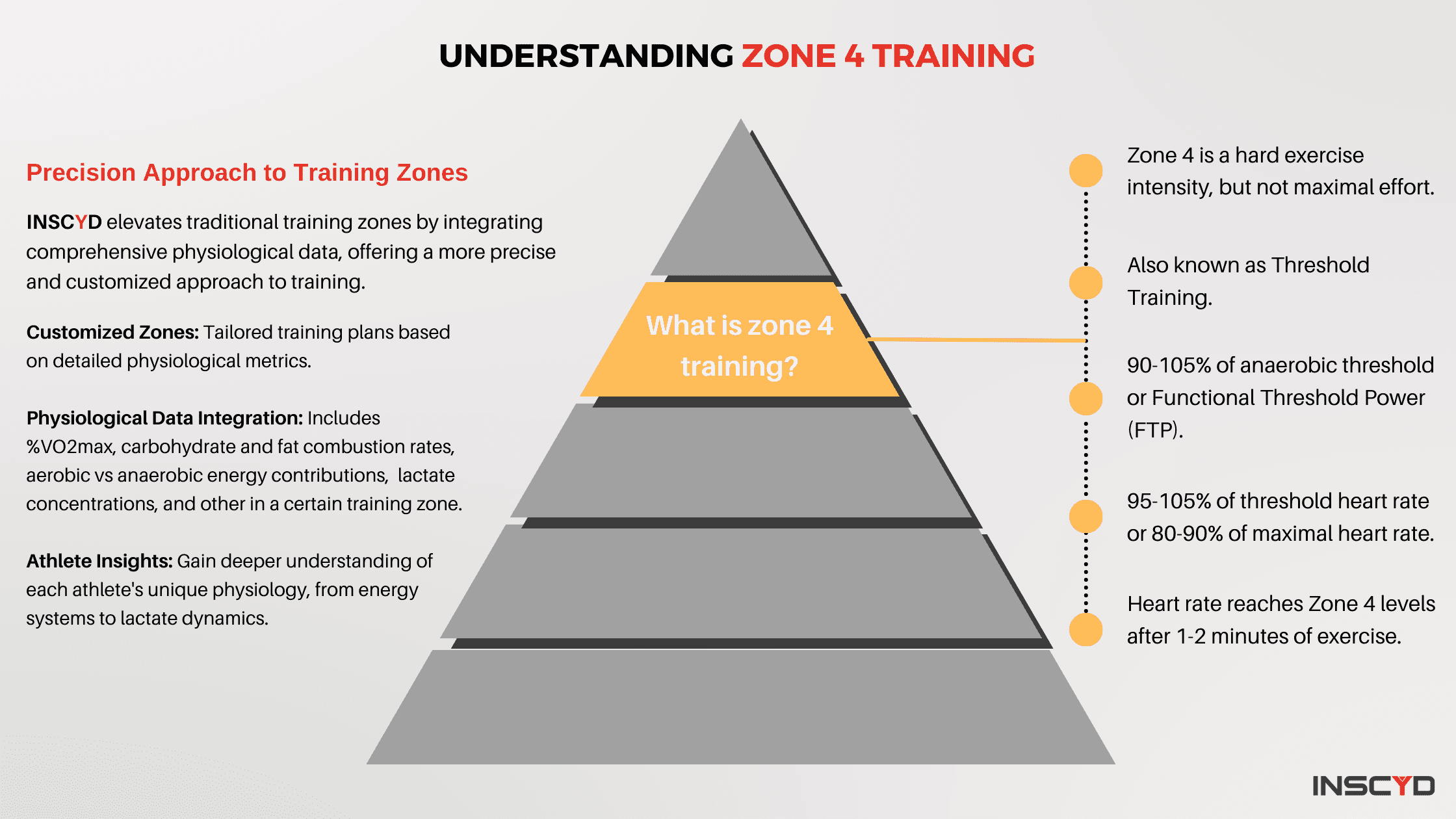
Zone 4 training is a specific training intensity that endurance athletes like cyclists and runners use. Zone 4 is usually part of a 5, 6 or even 7 zone training model. In all these models, zone 4 is a hard exercise intensity, but not a maximal effort.
Since zone 4 intensity is challenging, it is often used for blocks or intervals.
The zone 4 intensity is generally defined as 90-105% of anaerobic threshold or Functional Threshold Power (FTP).
If you train based on heart rate, zone 4 training intensity is roughly 95-105% of threshold heart rate or 80-90% of maximal heart rate. But keep in mind that it can easily take 1-2 minutes before your heart rate will climb towards this level, once you start exercising at a zone 4 intensity.
As you may have noticed, zone 4 covers the anaerobic threshold. Consequently, zone 4 training is also known as threshold training or FTP training.
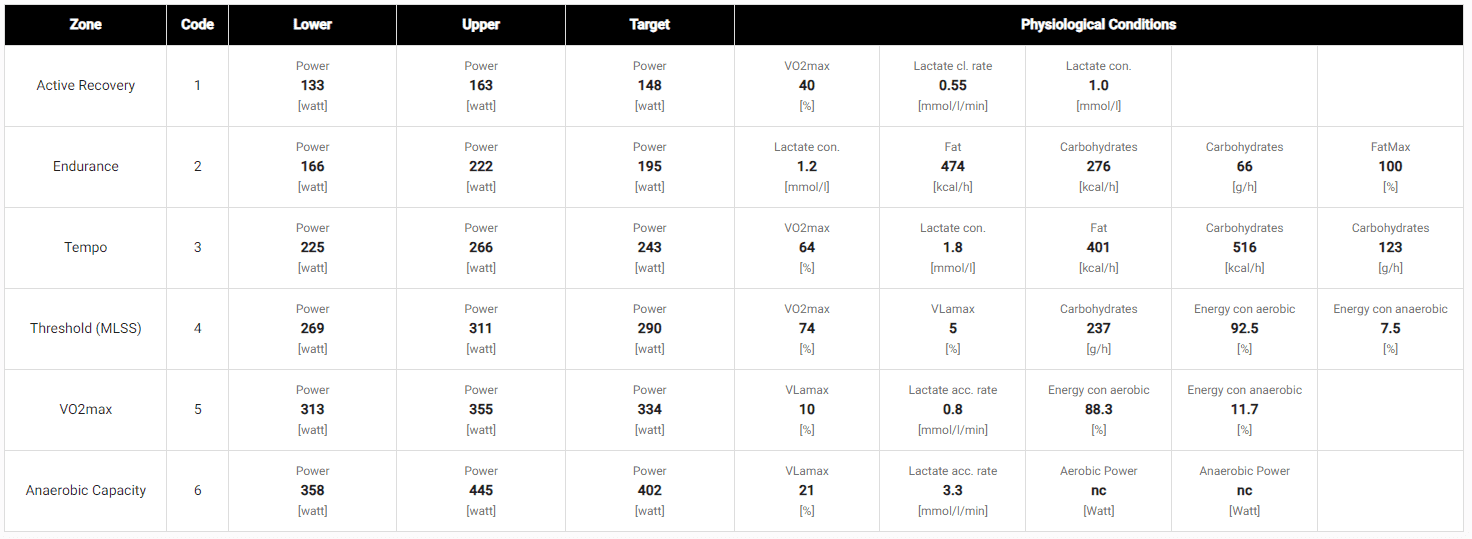
INSCYD training zones enable you to look beyond power data. For instance, by adding physiological data about the %VO2max, carbohydrate and fat combustion rates, aerobic vs anaerobic energy contribution, and lactate concentrations in a certain training zone.
As a coach or lab professional, you understand the importance of accurate training zones in endurance sports. INSCYD’s Training Zone Builder elevates your coaching capabilities, offering a level of precision that sets you apart.
🔬 Why INSCYD?
Elevate your coaching or lab services with INSCYD’s Training Zone Builder. See how this revolutionary tool can transform your approach to endurance training.
Expert coaches and athletes might find it interesting to know that during a zone 4 interval, lactate concentrations should eventually become steady state. In other words, lactate levels remain the same and do not increase nor decrease. Keep in mind though that this doesn’t necessarily mean blood lactate concentrations equal 4 mmol/L. Even though some coaches might still use this concentration for threshold intervals.
Keep reading for examples of zone 4 workouts and intervals.
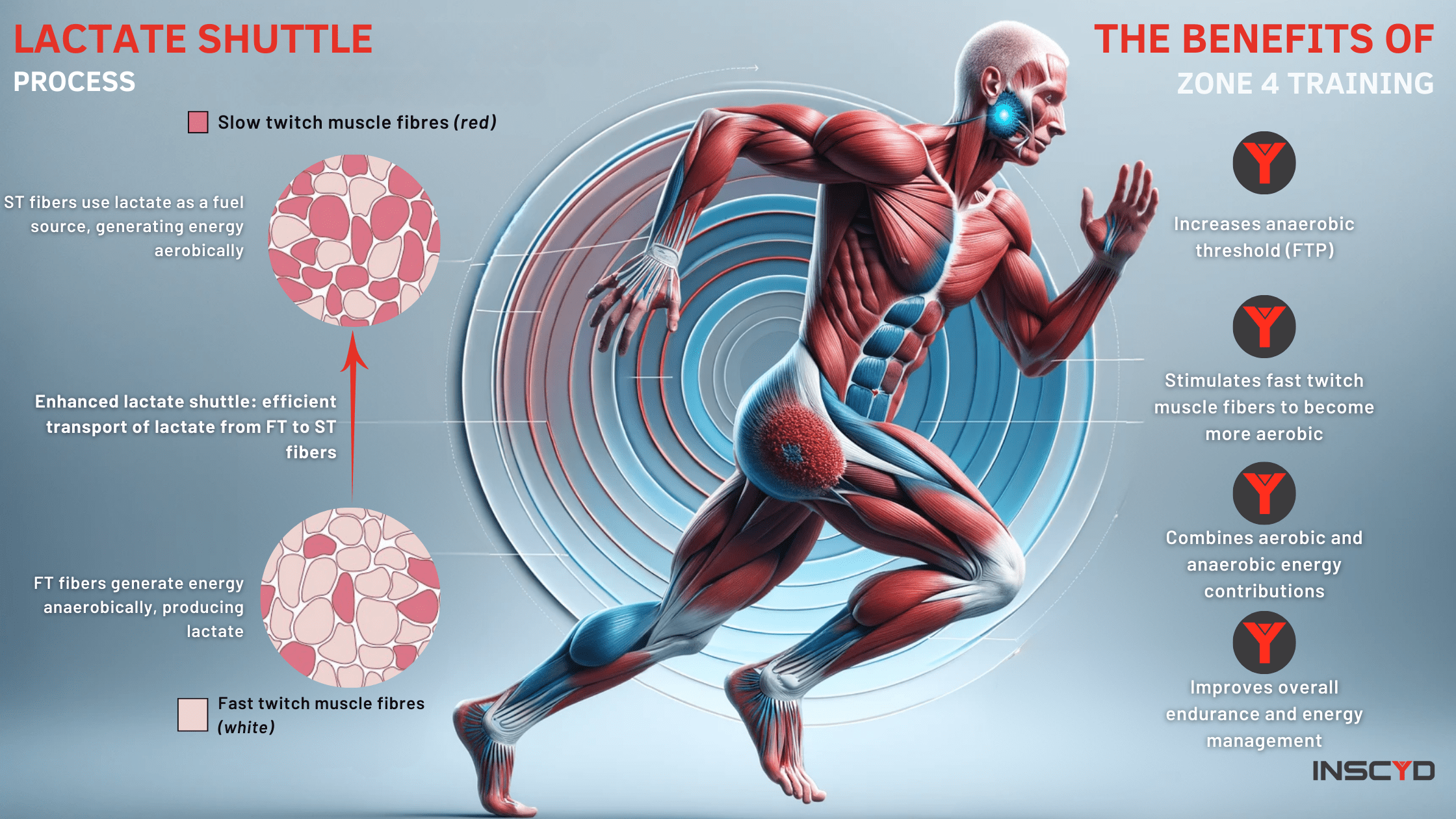
The benefit of zone 4 training is that it’s a hard exercise intensity that you can maintain for quite a while. It therefore combines intensity and duration.
Another benefit of zone 4 training is that it combines aerobic and anaerobic energy contribution. On a muscular level, a zone 4 intensity recruits both slow twitch muscle fibers (type I) and fast twitch muscle fibers (type II).
The most well known benefit of zone 4 training is that it increases the anaerobic threshold.
However, the true effect of zone 4 training is not as straightforward as many coaches and athletes think. Although zone 4 training is known for its anaerobic component, zone 4 training does not necessarily increase anaerobic power or anaerobic capacity.
Contrary to what you might think, if athletes spend a lot of time in zone 4 they’re stimulating fast twitch muscle fibers to become better at continuous endurance exercise. In other words, the benefit of zone 4 training is that fast twitch muscle fibers become more aerobic.
This can decrease anaerobic power, which could be good or bad, depending on your goal.

To discover the benefits of zone 4 training in more detail, we need to dive deeper into what physiologically happens when exercising in zone 4.
At a zone 4 intensity, both slow twitch muscle fibers (type I) and fast twitch muscle fibers (type II) are recruited.
Simplified speaking, fast twitch muscle fibers generate energy anaerobically. They produce lactate while doing so. Slow twitch muscle fibers generate energy aerobically. They can use the lactate produced by fast twitch fibers as a source of fuel. This phenomenon is called the lactate shuttle.
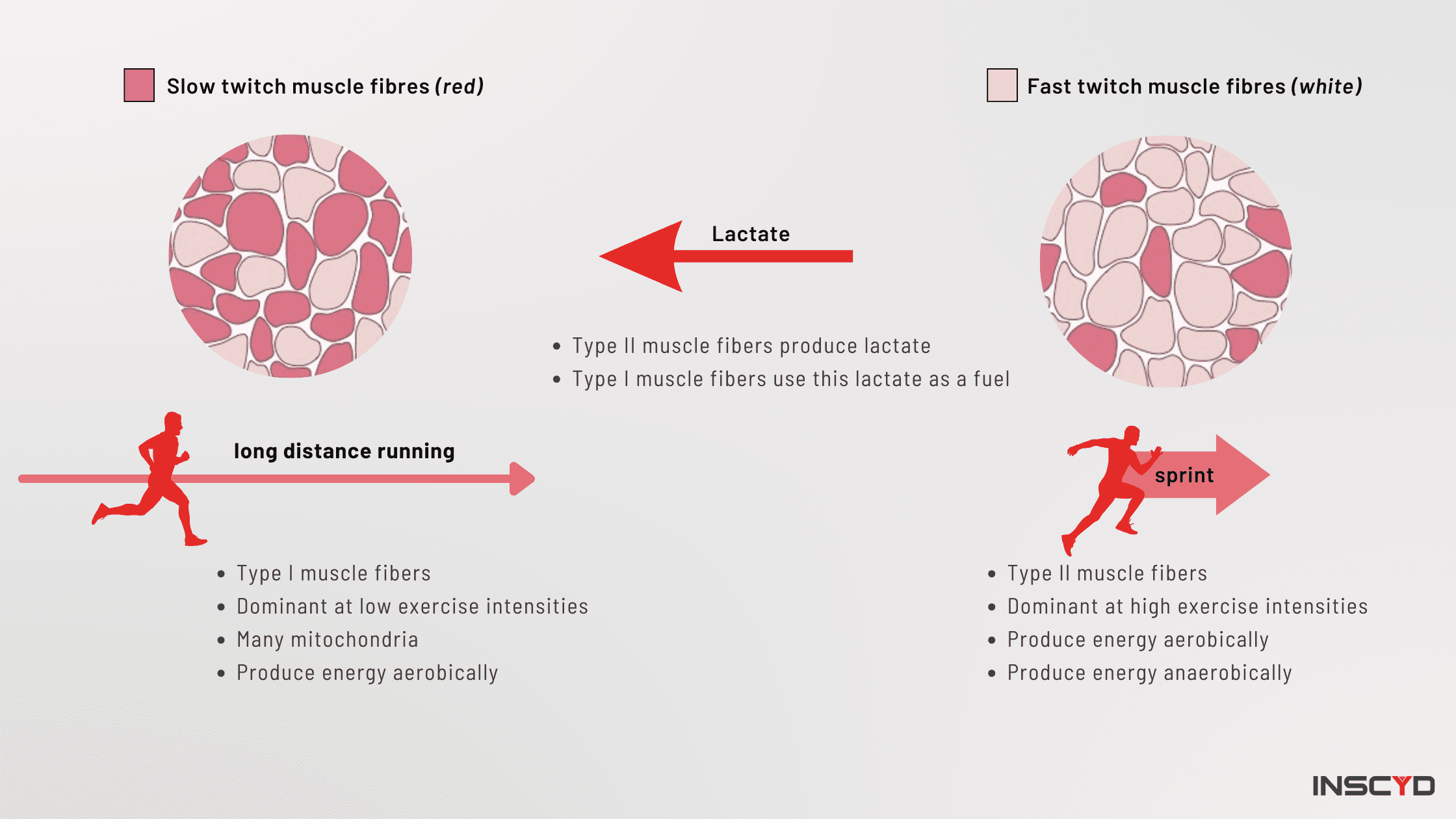
If you continuously train in zone 4, fast twitch muscle fibers become more aerobic and possibly less anaerobic. Sprinters and punchers probably think that’s why zone 4 training is bad, while triathletes and time trialists think that’s why zone 4 training is good.
In fact, the most successful triathletes in the world use zone 4 training as their key workout (although they call it zone 2..).
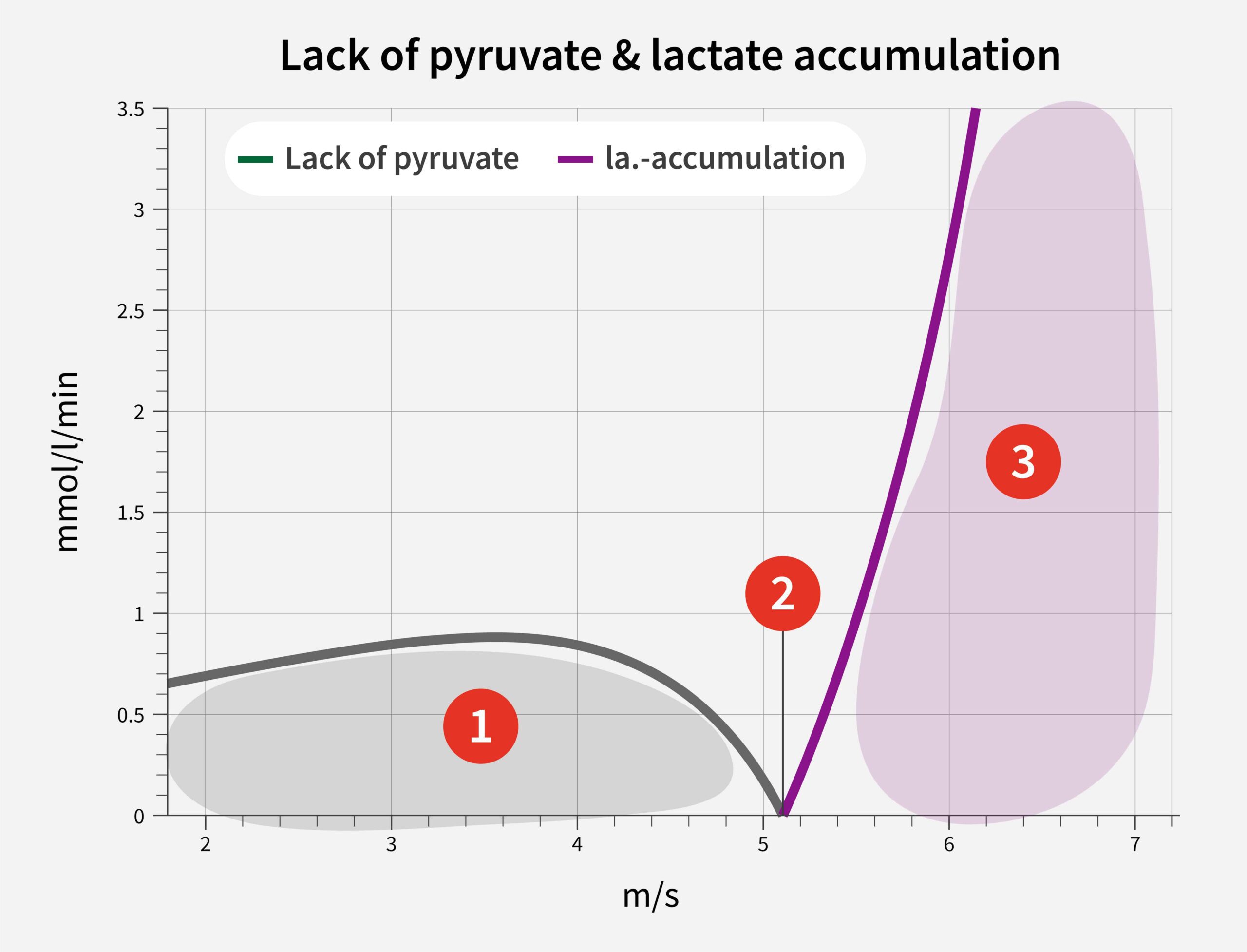
Discover how lactate accumulation and recovery play a pivotal role in optimizing your training and racing performance. Our comprehensive whitepaper delves into the nuances of lactate dynamics, offering tailored strategies for interval training and pacing in time trials.
Whether you’re a coach or an athlete, this whitepaper is your gateway to advanced training methodologies.

Summing up the benefits of zone 4 training:
It is not very likely that zone 4 training builds muscle, since it still lives on the endurance side of the strength-endurance spectrum.
In scientific literature, zone 4 training or threshold training, is often compared to other training methods like sweetspot training, high-intensity training, polarized training or pyramidal training.
Let’s have a look at some of those scientific conclusions.
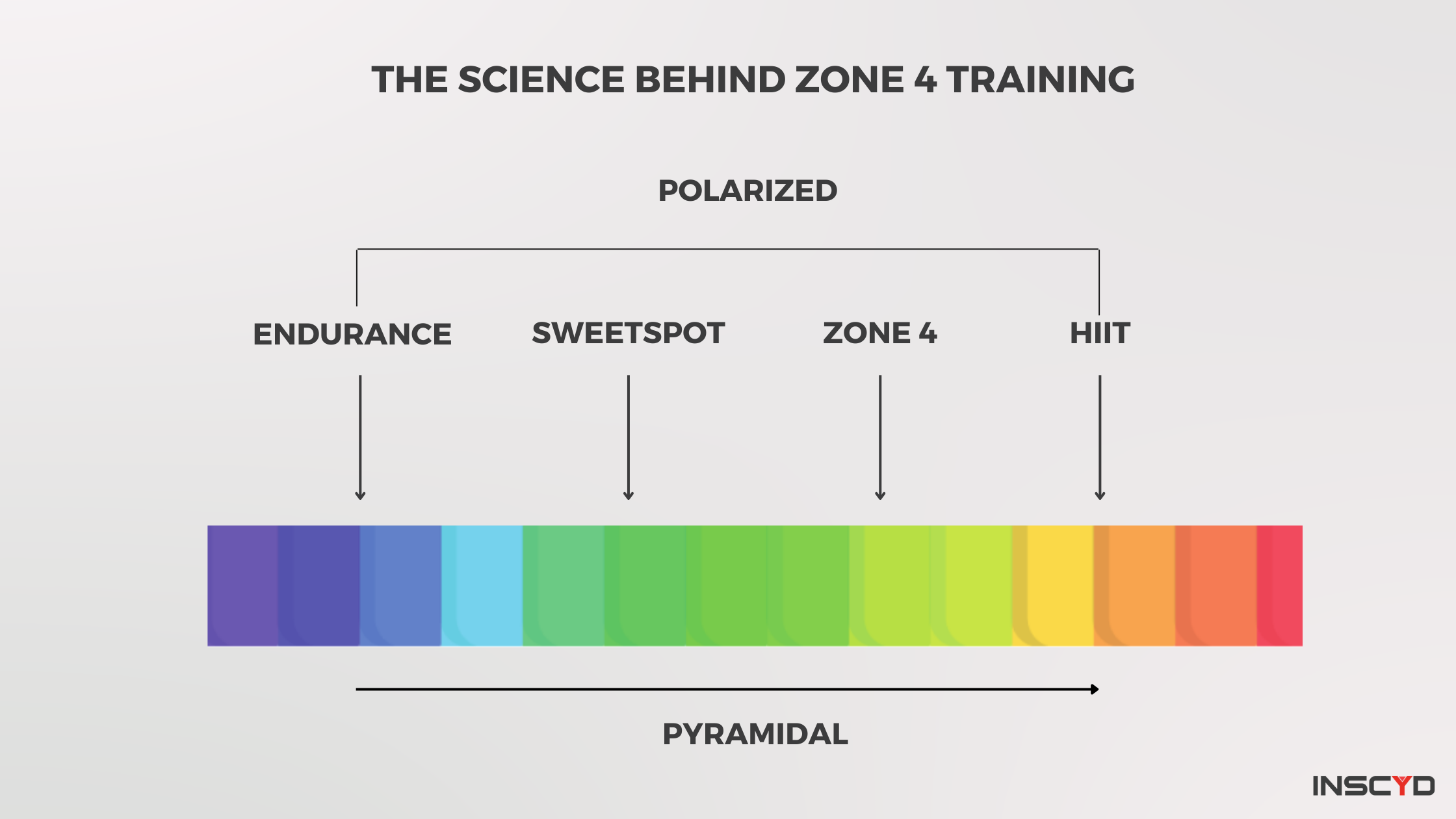
A systematic review looked at the effect of pyramidal training, polarized training, and zone 4 training (threshold training) on middle- and long-distance running performance. Their conclusion? Pyramidal and polarized training are more effective than zone 4 training.
Although some of the best marathon runners in the world use zone 4 training.

Another study looked at the impact on key endurance variables (e.g. VO2max) after 9 weeks of high-volume training, zone 4 training (threshold training), high-intensity interval training (HIIT) and polarized training. Forty eight runners, cyclists, triathletes, and cross-country skiers showed greatest results when implementing polarized training.
If improving fat metabolism is your goal, this study concludes that it doesn’t matter whether you implement polarized training or zone 4 training. Moreover, almost all studies show that zone 4 training helps to lose weight, but not to a greater extent than other training methods.
In conclusion, it looks like zone 4 training is not superior to other training methods for many athletes, although some of the world’s best athletes do use it. However, in these studies, scientists compared training in zone 4 to training methods like polarized training, which combine multiple training zones. In other words: training in zone 4 only is probably not the most effective training method.
Watch our exclusive webinar featuring sport scientists Sebastian Weber and Reinout Van Schuylenbergh, where we delve into advanced training methods and their practical applications. Discover the secrets behind the 3 and 5 zone models, polarized and pyramidal training methods, and how to adapt these strategies for peak endurance performance.
Typical zone 4 training examples are Over-Unders intervals and threshold intervals, like 4×8 minutes at FTP or 2×20 minutes at threshold.
The duration of zone 4 intervals is usually somewhere between 3-20 minutes, with longer intervals reaching up to 45 minutes. In a max effort athletes are usually able to hold zone 4 for 60 minutes maximum.
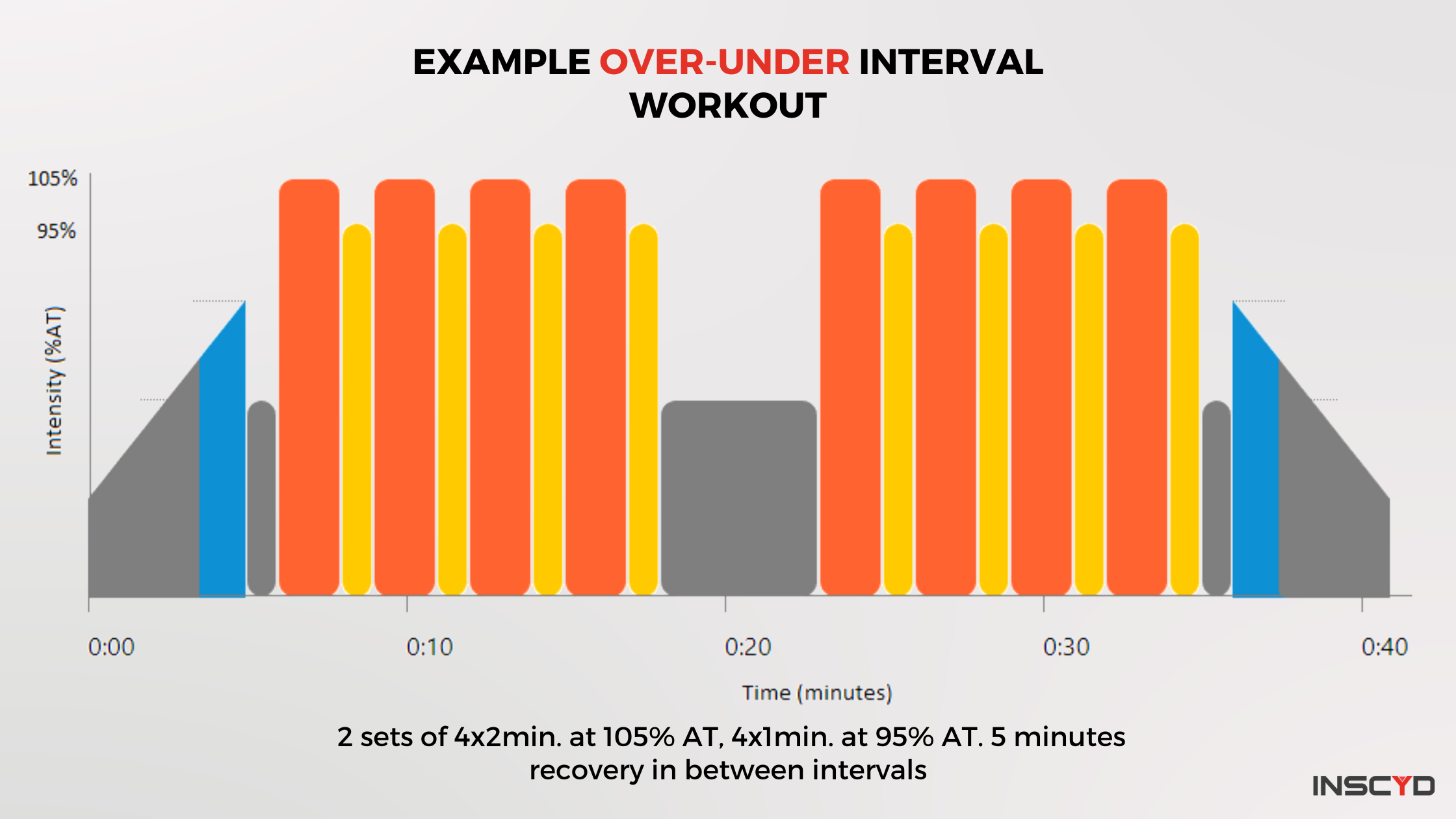
The intensity of zone 4 can be considered as the lower limit of high intensity training.
If you’re aiming for multiple zone 4 training sessions per week, 3 sessions per week is probably a good starting position. Keep in mind that zone 4 training is challenging, hence recovery becomes important if you aim for multiple sessions per week.
This brings us to another important aspect when doing zone 4 training: nutrition.
In zone 4, you burn a lot of calories, but not fat. Instead you mainly burn carbohydrates.
In our training zone image at the beginning of this article, you could see that the athlete burns 237 grams of carbohydrates per hour, in zone 4.
This means that you’re able to burn all carbohydrates stored in the body during a single zone 4 training session. Therefore, if you want to maintain training quality, you need to consume carbohydrates during zone 4 training.
INSCYD shows you exactly how much carbohydrates you burn in zone 4, or at any specific exercise intensity. This differs per person.
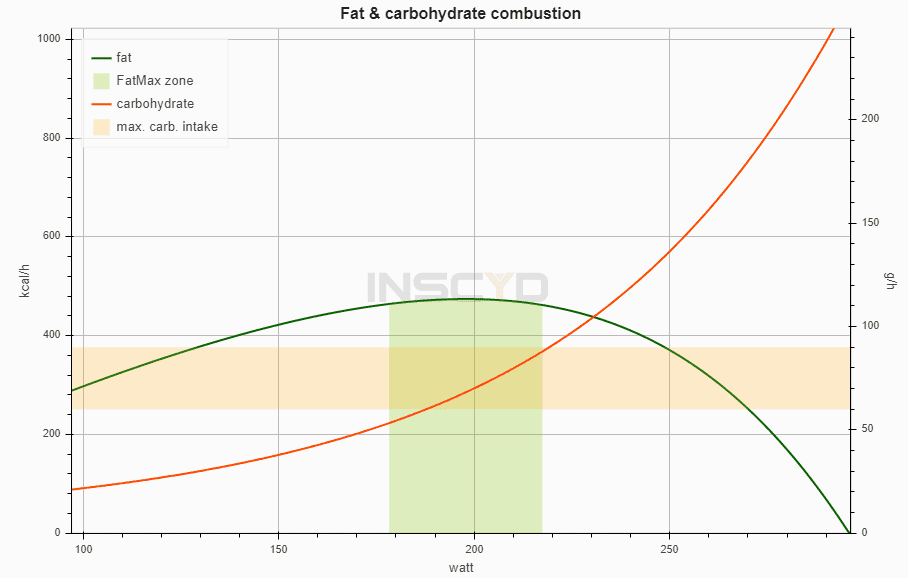
Knowing your fat and carbohydrate combustion rates allows you to create a nutrition plan that meets your energy needs. For zone 4 training that probably means you should consume sports drinks or energy bars if the training duration is longer than 1 hour.
Download our free white paper for a step-by-step approach to creating your zone 4 nutrition plan
Are you an athlete or coach looking to elevate your game to the next level? Understanding the science behind carbohydrate combustion, pacing, and fueling can be a game-changer for your performance.

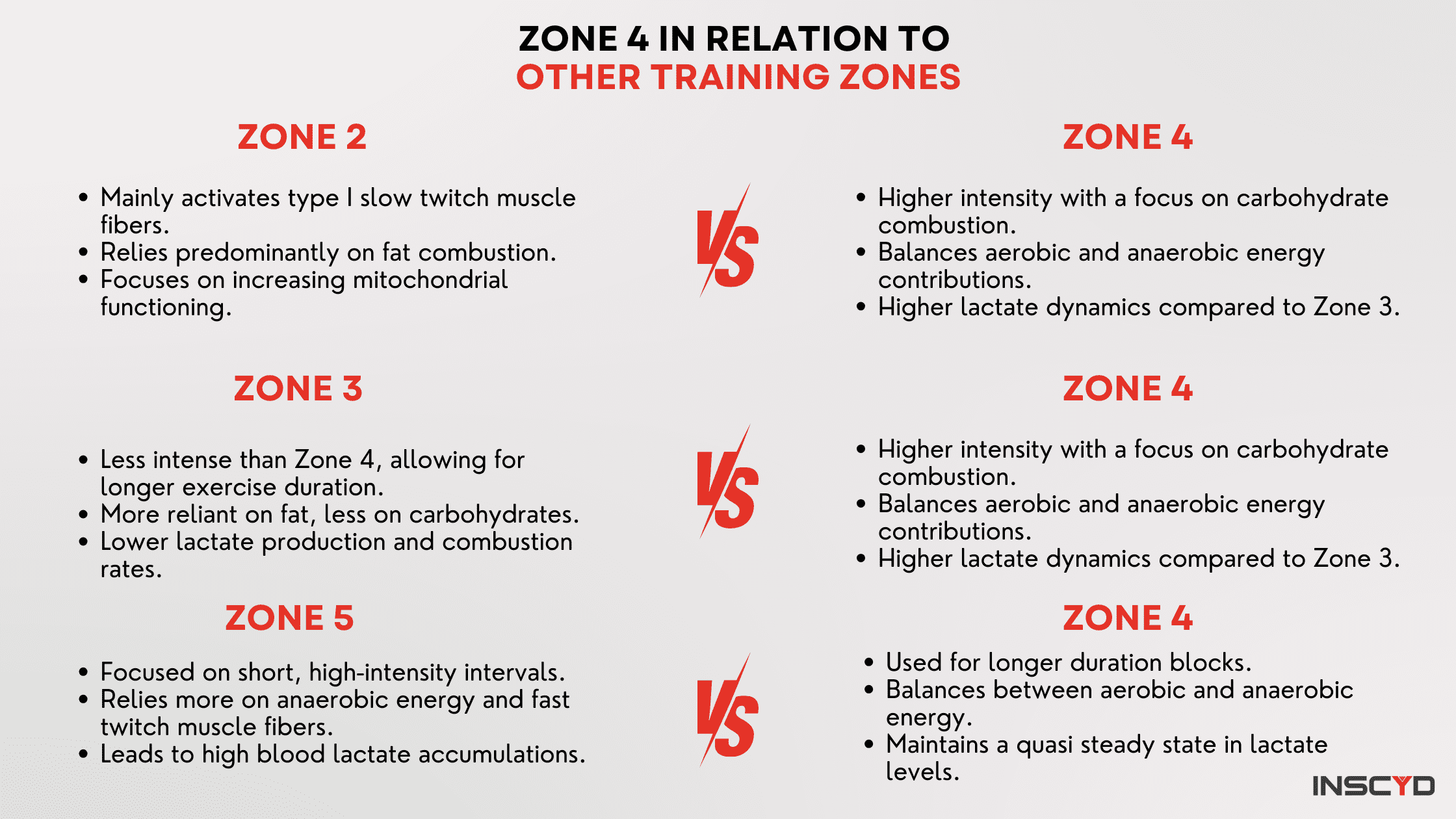
In the science section, we learned that training in zone 4 only is probably not the most effective training method. In practice, you’re probably going to combine multiple training zones. Let’s learn a bit more about the similarities and differences between training zones.
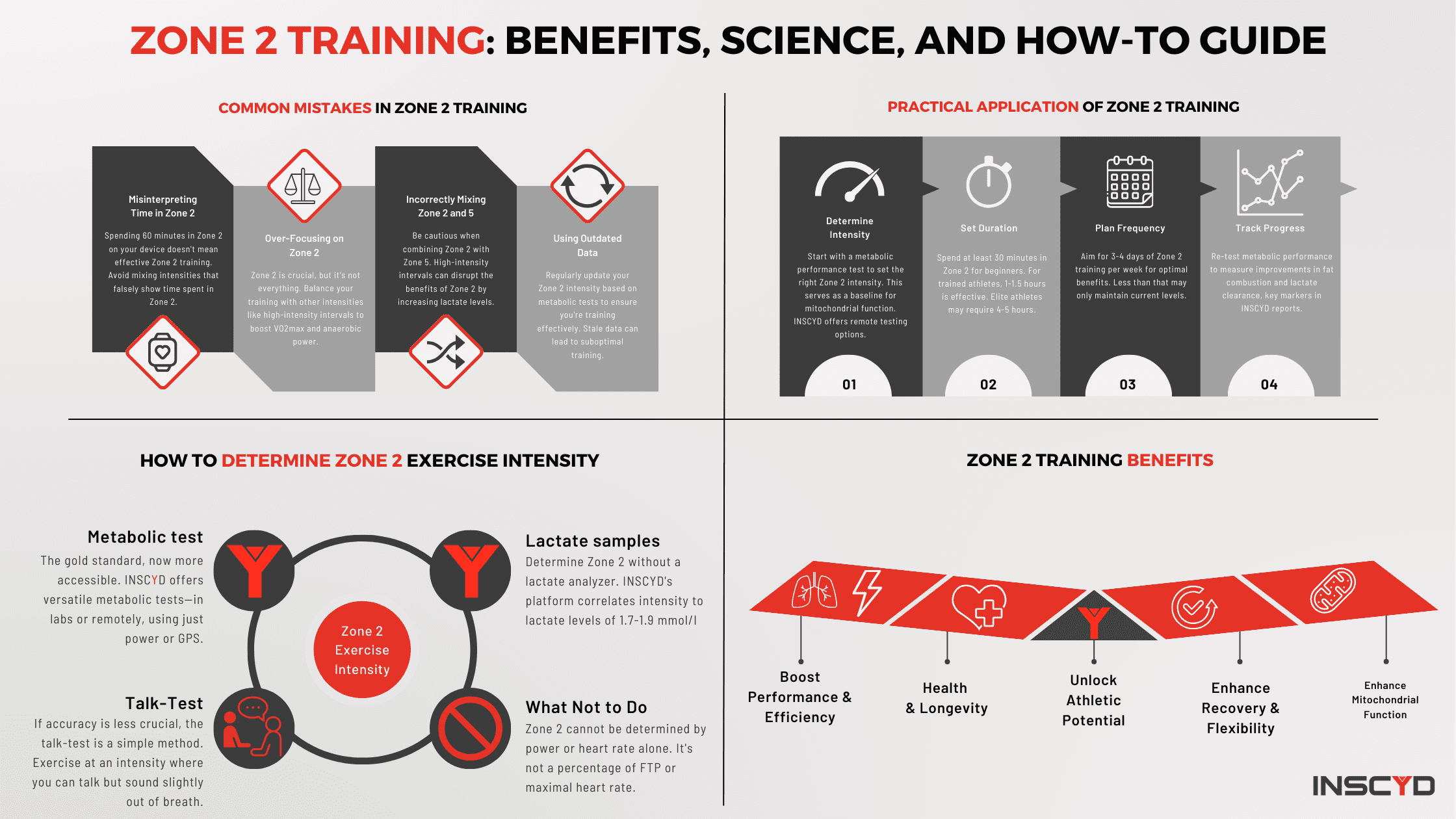
We’ve talked about the benefits, science and application of zone 2 training. Zone 2 is obviously less intense than zone 4 training.
When comparing zone 2 with zone 4, a big difference is muscle fiber type recruitment. Zone 2 activates mainly type I slow twitch muscle fibers, while zone 4 also activates type II fast twitch muscle fibers.
Another difference between zone 2 and zone 4 is that Z2 relies on fat combustion mainly, while zone 4 almost solely relies on carbohydrate combustion. As a result, you need to fuel very differently between these training zones.
While the benefit of zone 2 is about increasing mitochondrial functioning, zone 4 aims to increase the anaerobic threshold.
Both training zones should be considered when creating efficient training programs.
Watch Our Exclusive Webinar: “Efficient Training Programs for Athletes“
Dive deeper into the world of endurance training with our insightful webinar, featuring Sebastian Weber, a renowned coach of 4x World Time Trial Champion Tony Martin. This session is packed with practical examples and theoretical knowledge to help you create more efficient and effective training plans.
When comparing zone 3 training with zone 4, Z3 is a little bit less intense than Z4.
As a result, you can exercise longer in zone 3. For some that’s why zone 3 is also known as the sweetspot training zone: the perfect balance between intensity and volume.
Whether zone 3 is better than zone 4 depends on your personal metabolic profile and goal. If you truly want to answer this question, you need to look at the differences like:
INSCYD is the only tool out there to precisely compare the effect of exercise intensities on the athlete’s body. With an INSCYD metabolic test, you know your current fitness. With an INSCYD Performance Projection, you can set future goals and understand what to work on.
Although zone 4 and zone 5 are neighbours, they are quite different. Zone 5 is the fundamental ingredient for short high-intensity intervals, while zone 4 is often used for longer duration blocks.
Obviously, zone 5 training relies more on anaerobic energy, fast twitch muscle fibers and carbohydrate combustion than zone 4. Zone 5 – also known as the anaerobic capacity training zone – results in high blood lactate accumulations, while zone 4 is quasi steady state.
Threshold training or zone 4 training is used by the world’s most successful triathletes and marathon runners.
When doing zone 4 training, it’s important to accurately prescribe the intensity, since it’s a thin line between going too slow and accumulating fatigue very rapidly. A metabolic test like the INSCYD test solves this.
Zone 4 training is often a block or interval training, like over-under intervals. Since the intensity is high, athlete’s should properly fuel for this type of training. The only way to do that effectively is by adjusting energy intake based on the amount of carbohydrates burned. The INSCYD carbohydrate combustion graph is the most precise way of doing that.
When done correctly, zone 4 training increases anaerobic threshold and improves the lactate shuttle from fast twitch muscle fibers to slow twitch muscle fibers.
As a coach or lab professional, you understand the critical role of precise data in crafting effective training programs. INSCYD’s cutting-edge platform offers unparalleled insights into athletes’ physiology, enabling you to:
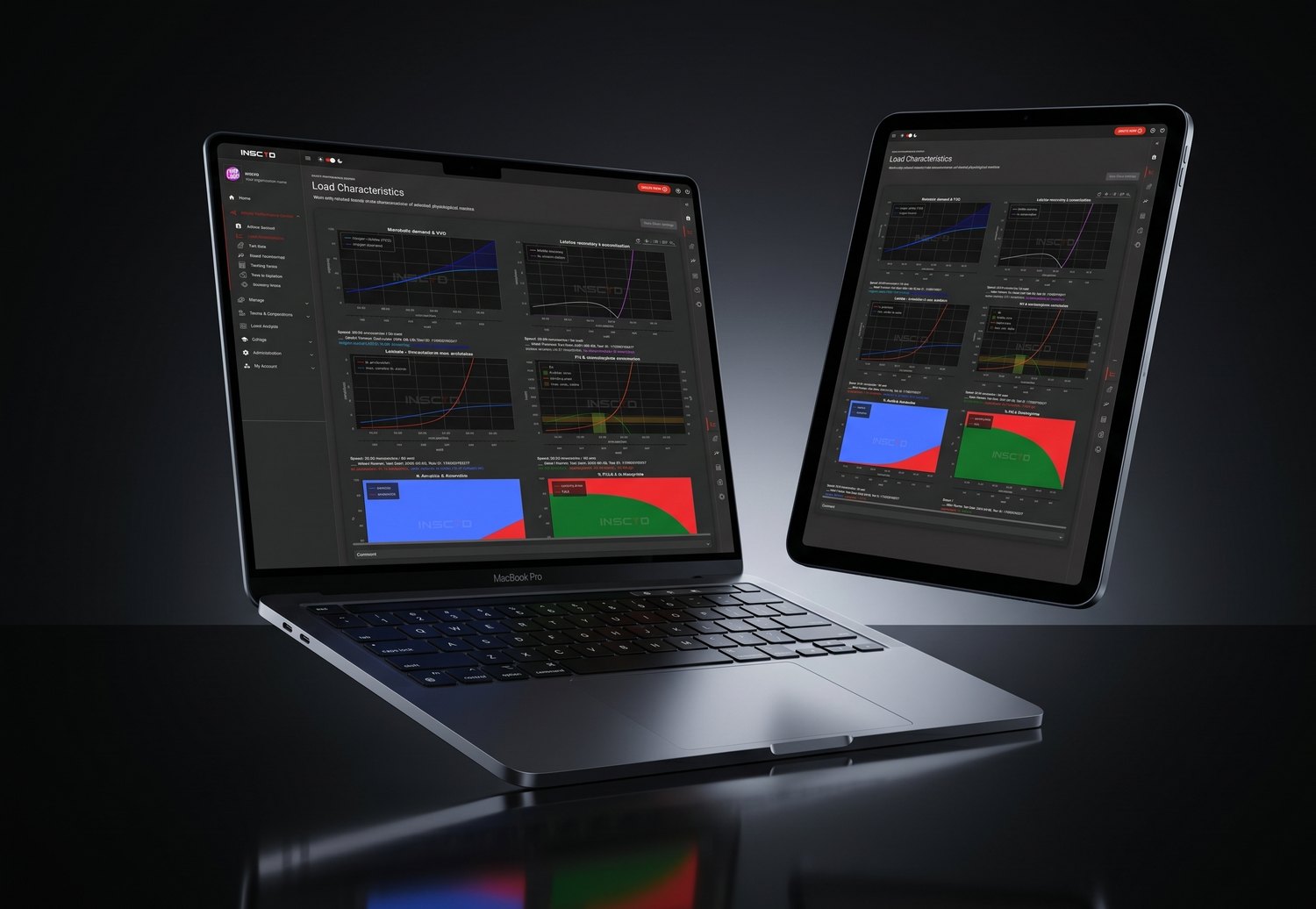
VO₂max, VLamax, FatMax, thresholds, fuel use and training zones, from a single test in the lab, in the field or fully remote.

