How to Set up Efficient Athlete Training Programs
In this partner webinar with Azum, Sebastian Weber talks about creating efficient and effective training plans. Theoretical basics are linked with application examples from practice.

In this partner webinar with Azum, Sebastian Weber talks about creating efficient and effective training plans. Theoretical basics are linked with application examples from practice.
Agenda
- Differentiating primary and secondary goals
- Timing, timing, timing: how long, how often, how many repetitions?
- Periodization & Structure: introduction use of macro-nutrients to make informed decisions about training & recovery or the relationship between stress and recovery
- Use case I: Reduce VLamax to save carbohydrates
- Use case II: Increase VO2max
0:00 So, good afternoon, good evening, good morning, everybody, depending on where you are.
0:08 Ah, Raymond is confirming that there is sound. Oh, Mark Neff still doesn't have sound. Okay. So, obviously, this didn't go as planned. Sorry for that. Instead of sharing my screen, I'm sharing the presentation here with you now. So, what's going to happen is that we will miss some of the nice animations, which were in there. So, I hope that's not too bad here and we can still do it, I'm pretty sure.
0:45 Some people seem to have audio problems. Please double check. Seems like most people have audio. So, because we are late anyway, I would like to maybe basically start right now. Thanks again for your patience and for staying with us. I assume the ASOM guys will record this and make it available for later. So, let's get straight into that. Again, sorry for the delay here. Today's webinar is going to be about how to set up efficient training programs. So, this one is not so much about physiology or training science.
1:29 It's really just the mechanics and the workflow. And it's partly, I have to admit, sharing my own experience from creating training programs for recreational amateur and professional athletes for a long, long time. Side note here, housekeeping item. Most people have sound, have figured it out. Sorry, Patrick and Philip, if you still have issues, I'm going to continue because from our end, it looks all cool with the sound. But again, we're going to record that. Okay, so it's about the mechanics, how to set up training programs. It's like a guideline, basically.
2:12 Okay.
2:16 Okay. So, let's get straight into that. The agenda is basically where to start. Like, what's your starting point when you create a training program? And then the side on the timings and periodization structure. And then we are going into some techniques or hints or tricks and some examples of, you know, some very general and very broad, very high level concepts of training programs. But again, the main mechanics is really how to efficiently design training programs, time efficient and the right training program. So, it's all about focus.
2:59 It's all about focusing on creating training programs in a way that it is time efficient and that you get good training programs in a decent amount of time. And basically, what is a training plan? A training plan is like a route. It's like a route in your navigation system, as I'm saying, where you basically try to connect two locations or two dots. You're trying to connect where you want to go. So, what is your goal with where you are right now? And the training program, hopefully, is the fastest, most efficient direct connection between those two.
3:49 That's kind of the idea behind it. Okay. That's kind of the idea what a training program should be. So, what this means is that in the first place, you have to understand as good as possible your goal. You have to start thinking about what is the goal of myself or the goal of the athlete. Is it a specific race? Is it a specific kind of event? Okay. That's where it all starts, obviously. Okay. And then, in the second step, defining on where you want to be, you want to think about where you need to be.
4:30 So, you want to think about all those different factors that maybe contribute or that are out there in terms of, you might call them KPIs, so key performance indicators, or areas where you could see improvement. Could be nutrition, could be technique, body weight. I mean, you can really hear fat combustion, hydration, you know, all different kinds of things depending on the event of yourself or of the athlete.
4:59 Okay. And then, what you need to do is, you need to figure out which of those possible metrics, possible performance indicators of areas for, you know, which determine your sporting performance. Which of those are important for my event? Maybe it's aerodynamics. Maybe it's running economy. Maybe anaerobic threshold is important. Maybe it's not. Maybe it's not. Maybe it's not. And this obviously depends on the event. So, obviously, a marathon race, a standalone marathon run, you know, has different requirements than the 20K time trial. Some are maybe similar, maybe in terms of, for example, aerobic capacity, and some, for example, aerodynamics, obviously, in a marathon are not really important, right?
5:51 Nutrition is maybe important in a marathon. Wild is maybe not important in a 20K time trial. So, that's really, you know, that's really what you want to figure out. You want to figure out which of those performance indicators or physiological areas or markers are important for your goal. Okay. Okay. Okay. Okay. And so, bottom line is identify the most important ones. At the end, maybe, you know, maybe even a four-hour marathon aerodynamics can be a little bit important, but it's of minor importance, obviously, right? So, you want to find out what are the most important areas which determine if I'm able to reach my goal, either finishing a marathon or finishing Ironman or winning a 20K time trial, whatsoever.
6:44 You know, understand which areas are the most important ones. And then, the second part, going back to the example that your training program is a route that connects point A and point B, now that you understand, so to speak, point B where you want to go, you need to understand also point A where you are right now, right? Otherwise, you can obviously not navigate, right? You cannot navigate in an efficient way if you don't know your current location. This is where it all starts. And, okay, normally there were different pictures of different testing methods, but, you know, what you need to do is, what you want to understand, to understand where you are at the moment,
7:33 is you need to determine your current status of performance or the current values behind those metrics. And that might be, in some cases, very difficult. Take aerodynamics. Not that easy to know your CDA values. I mean, maybe in the future, with, like, these speed sensors on the bike, it's getting more and more popular, but it's still kind of difficult. Or VO2max or whatsoever, right? Body weight, for example, would be something that's relatively easy to assess and understand where you are. It's a moment, okay? So, long story short, you need to test.
8:07 You need to find out what is my current status. What is my point A? What is my starting point? Okay? And there's nothing else you can do than do testing. And, obviously, to be very clear here, it's also then a question of accuracy, right? Let's say your goal is to improve your VO2max. It identifies this as being a key performance indicator for your sporting goal, for your race or whatsoever, right? And what you should be aware of, what, you know, what is important is that, for example, at the end, you might be looking for a 5% or 5 milliliter, let's say, 5 milliliter improvement in your VO2max.
8:56 If your assessment of point A, so if your original assessment, okay, what is my VO2max right now, is, you know, has a resolution of only 5 milliliters, so the inaccuracy is the same or in the ballpark of the same magnitude that you're wanting to improve, it's obviously becoming very, very difficult. So, you need to be aware that testing has to have some kind of quality in terms of accuracy.
9:24 Okay, and then you basically need to sort out the numbers. And I had a nice animation here on that slide, but obviously now, because I cannot share my screen, it's not working, so I have to skip this one. And when you sort it out the numbers, and that's the key part here, you want to compare. That should be pretty obvious. You want to compare targets versus actual comparison. Okay, so you take the most important of your metrics. I just came up with some examples here. This could be, you know, the key performance indicators here in red could be something for, let's say, a marathon run, right?
9:58 Body weight is maybe important. Running economy is maybe important to you, sparing carbohydrates and maybe EROC capacity. So, maybe these are the four areas that you identified which offer room for improvement. So, now, what you want to do is you want to look at, okay, what is my goal? Like, what is the goal for, you know, achieving my goal? You know, whatever, doing a marathon, sub three hours or sub four hours or whatsoever. What is my goal body weight? And where I am at the moment? And understand how much room of improvement is in there.
10:33 Okay? And then you maybe want to sort it out in a hierarchy or whatsoever to understand which one offers the most room of improvement. Okay? So, you want to compare actual, again, where you are right now versus where you want to be. And then we come to the timing. And that is already now starting to go. You can see it now. It goes step by step more into how we put this into practice and creating a training program. Okay? And it might sound, you know, stupid easy here to say, of course, you need to allow for a certain time.
11:08 But let's, you know, make up your mind about this. Let's think about how much time do we actually need. So, for example, body weight. We want to, you know, change body weight. We want to work on maybe decreasing body fat. Okay? How often, how many days per week do we want to work on that? Well, in this case, I wrote down seven days per week. Maybe it's only six days. Right? Maybe you allow for one of these popular sheet days where somebody can sheet and can, you know, and can, you know, don't really be strict with their nutrition.
11:41 And then you want to think about how much time do you need for this? Because you need to communicate this to the athlete. Right? Let's give an example. You come, your athlete comes in and you talk with your athlete about, okay, let's, you know, we want to drop body weight by, let's say, three kilograms, you know, till the race. So, you need to think about how much can we drop it per week in average. Not in the perfect scenario, but in average. And if you look at those numbers, you will find you will need a decent amount of time.
12:10 Because if you don't want to reduce muscle mass, but you, let's say, you want to only reduce fat mass, which maybe ultimately is the goal. And you do the math behind it and look at how much fat do I actually burn during my trainings? How many grams? It's very easy to understand, okay, maybe in one day of training, I only burn 100 grams of fat. And if I do this three times per week, that's only 300 grams of fat. Right? Giving or assuming that there's no additional fat stored.
12:39 So, three kilograms would take 10 weeks. This is how I come up with this example. Right? So, again, let's say you have a training session three times a week. In each training session, you can basically be in a deficit of 100 grams of fat. Three times a week is 300 grams per week. If you want to lose 3,000 grams, it takes you 10 weeks. Okay? So, and you do the same for other performance indicators. Right? Let's say you identified running economy. Second from the top here. You identified running economy as being one of the main, you know, room for improvements.
13:14 Then you need to think about how often do I need to work on this? And, again, it might sound too simple. But let's assume we say you want to work on running economy. But we only have one dedicated session to work on running economy every two weeks. One session in two weeks. Most likely it's not enough. Okay? So, think about it. How many sessions per week do I need to have? Because it's going to get busy. Right? It's going to get busy. We now already have four key performance indicators.
13:44 And you need to all somehow pack those, you know, into the training program. So, think about the minimum or possible minimum frequency. How often do you need to have a dedicated day or dedicated training session to work on one performance indicator? And maybe at the end you can combine. Right? Maybe one training session serves two purposes. And then you want to think about how long does the adaptation take? You often have this discussion that, you know, whatever. How long does an adaptation, for example, VLA max take?
14:21 Well, in most cases, much, much longer than an adaptation of VO2 max. So, think about how many weeks do I need for that? And that's already important when we come back later to rolling out the training program. Okay? So, now where we are is we understand at this stage, you know, what we want to do, what we want to work on in the training program. Decrease body weight, improve running economy, improve VO2 max, whatsoever. So, the next question is how do we do this? And there is, this is where it starts to get a little bit more complex, obviously.
14:58 Because how you want to do this differs in terms of the athlete, what kind of athlete do we have in front of you? You know, and it depends on what are the boundaries? What is the environment? Are we looking at an athlete with, like, unlimited amount of time per week for training and unlimited resources, like access to the pool, access to the gym, you know, access to smart trainers, like super nice pain cave or whatsoever. This is one of the first steps to understand, right? Because, for example, VO2 max, it's relatively easy to come in and say, oh, well, what, you know, want to improve VO2 max.
15:37 Just ramp up training volume, right? If your athlete is now at eight hours, just get him to nine, ten, step by step. Get him up and up and up in more training hours. And there's a very fair chance that this would increase the VO2 max. But maybe there's a limit. So, understand the boundaries, right? Or I have a guy where maybe I want in on the bike, in the cycling training, on the bike training, I want to have him ride climbs several times a week. But maybe he lives in an area where there are no mountains.
16:05 So, first is understand the boundaries. That is very important. Obviously. Okay. And then the next step for me is to create a framework. So, how I personally do it and how I taught it to, you know, employees in my companies, you know, coaches who started or people who start to become a coach is to first create this framework. First, capture all the possibilities, all the boundaries. So, where are basically the time slots, right? How much time does your athlete have? Can he or she go to a swimming, to the pool in the morning before work?
16:46 Can he go for a run at lunchtime? You know, can he do a long ride on the weekend? What is the framework? Right? It's not meaning that you necessarily need to fill out or want to fill out or the athlete wants you to fill out all those slots with a lot of training. It's just understanding it's a first place of possibilities. Okay. What wiggle room, to speak, do I have here to plan my training? Because this is what limits your, so to speak, creativity here of, you know, how you can create a training program.
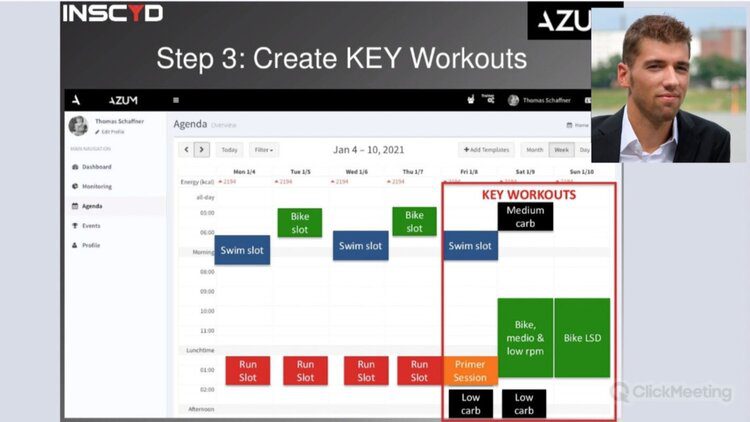
17:19 And once I have this, then I can basically go in and pick some days or one day and start to plan one of these key workouts into that, right? I already showed an example here where it's a combination of a primer session, so a specific training session on Friday evening, orange here in the graph, which, you know, then followed with, you know, some kind of specific nutrition regime and then followed and connected by a specific workout on the bike the day after. Okay. Okay. So you might have one day or a string of two or three days, which in combination create a key workout.
18:09 And this is what you want to do first. So in the week, you first want to, you know, plan and create the key workouts for your key performance indicators for your main areas of improvement, which are most important to you and your athlete. Okay. First do those. And once you have designed those, you can maybe find another time in the week where you do another key workout, either for the same area for the improvement, for the same KPI or for a different one. But first block spaces and create those blocks for key workouts.
18:47 And after that, you, so to speak, can fill up the blanks, whatever is, you know, possible, how much time is left. You can fill up other slots with, so to speak, secondary important training sessions, right? Of course, they should still serve each training session should actually, should serve a specific purpose, right? And on a little side note here, when you do it this way and you can explain it this way, I really advise you that you, I really recommend that you explain exactly the strategy or the step-by-step to your athlete.
19:30 Because for an athlete, if you just send the training program, the athlete doesn't know if it's not communicated, the athlete doesn't know why the training program looks how it looks like. But when you can come in and say, okay, this is the key workout, this is what you should, you know, focus a lot on, this is where you have to be really precise. And these are the other workouts, this is how I all created, this is what's more important, what is less important. And this is especially why we are doing it, the confidence of your athlete in your coaching, you know, basically skyrocket.
20:06 It's just super, super important. And the confidence of the athlete in his own training program will also increase tremendously. Okay, so now combining those key workouts. You've seen in the previous slides, those key workouts are not on consecutive days maybe, right? And one sentence or one quote, so to speak, I would like you to remember, when you plan a whole week, when you create a whole week of training, don't think about the training, think about the recovery. That's what you're doing. When you plan a whole week, you think about, okay, I did on day one, I did a specific training session.
20:52 How long does the athlete need to recover from that? When can he do the next one? So when you fill those blanks, when you put in training sessions on specific days and you start to combine those, right? You're asking, for example, if it's a triathlete, you would ask yourself the question, okay, can this guy do a hard swim on Wednesday morning? Then the answer to that is, okay, what happened previously? What happened previously? Did he have a hard swim session Tuesday night or did he just have an easy jog?
21:24 So different muscles and different intensity. So think about the recovery. Think about the recovery when you plan a training. Don't think about the training really. And one very nice and very simple way to think about the recovery is to look at carbohydrate combustion or availability. And don't get scared away here. I'm not talking about that you need to measure it precisely or that your athletes can only train with a metabolic heart and that you have to have a food diary. No, no, no, no. It's about to have a rough idea or keep this in mind.
22:01 How much carbohydrate will an athlete potentially burn during a session and how much time does he need to fill up his glycogen stores again? And, of course, this is not explaining all the recovery. Recovery is much, much more than just replenishing glycogen. But it's a nice and relatively easy indicator, especially when you think about scheduling or planning higher intensity workouts. Right? So an exercise session, a workout where an athlete spends significant time in higher intensity exercise domains, obviously there's a lot of carbohydrate utilization. And the only way to ensure that there's a high quality of training and your athlete is actually able to do this session is to ensure that he or she has enough carbohydrates.
22:53 Okay? And a lot of stuff like, you know, overreaching syndrome or, you know, getting sick and maybe, you know, losing body weight by losing muscle mass is all somehow more or less a little bit linked, not everything, but many, many of these aspects are linked to glycogen depletion. So, therefore, looking at carbohydrates on a high level, just think about it. How much does an athlete burn? How much time does he have to replenish? It's a nice way to understand if the structure of key workouts and secondary important workouts is set up in a correct way.
23:31 And, you know, one starting point obviously would be, for example, in some kind of assessment, get your carbohydrate combustion rate of an athlete, right? To understand then at which intensity, long, slow distance, medial training, whatsoever, threshold intervals, what is the carbohydrate combustion, right? And especially when it comes to intervals, it's not that easy to understand, to do the math here. So, what I recommend is put or have the fat and carbohydrate combustion, so do have the utilization rates in, you know, in the training zones or in your training program, right?
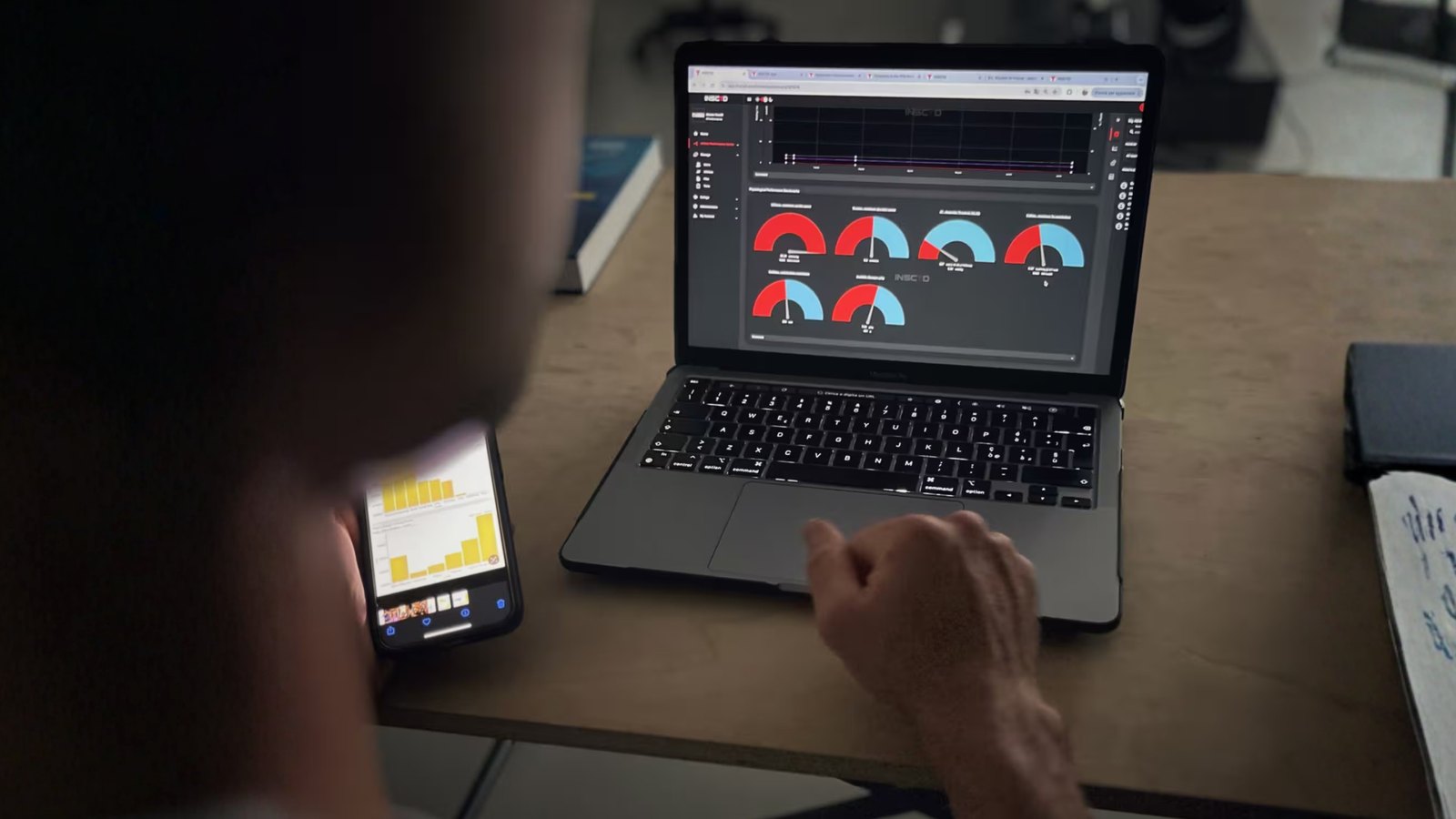
24:18 So, you can see it here. That's a screenshot where you can see, okay, fat and carbohydrates per hour for each zone, for each intensity zone. Okay, how much does the athlete actually, you know, actually combust or actually burn? And then the nice thing here about this platform, which I'm showing here, is that it automatically calculates, automatically projects, actually. So, when you plan a training, it projects the amount of carbohydrates burned in the planned training. So, instead of manually calculating, oh, you know, this is six times four minutes on at 300 watts, and this is X amount of carbohydrates, and whatever, five times six minutes off, blah, blah, blah.
25:02 You know, it gets very difficult to do it manually. Here it is in automatically. And on top of that, you could also obviously compare it with an assumed intake. It can be rough. Again, not really varied if it's not a strict food diary, because that's obviously very cumbersome to do this. But at least have a rough idea. Have a rough idea of what is the approximately energy intake of the athlete, and what is the approximately energy utilization in the training. Because, again, overreaching or overtraining syndrome is linked to a deficit in energy.
25:43 Actually, there are a lot of nice studies which show that the only way how you can trigger overtraining syndrome is if you have a deficit in calories, especially a deficit in carbohydrates. So, it is your security layer, or it is a nice marker. Okay. So, one guideline, one very practical, efficient way, one very efficient way to actually, you know, have an idea about the recovery needed in between and the overall training stress. Okay. And then the last step is to roll out the training program. So, again, what we did is we identified where we want to go, where we are, which are the most important metrics we want to work on, how many weeks it takes, how often we want to train on, you know, a specific key performance indicator.
26:39 Okay. Okay. That is, that is the, yeah, that were the first steps. Now, we have created this one week of training with a key workout and with a secondary important workout. And now it comes to rolling it out. And this is something I want to emphasize here because in many, many coaches, there seems to be a kind of hesitation to just take one training program and roll it out and scale it over several weeks. And therefore, I brought in this nice quote from Dan about training programs that often, you know, it is not the most exotic or most sexiest or sophisticated in terms of all the details training program that work.
27:30 The training program can be relatively simple and still work very, very good. Right. I have one little anecdote to share here myself. A few years ago, I did a training program for an age group who wanted to win national TT championships and whatever, 50 plus age group. And the training program that he got from me was super simple. It was basically more or less only one or sometimes two different workouts. They were just repeated over and over and over again. So the process to create the training program was maybe three to five minutes.
28:16 So process to find out what training to do was like half an hour. Okay. Okay. And this is what I would like to emphasize or what I would like to create some kind of awareness to. It is not so important, actually, to week to week, every week change, you know, little details about the training program. Maybe it's nice for some entertainment for the athlete. But this is not what it's about, especially endurance training. The key for success in training, especially in endurance training, endurance training is repeating the right and efficient training programs.
28:54 And I want to give you some examples. When you look at treatment and you have to take medicine in order for a specific treatment, the main work of the physicians, of the doctors is to find out what is the issue, what is the medical problem, and then to find out what is the most efficient and best treatment. And once it is figured out, basically, you would get the same drugs, the same medication regularly, right? It's not like the doctor says, oh, you know, this week we take ibuprofen and next week we say, you know, we use something different.
29:29 No. If the doctor is convinced that this is the right treatment, then this is what's basically happening. Another example, think of physiotherapists. Good PTs actually spend a lot of time similar to what we should do in a training program. Spend a lot of time finding out, okay, what is the problem? Where does the problem come from? What is the root cause of the problem? And then you maybe end up with one, two, three exercises or, you know, treatments, which are basically just then repeated and repeated and repeated, right?
30:04 And in sports, if you move from endurance sports into the gym, it's the same thing. If, you know, if an athlete wants to increase muscle mass on the biceps, for example, in this picture, it's not that he uses different exercises from one week to another, right? He or she would just go into the gym and repeat arm calls over and over and over and over again, maybe a little bit. Different in terms of repetitions or weight or something, right? Progressing or the weight. But at the end, the exercise, the main exercise is the same.
30:46 And I'm bringing this up and I'm spending so much time on this topic because, again, so many coaches, I know many, many coaches in endurance sports who think, who feel they need to offer something different to the athlete in each and every training session. And, again, it's maybe nice for entertainment, but it's much, much more important to explain to your athlete, look, we did diligence work to find out what we need to work on. And now we identified the right training and the most efficient training and now we just keep doing it, right?
31:16 And variation comes from choosing different training road or slightly changing the training content. But the main principles are the same. If you identified the right training principles, the right direction, where to go, it's not changing. Okay.
31:34 And, therefore, rolling the training program out is basically repeating it, repeating it, repeating it, repeating it. Okay. Of course, you can increase the time a little bit and maybe have an unload week. So, you may be progressively, like in terms of periodization, you may be increased a little bit from week to week over three weeks and then you unload a little bit whatsoever. All cool, but the main thing stays the same. So, what this means is once we have our main training week, once we completed all these steps, key workouts, secondary workouts, combining them, looking for the recovery.
32:11 Once we have this set up, honestly, what is just happening more or less is use this as a template, right? Use our perfect week, what we think what is the right best training for an athlete. Use this as a template and, honestly, just roll it out. And then you can maybe, again, modify it. Maybe you have whatever. Maybe your athlete has a day where he has a business meeting or a little trip, so he needs to interrupt the training or, you know, some kind of family business, a celebration, a birthday party.
32:49 Maybe somebody, okay, all cool, but at the end, it is just about rolling it out, maybe modifying, have an unload week, so on and so forth, and then repeat for the time period that we identified in the previous step. How much time do we need to lose three kilograms of body fat? How much time do we need to increase VO2max or to have a chance to increase VO2max by five milliliters or five percent, right? And this is the period of the training program. This is the amount of time you should actually allow for this training program, and you should be confident in repeating more or less the same, right?
33:30 So, last topics here, give some use cases, because that's often what people ask, well, what are some ways to work on these key performance indicators? And, of course, there are so many. There's, you know, VL-AMX, there's body weight, there's climbing technique, working on rhythm changes, whatsoever. So, we just picked two here. We just picked one of the main determinants of the pure raw power output, which is glycolytic and aerobic power. So, let's start with VL-AMX. And I just brought this example here to show the effect of a decrease of VL-AMX, in this case, black number 0.57 to 0.3.
34:20 What would it change in theory? And in this case, in this example, we just assume that sparing carbohydrates or carbohydrate combustion is relevant to our performance. And if you would look here at 90 grams of carbohydrate combustion with the solid curve, it's maybe at 190 watts. And with the dashed line, it's maybe somewhere in the ballpark of 240. So, there is a significant increase in power output for the same carbohydrate combustion rate, right? So, what could be a key workout or, in this case, a combination of key workouts?
34:58 And I indicated a little bit before in this example training program. So, one nice combination on how to do things here is to have a combination of two sessions. One is a primer session. So, a session that prepares the main session. So, in this case, it would be a higher intensity session, maybe shorter, only one or two hours that, you know, is in a higher intensity, maybe intervals. And it is, you know, reducing your – or it's reducing the glycogen stores of the athlete. And, you know, it can be shorter.
35:38 And maybe, you know, you can, so to speak, kill two birds with the same stone here because maybe you can use it as a training to also increase the VO2 max of the athlete. And then, similar, if you remember what we've shown in the agenda before, the key workouts on, you know, Friday and Saturday. This is something you could do, for example, on a Friday evening or afternoon. And then, on Saturday, maybe, it's followed by a longer session, by an endurance session, which maybe, for example, repetitively uses medium to higher intensity threshold or in that ballpark.
36:14 This may be, you know, reduced cadence in terms of cycling or, you know, would be some hill, some mountain runs in terms of running, but then, obviously, it wouldn't be five hours. So, repetitively, in this longer session, again and again, like every hour, have, you know, elements or periods of time where intensity is medium to anaerobic threshold in this ballpark and reduce the cadence to increase the torque. And you could combine this, similar to what we've shown before, you could combine this with, for example, after the primary session, not reload, not replenish glycogen.
36:59 So, have a fairly low, not no, not no carbide, but a fairly low carbide dinner. Then, on Saturday morning, as this example, you know, you could have a breakfast, which is not only carbohydrates, to keep carbohydrate stores a little bit lower. Could be one combination, how you combine two days or how you combine two specific training sessions, right? And maybe you find a way to repeat this, right? Maybe you can, maybe the athlete could buy himself some time to not do it only Friday, Saturday, but to maybe also do it Tuesday and Wednesday.
37:33 Because, again, the training success comes from repeating efficient and targeted workouts and training interventions. And then, for the same reason, you basically just keep doing it. You just keep doing it for weeks and weeks. And you can, again, you can vary the time of climb or the duration. Like, that doesn't really matter, right? If it's slightly above anaerobic threshold or slightly below, if it's, whatever, 50 minutes or 20 minutes, that's not really game-changing. What is game-changing is repeating inefficient and assumes this is the efficient way for you, Adley, to do it.
38:15 The key element to success is repeating it. Other use case, increasing VO2max. And I brought up another example. And most people would like to think, okay, now we are talking about VO2max intervals. Yeah, this one here is maybe a little cheat. Because often what I found when you talk to athletes and you ask, okay, you know, we are time crunch, we are time limited, I cannot afford spending more time. But if you ask them, okay, would you be able, for example, to do 30 minutes in the morning before you go to work, right?
38:54 Just maybe 25 minutes whatsoever, it doesn't really matter. Then maybe you can even increase intensity from just base intensity to media or something, right? But would you be able to just have your bike sitting on the rollers and you just put your bib shorts on and nothing really to do and just, you know, ride for half an hour before breakfast? You need to shower anywhere. You need to change anywhere. You know what I'm saying? It's logistics-wise relatively easy for most people to access. And if your athlete feels like he can do it and he does that or she every morning, every day before office, that's an extra two and a half hours of endurance training.
39:37 And for somebody with, let's say, eight to 10 hours of availability of time per week, that's a huge increase in training time. And then you can play around with things, right? Just to give you some ideas how to make it an even more efficient or better training program. You can have it before breakfast. So you can have, can do this session, low carbohydrates, might be a nice additional variety, might be a nice additional training stimulus. Once the athlete is accustomed to it, you can, instead of just going easy, increase intensity.
40:17 Also makes it not that boring. If it was whatever, five minutes on, five minutes off, base, medio. You can do a little RPM changes. So you can have your athlete, whatever, doing 30 seconds high RPM, 30 seconds low RPM. You can have them riding this in the drop bars or in case of triathletes or time trial is even better. Have them doing it in aero position. Or lower the aero bar a little bit and try to have a more extreme aero position. Try to get more comfortable to this aero position, right?
40:48 Have the athlete put the rollers, put the bike in front of a big mirror. And practice tucked in position, right? Practice shoulder shrug. So there's a lot of technical aspects you can add to these kind of trainings to make it even more efficient, right? And not only increase your view to max, but make it more complete. And now you are immediately adding variety and adding something new. If you still have the feeling, if you still have the feeling, you always have to come up with something new to your athlete.
41:21 Even though, no, you don't in terms of physiological adaptation. You know, this is what you could do. You could have your athletes in the first week or the first two weeks, just do normal, steady 30 minutes riding. And then you add these elements, technical training in front of the mirror, cadence, so on and so forth, right? That's what you could do. And of course, don't want to let this, don't want to finish without. Of course, you could, for increasing, going back to the main topic, you could also have your athlete doing classic review to max intervals.
41:55 And I came up with another variation of it, which is three times eight minutes, but the eight minutes is broken up. So it's two, four minutes, and then it's one minute easy, and then it's another four minutes. That's often very helpful for the athlete, especially athletes who struggle doing the intensity. I would prefer also decrease the intensity for the on phase. But one variation is to actually break up those eight minutes or 10 minutes or 12 minutes, whatever you want to do, and have one minute of lower intensity in between.
42:32 But this lower intensity does not mean just spin easy. As you can see here, it's saying medial. So you can also say maximum rate of lactate combustion. So, or an inside test would be a maximum lack of pyruvate. So you would have this one minute and the intensity where the recovery of the athlete in terms of combusting lactate is highest. That's what you want to do. And you keep, if you want to go a little bit into the physiological details, you keep a relatively high intensity, which is not allowing your athlete to replenish creatine phosphate entirely.
43:15 And therefore, when he goes into the second half, so after the one minute break, and he goes into the second half of the training, more of the energy needed is covered by aerobic metabolism. And that's obviously what you're trying to target here.
43:33 And with that, I want to thank you.