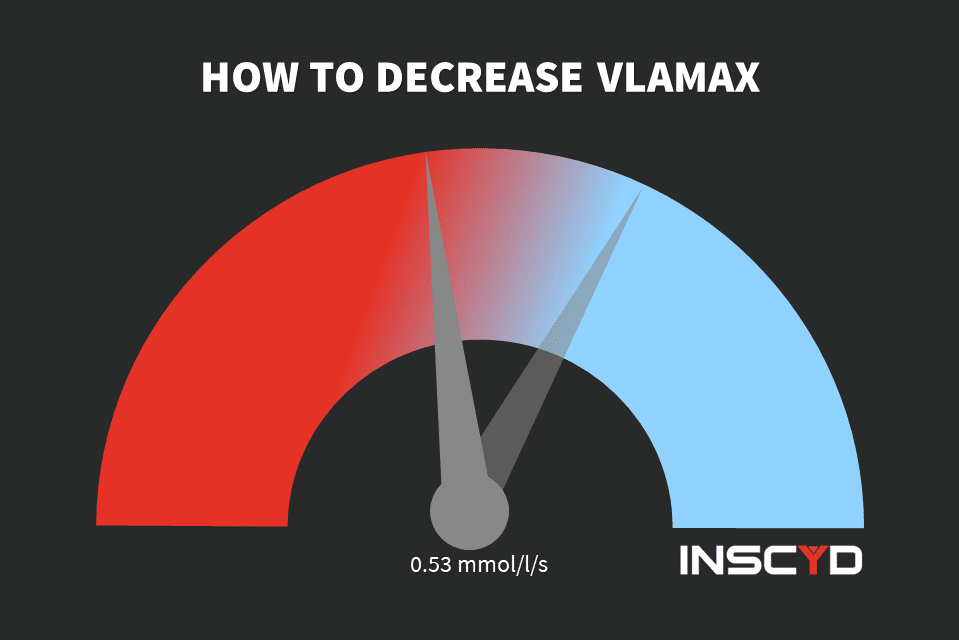
Five training tips to decrease VLamax in endurance athletes, using sweet spot intervals, low-glycogen sessions, and controlled nutrition periodization to reduce glycolytic power and raise anaerobic threshold as a result.
Want to reduce your VLamax so you burn less carbohydrates and increase your anaerobic threshold? Here are 5 training tips on how to decrease VLamax, talking about: training intensity, frequency and nutrition! PS you can also download the tips in PDF.
Having a high VLamax will make you go faster in any sprint or attack*. But there is a serious downside… Athletes with a high VLamax burn more carbohydrates at any given exercise intensity. This can become a problem in long endurance events like a triathlon or marathon.
That’s why we often get the question: how do you decrease VLamax? Here are 5 training tips that will decrease VLamax. Bonus: when decreasing VLamax, you automatically increase your anaerobic threshold (FTP)*.
*all other things equal. Learn the basics about VLamax via this link.
When you try to lower your VLamax, you want to decrease the activity of the glycolytic energy system. More scientifically, you try to lower the glycolytic enzyme activity. These enzymes are mostly located in all kind of fast twitch muscle fibers.
Now here’s the challenge.
If we want to adapt those muscle fibers, we need to activate them. Fast twitch muscle fibers are mainly used at higher intensities.
We can recruit fast twitch muscle fibers by increasing the intensity above base endurance. To trigger the recruitment of these muscle fibers even more, it is highly beneficial to increase the force or torque which is involved in such a training. In cycling this would mean riding at a low cadence.
However, high intensities also make the glycolytic energy system more active. Which is quite the opposite from what we want.
Therefore we should not increase the intensity too much. It’s better to stay below anaerobic threshold.
In summary: increase the intensity to target the right muscle fiber, but keep the intensity low enough to prevent a highly active glycolytic energy supply. Some call this sweetspot training.
“I work with a high VLamax athlete who is aiming for the National TT Championships in China. In the past the athlete did a lot of high anaerobic training with the idea that you need to train hard to go fast.
With INSCYD I was able to show him and his team that we need a different training approach when aiming for the National TT Championships. We need to decrease the VLamax.
After reading the 5 tips to decrease VLamax, we started implementing more high torque, low cadence training. We also decreased training intensity to sweetspot training. At first the athlete and his team were skeptical but eventually we tried it and it showed to be a great success.
After 2 months, the VLamax decreased almost 30%, which results in a serious increase in his anaerobic threshold and an increase in fat combustion. We are looking forward to the Championships now!”

If you want to decrease the glycolytic energy production, you can cut back on the fuel for this energy system. Glycolysis uses glucose (carbohydrates) or glycogen (glucose stored in the muscle) as a fuel.
Training on low (not empty!) glycogen stores with reduced carbohydrate substitution has shown great effect on VLamax adaptation. Especially when combining it with “sweetspot” training intensity, because at this intensity, you’re still able to use fat as a fuel.
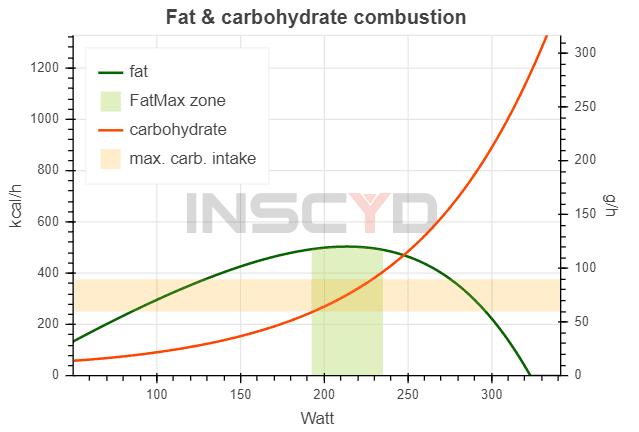
You can use the fat – and carbohydrate utilization curves, within INSCYD, to effectively set the right training intensities for your athletes.
“For time trial athletes, I aim at improving fatigue resistance by reducing the VLamax. For one of my riders Tom, I prescribed rides with reduced glycogen stores. Note: these rides are not fasted, just with a focus on quality protein replacing the carbs in your pre ride meals.
This helped Tom a lot. He can now hold power figures for 50 miles (1h:40mins) that he used to hold for 25 miles (50 mins) races.”
Interested in the other 3 tips? Download the whitepaper for free! Fill in the form and get the tips in your email inbox.
VO₂max, VLamax, FatMax, thresholds, fuel use and training zones, from a single test in the lab, in the field or fully remote.

