The 4 mmol/l lactate threshold is a population average, not an individual physiological event. This article explains why fixed-concentration threshold methods produce inaccurate results and what should replace them in lab practice.
Many performance labs and coaches determine the anaerobic threshold based on a lactate concentration of 4 mmol/l during an incremental test. This article answers whether that is a valid method of assessing the anaerobic- or lactate threshold.
The 4 mmol/l mark is widely known and used to determine the anaerobic threshold. But why? Let’s have a look at the origin of the 4 mmol/l theory.
In 1976, INSCYD’s advisory board member Alois Mader and his colleagues introduced the terms “lactate threshold” and “aerobic-anaerobic threshold”. Mader, who was working in Cologne (Germany), found that a blood lactate concentration of 4 mmol/l can be a criterion for the assessment of these thresholds, during an incremental lab test. His work was published in German.
In 1981, Bertil Sjödin and his colleagues introduced the English term “Onset of blood lactate accumulation” or “OBLA”. They also used a blood lactate concentration of 4 mmol/l to determine their exercise intensity: OBLA.
In more recent scientific publications, the 4 mmol/l lactate threshold mark is referred to as LT4.
As mentioned, Mader and his colleagues (also referred to as the Cologne group) used the 4 mmol/l mark in an incremental lab test. Soon other scientists started to demonstrate that the Individual Anaerobic Threshold (IAT) did not always occur at a blood lactate concentration of 4 mmol/l, when using an incremental lab test that was different from the original protocol.
To solve this problem, Mader and his team worked on a new test to determine the anaerobic threshold. They asked volunteers to exercise at a constant intensity (at the expected threshold intensity) for ~30 minutes. They then identified whether this intensity was indeed the maximal intensity at which blood lactate concentration remained stable. The highest intensity at which lactate remained stable was called “maxLass” or “MLSS”. To this day, this method is considered the “gold standard” method of assessing the anaerobic threshold.
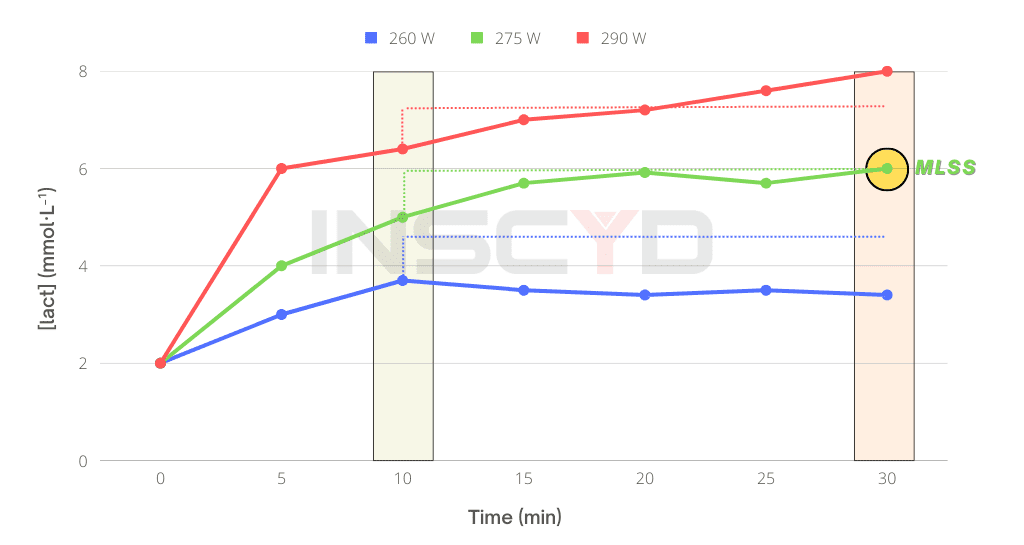
Because the MLSS test takes a lot of time (you have to do multiple ~30 min tests), interest in determining the anaerobic threshold via an incremental test remained. One way to solve this problem was by comparing the MLSS tests with incremental lab tests.
In 1985, Mader and Heck published their new findings in a scientific paper called: Justification of the 4-mmol/l Lactate Threshold. There are two important conclusions in this paper:

In other words: unless you’re using the exact same incremental test protocol that Mader and his team used in 1976, a blood lactate concentration of 4 mmol/l is not a good marker for anaerobic threshold in your (lab) test.
Are you a dedicated sports coach or performance lab professional, striving to optimize your athletes’ performance? Do you want to understand the intricacies of anaerobic threshold assessment and apply the most accurate methods for your team? Don’t rely on the outdated 4 mmol/l lactate threshold. Dive deeper into the science of lactate threshold assessment and maximize your athletes’ potential.
Now you’re probably wondering: what was the original protocol?
According to their 1985 publication, there are a couple of factors that determine whether you can use the 4 mmol/l mark to determine the anaerobic threshold.
The 1985 publication shows that if you don’t check all these boxes, you should not use the 4 mmol/l mark to determine the anaerobic threshold.

We learned that the 4 mmol/l mark is not a good indicator for the anaerobic threshold (AT) if you’re not using the original test protocol. But then, what is the lactate concentration at anaerobic threshold?
Your lactate concentration depends on the exercise intensity, the exercise duration and the initial lactate concentration. As a result, your lactate concentration at threshold intensity could be “anything”. Here’s an example of how you could measure lactate concentrations above 8 mmol/l at threshold intensity:
Go out and do a (very) hard 5 minute effort. After 5 minutes, continue with a 10 minute interval at your AT intensity. Voila, you’re now exercising at your threshold intensity with a lactate concentration that will remain well above 4 mmol/l.
Even if you’re only interested in lactate concentrations in a graded exercise (starting with low lactate concentrations), there’s still not one specific lactate concentration that you’ll find. Ralph Beneke and his colleagues show that in “gold standard” MLSS tests, you can find an AT lactate concentration somewhere between 2 mmol/l to 8 mmol/l.
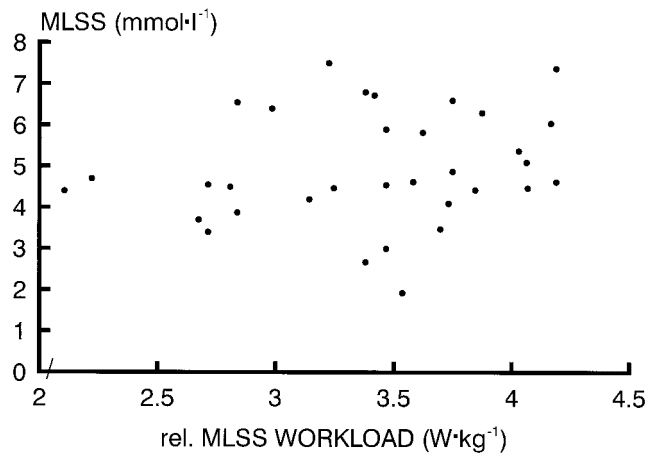
There is no correlation between MLSS blood lactate concentration (y-axis) and MLSS workload (x-axis). The lactate concentration at MLSS can range somewhere between 2 and 8 mmol/l. (Source).
As Mader quotes in his 1985 publication:
“(..) endurance-trained persons probably have their thresholds at lower lactate concentration levels. Work loads in training corresponding to the 4-mmol/l threshold value were poorly tolerated by trained individuals, but well tolerated by untrained persons.”
Even though Wikipedia still suggests the 4 mmol/l mark for approximating AT, we now know better. Those who unintentionally founded the 4 mmol/l idea in 1976, already showed that you could not use this mark in any other test protocol in 1985.
Unless you are using the original test protocol in runners, there are better ways to determine the anaerobic threshold. INSCYD performance software enables you to accurately determine AT, while using your current (lactate) test protocol. The best part: the results are not limited to AT only. Instead, you get a full 360 metabolic profile.
INSCYD enables coaches to build a complete metabolic profile of an athlete using simple power-based (cycling) or GPS-based (running) field tests—no metabolic cart required.
NSCYD also supports field- or lab-based lactate testing, offering multiple ways to collect data based on what’s available.
With INSCYD, coaches and human performance labs gain access to the key physiological metrics that actually determine performance:
… and many more metabolic insights.
“INSCYD goes beyond power analysis and allows us to see what happens in the body on metabolic level at every type of intensity.”
“INSCYD helps me to make sure that we make the best possible training program.”

“INSCYD enables us to precisely capture key performance metrics of the energy metabolism of our swimmers”

“INSCYD enables us to take real-world data from testing & training. This saves us time and effort, and refines the quality of our job.”
“Thanks to INSCYD, my trainer and I always know where I currently stand and where I can improve my performance.”

“I am convinced by the effectiveness of INSCYD to improve performance – it has proven to be a very powerful tool for us.”

“The INSCYD test opened my mind to an entirely new world of training and racing.”

“INSCYD testing helps my coaches to create the best training programs for us.”

“The more we can understand how an athlete does what they are capable of doing, the better we can focus on what they need to do to get better. This is why I am happy to partner with INSCYD.”

“INSCYD enables coaches to find that missing piece in training, to understand what is going on in the athlete's body and get the best out of them.”

“INSCYD looks inside the muscle and body in order to understand what’s happening based on a very limited number of measurements.”

Ready to begin? If you’re not yet using INSCYD, book a free demo to take the first step toward integrating physiology-based training into your performance testing and coaching.
Get VO2max, VLamax, MLSS, LT1, Fat – and Carbohydrate combustion rate, and many more vital metrics.

VO₂max, VLamax, FatMax, thresholds, fuel use and training zones, from a single test in the lab, in the field or fully remote.

