
HIIT and Norwegian 4×4 intervals both stimulate the glycolytic system, not just aerobic fitness. VLamax utilization determines your interval training outcome, and ignoring it leads to unintended anaerobic adaptations.
In Part 1 of this series, we compared the aerobic metabolism’s response during HIIT intervals and Norwegian 4×4 intervals.
We used two representative interval formats:
We demonstrated that HIIT (40 seconds on / 20 seconds off) produces a higher percentage utilization of VO2max but for a shorter duration at high VO2. In contrast, Norwegian 4×4 intervals reach a significantly lower %VO2max, but with longer exposure time at that level.
These findings about how both training methods work to increase VO2max are well established in the scientific literature and may even be common knowledge among exercise physiology experts.
However, this was not the main finding.
The main finding of Part 1 was that this general concept is not the same for every athlete. Even for athletes who have the same VO2max. Two athletes with identical maximum aerobic capacity but differently developed glycolytic capacity receive a vastly different training stimulus on the aerobic system. Very different than expected. The inter-individual differences can be huge.
We found that the solution is to prescribe training intensity not as an extrapolation of threshold intensity (FTP, LT2, or similar proxies), but to base the intensity on the very metric the training aims to improve: VO2max.
Read the full Part 1 analysis here: HIIT vs Norwegian 4×4: How VLamax Determines Your Aerobic Training Response.
Both HIIT and Norwegian 4×4 are well researched in the scientific literature for improving VO2max. Both are evaluated in terms of aerobic adaptation. And if your goals are to increase fat combustion rates, spare carbohydrates, or raise threshold values, both methods can achieve this via increasing VO2max.
So how is it that not all athletes receive the same benefit from these intervals, and some athletes do not seem to improve at all? What we are talking about here is not the comparably smaller difference in efficacy because of the inaccurate intensity definition we disclosed in Part 1. What we are talking about is that some athletes show no improvement at all from one of these methods, or in some extreme cases even show decreased overall performance. The latter can happen particularly with highly endurance-trained athletes doing HIIT.
What are we missing?
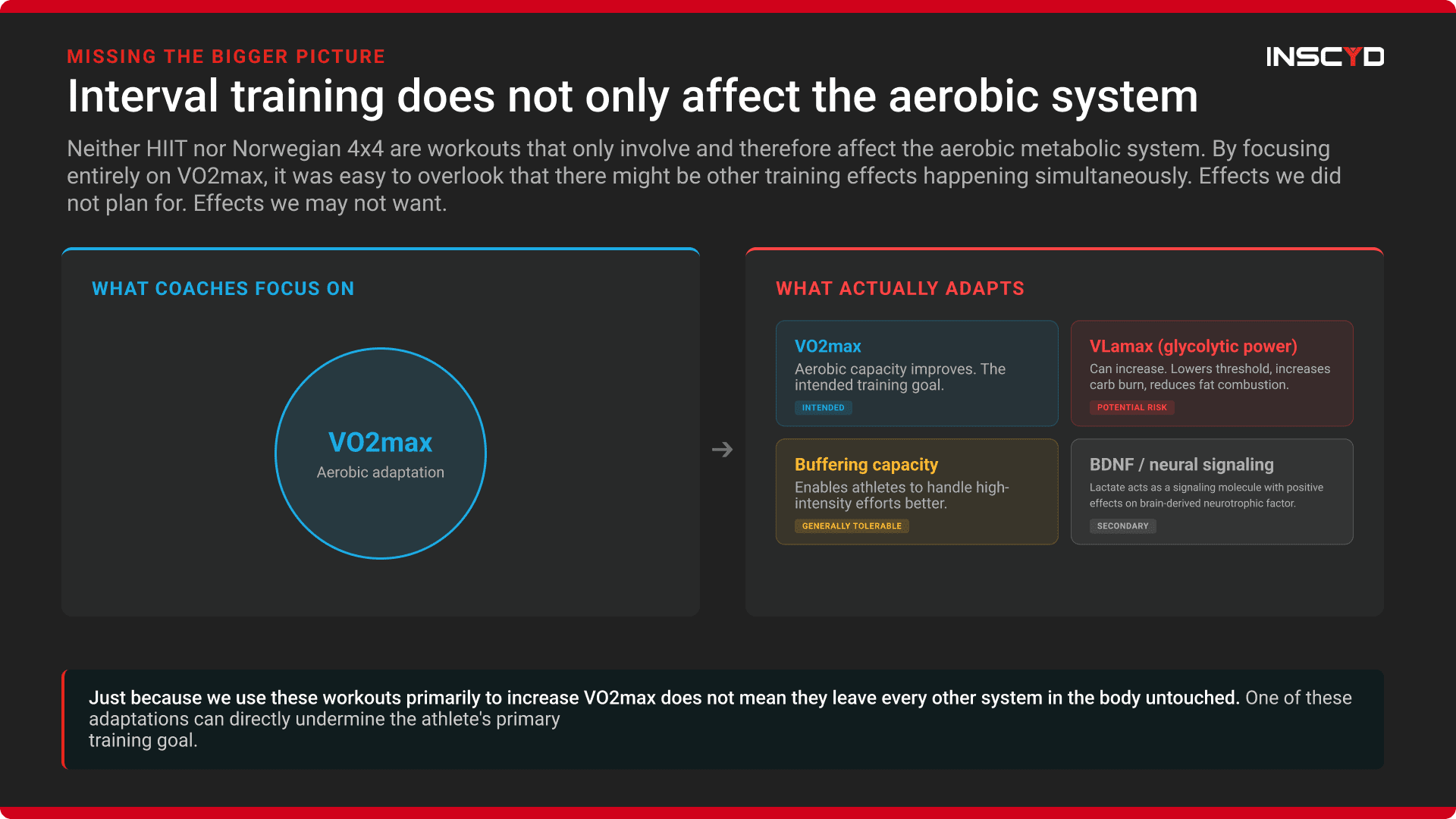
The overlooked component is this: neither HIIT (40/20 in our case) nor Norwegian 4×4 are workouts which only involve and therefore affect the aerobic metabolic system (VO2). Just because we want to use these workouts primarily to increase VO2max does not mean that they do nothing else to any other system in the body. By focusing entirely on VO2max, it was perhaps easy to overlook that there might be other training effects happening that we did not anticipate and which we may not even want.
For example, think about the massive lactate buildup during these sessions, especially during the 40/20 HIIT intervals. This lactate can likely act as a signaling molecule with positive effects on substances such as BDNF (Brain-Derived Neurotrophic Factor), which helps protect nerve cells in the brain (El Hayek et al., 2019). Both workouts are also prone to increase buffering capacity in the muscles, enabling athletes to handle high-intensity efforts better. A side effect that might not be needed if the training goal is to spare carbohydrates and increase fat combustion, but it does not really hurt either.
But there is something that can potentially hurt reaching the athletic goals.
And this something is likely the reason why some athletes do not seem to get any improvement from one or both of the training methods we discuss here. And it is very likely the reason why some athletes even decrease their performance for long endurance events by doing HIIT.
It is well established that both HIIT and Norwegian 4×4 can lead to significantly elevated lactate levels. This is especially true for HIIT intervals.
If lactate concentration is elevated, lactate production must also be elevated. We already established in Part 1 that VO2 is very high during these sessions, in the HIIT case close to VO2max. Lactate is combusted in the aerobic metabolism as a fuel (Brooks, 1985), and the higher the VO2, the higher the lactate combustion rate. So if VO2 is near maximal, a large fraction of the produced lactate is being consumed as fuel.
Yet the concentration still rises.
This means the production rate of lactate has increased by a substantial margin to outpace even the elevated combustion.
Now apply the same training principle we discussed in Part 1 for VO2max. The basic idea: the more we use a system, the higher the stimulus for that system to adapt. This is the entire basis of the concept that higher %VO2max utilization leads to greater VO2max improvements.
If this holds true for the aerobic metabolism, it also holds true for the glycolytic (anaerobic) metabolism.
A significant increase in lactate production, as seen in both HIIT and Norwegian 4×4, is a clear sign of elevated glycolytic activity and therefore a valid and powerful training stimulus on the glycolytic system. Scientific research has confirmed that high-intensity training can lead to a positive adaptation of the anaerobic metabolism (Abe et al., 2015; Torma et al., 2019).
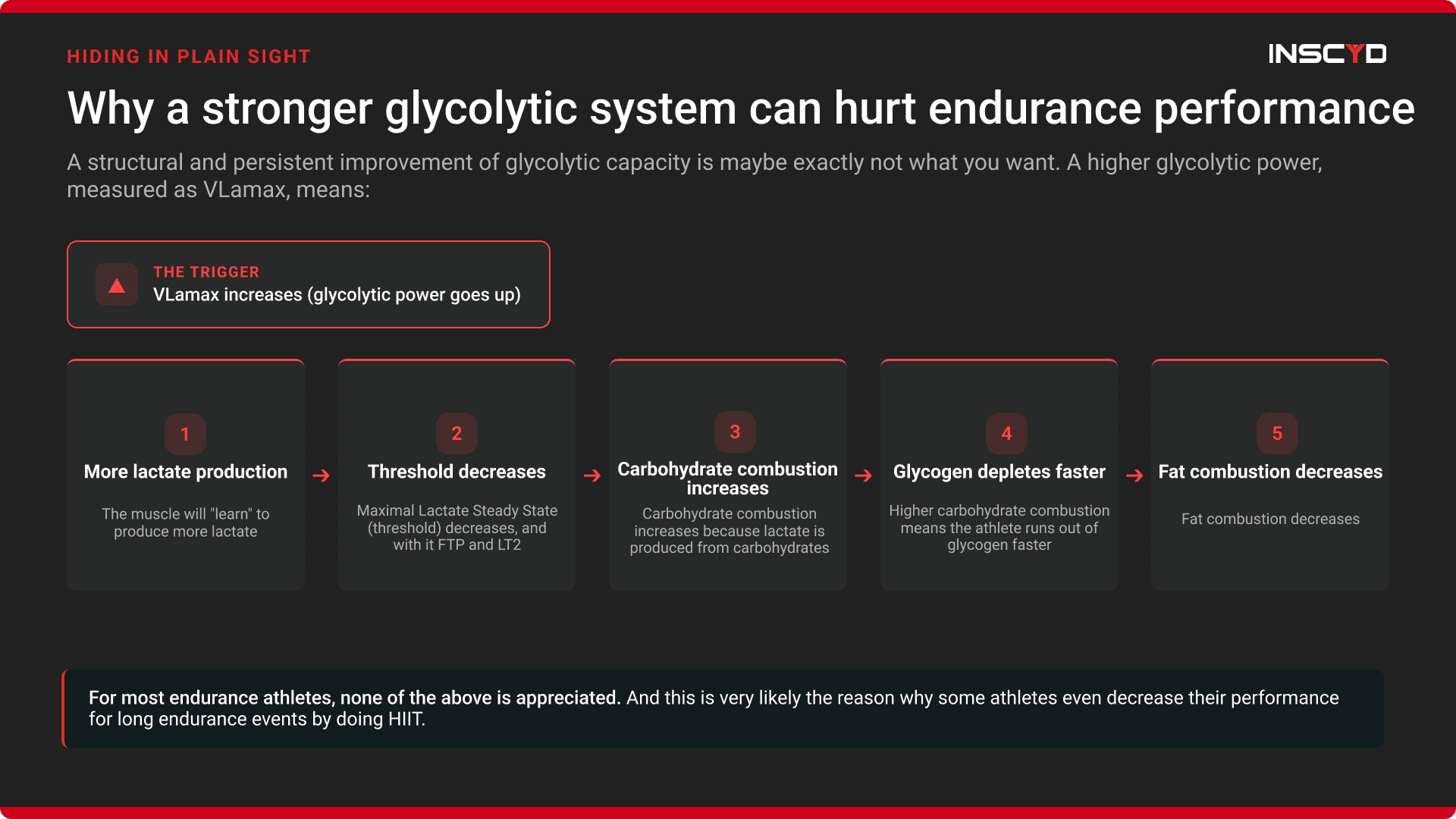
In contrast to increased buffering capacity or BDNF signaling, a structural and persistent improvement of glycolytic capacity is maybe exactly not what you want. A higher glycolytic power, measured as VLamax, means:
For most endurance athletes, none of the above is appreciated.
So the question becomes: how large is the glycolytic stimulus during a given interval session? This is the same fundamental question we asked for the aerobic system in Part 1.
For the aerobic system, we used VO2 (oxygen uptake in ml per minute) as a marker of how intensely the aerobic system is being used. We expressed it as a percentage of VO2max to get fractional utilization.
The equivalent for the glycolytic system is the lactate production rate (in mmol per minute). We can express the actual glycolytic rate relative to the maximum lactate production rate (VLamax) to get the %VLamax utilization. This tells us, in relative terms, how hard the glycolytic system is working during a given effort.
There is one important difference in kinetics. Oxygen uptake responds slowly and either builds toward a steady state or climbs toward VO2max over time. Lactate production rate reacts faster, but instead of climbing toward maximum during prolonged high-intensity efforts, it actually decreases due to muscle acidosis and declining pH values.
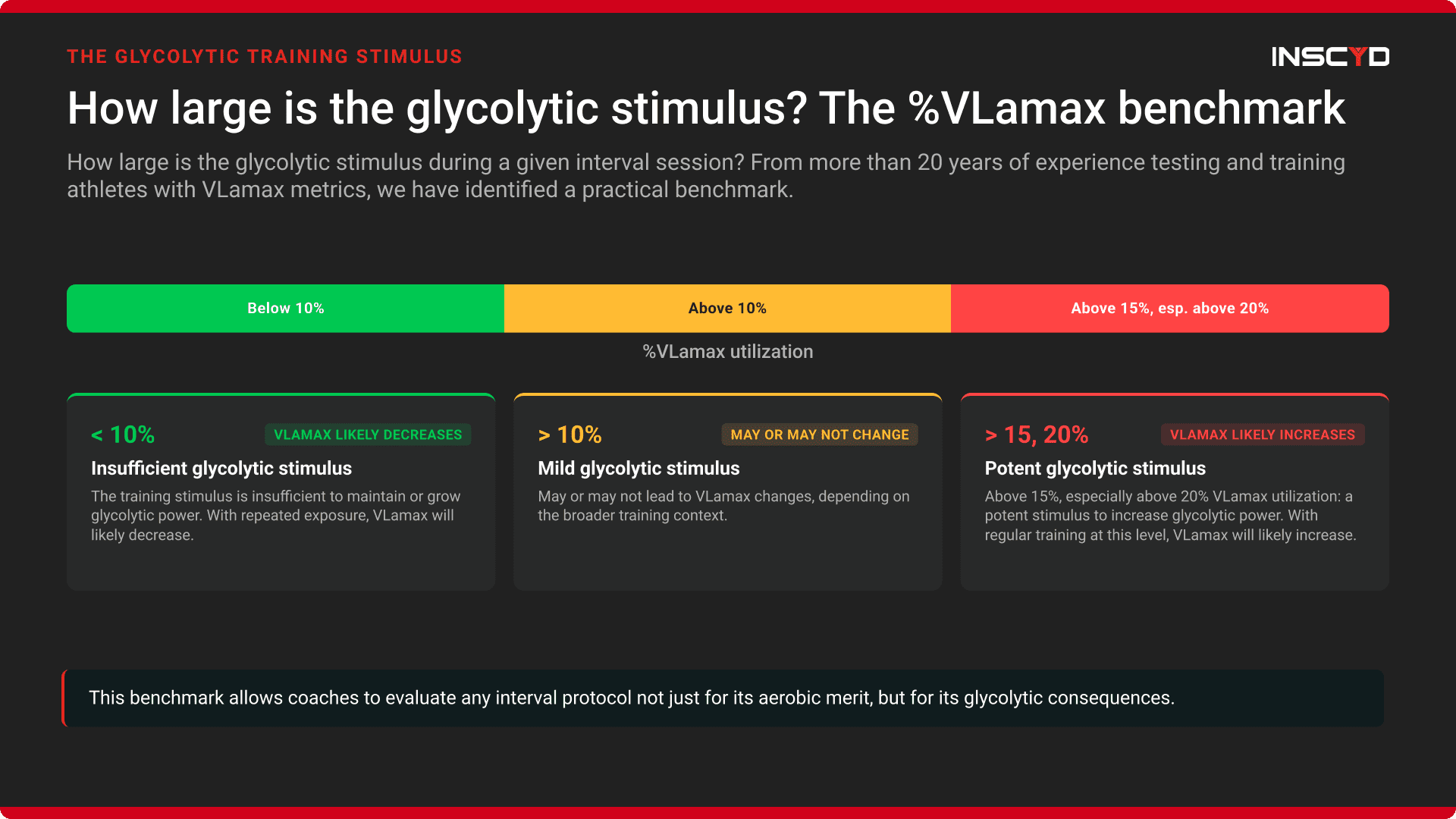
From more than 20 years of experience testing and training athletes with VLamax metrics, working with athletes from recreational to Olympic level across all endurance sports worldwide, we have identified a practical benchmark:
Below 10% VLamax utilization: The training stimulus is insufficient to maintain or grow glycolytic power. With repeated exposure, VLamax will likely decrease.
Above 10% VLamax utilization: A mild glycolytic stimulus. May or may not lead to VLamax changes, depending on the broader training context.
Above 15%, especially above 20% VLamax utilization: A potent stimulus to increase glycolytic power. With regular training at this level, VLamax will likely increase.
This benchmark allows coaches to evaluate any interval protocol not just for its aerobic merit, but for its glycolytic consequences.
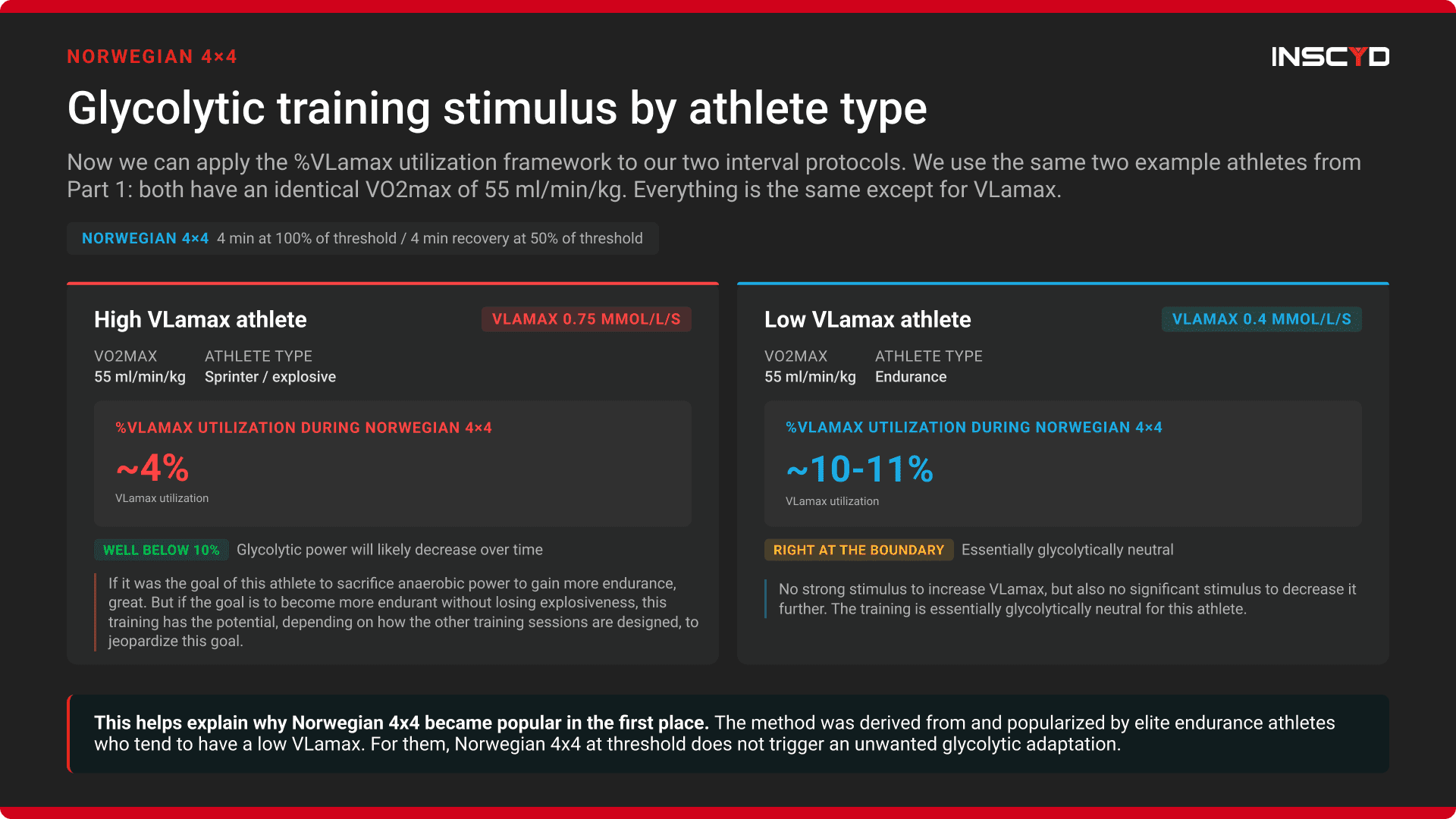
Now we can apply the %VLamax utilization framework to our two interval protocols. We use the same two example athletes from Part 1: both have an identical VO2max of 55 ml/min/kg, the same body weight, the same body composition. Everything is the same except for VLamax. One athlete has a low VLamax of 0.4 mmol/l/s (the endurance specialist). The other has a high VLamax of 0.75 mmol/l/s (the more explosive, sprinter-type athlete).
Both perform Norwegian 4×4: 4 minutes at 100% of their individual threshold, 4 minutes recovery at 50% of threshold.
At the controlled effort of threshold (MLSS) intensity, glycolytic activity actually forms a steady state. By definition, the metabolism is in steady-state conditions: no significant drop in pH, no acidosis-driven inhibition of glycolysis. The glycolytic rate stays relatively constant throughout each interval.
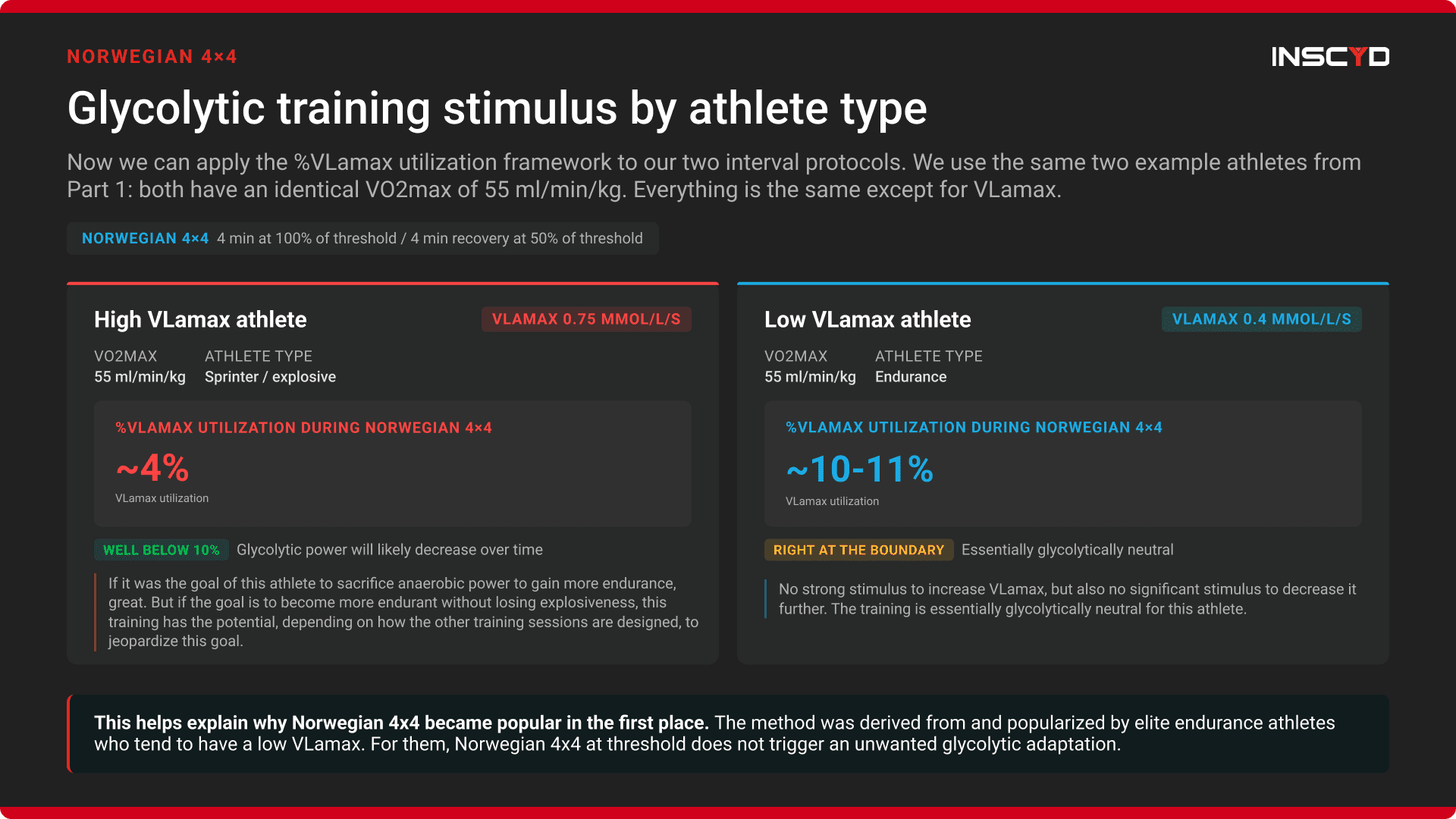
As we can see in the graph, the training stimulus on the glycolytic system is vastly different for the low vs. the high glycolytic athlete during threshold intervals:
The high VLamax athlete (0.75 mmol/l/s): VLamax utilization reaches only approximately 4%. This is well below the 10% benchmark. If this athlete performs Norwegian 4×4 as a dominant and regular part of their training program, this training has the potential to decrease glycolytic power over time.
If it was the goal of this athlete to sacrifice anaerobic power to gain more endurance, great. But if the goal of the athlete is to become more endurant without losing explosiveness, this training has the potential, depending on how the other training sessions are designed, to jeopardize this goal.
The low VLamax athlete (0.4 mmol/l/s): VLamax utilization sits at approximately 10-11%. This is right at the boundary. There is no strong stimulus to increase VLamax, but there is also no significant stimulus to decrease it further. The training is essentially glycolytically neutral for this athlete.
This helps explain why Norwegian 4×4 became popular in the first place. The method was derived from and popularized by elite endurance athletes in triathlon and distance running. These athletes, by nature of their sport and training history, tend to have a low VLamax. For them, Norwegian 4×4 at threshold does not trigger an unwanted glycolytic adaptation. It provides aerobic stimulus without glycolytic risk.
But that does not mean it works the same way for every athlete.
In this part of the video, Sebastian walks through the VLamax utilization data for both athlete types during Norwegian 4×4:
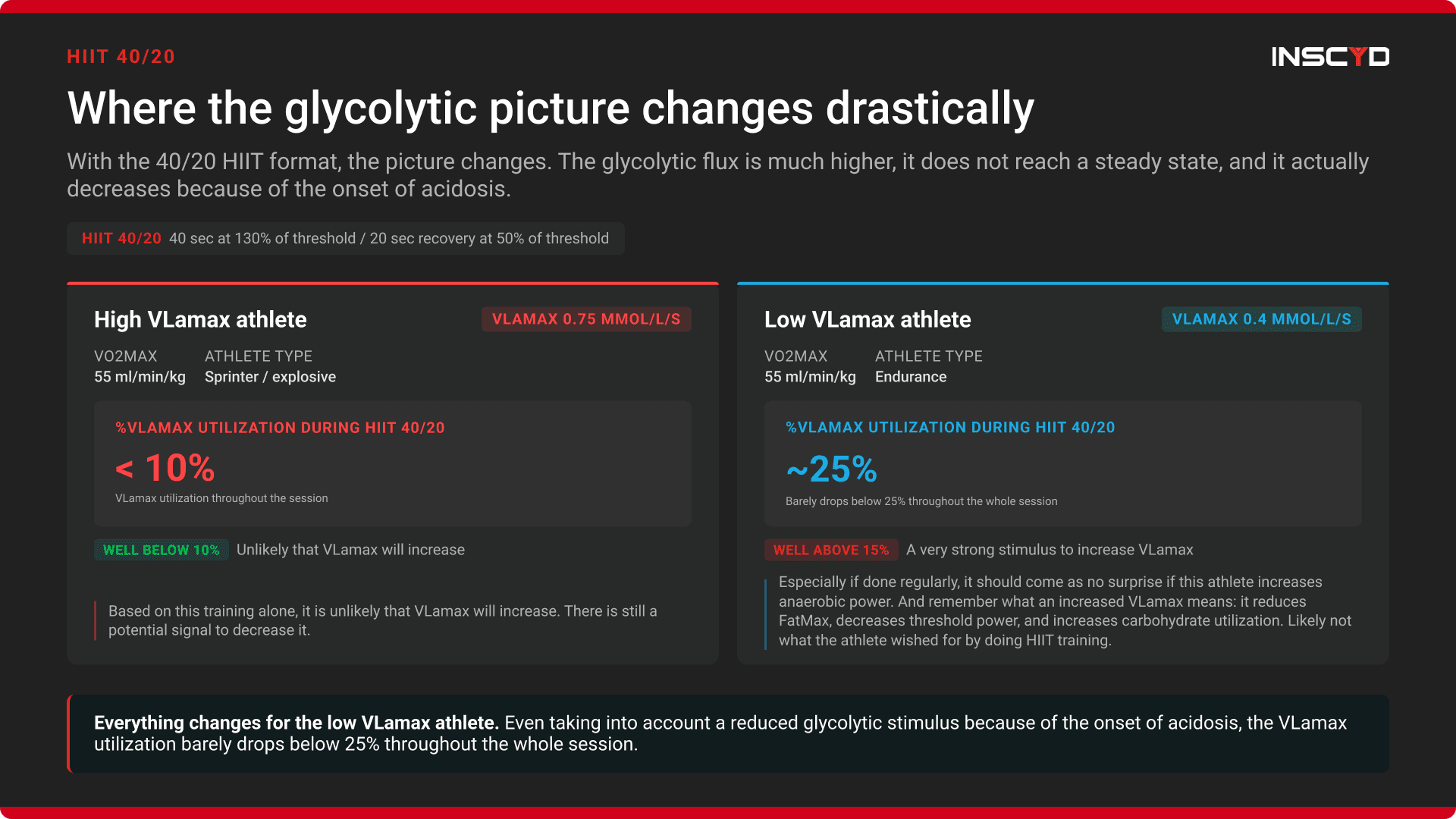
With the 40/20 HIIT format, the picture changes. Not only is the glycolytic flux (lactate production rate) much higher than during Norwegian 4×4, it also does not reach a steady state during the short 40-second intervals. Moreover, it actually decreases shortly after the start of the interval session because of the onset of acidosis, which cannot be cleared in the short 20-second recovery periods.
The high VLamax athlete (0.75 mmol/l/s): VLamax utilization stays below 10% utilization of his big anaerobic engine. Based on this workout alone, it is unlikely that VLamax will increase. There is still a potential signal to decrease it.
The low VLamax athlete (0.4 mmol/l/s): Everything changes. Even taking into account a reduced glycolytic stimulus because of the onset of acidosis, the VLamax utilization barely drops below 25% throughout the whole session. Based on what we know about trainability of the anaerobic system, this is a very strong stimulus to increase VLamax. Especially if done regularly, it should come as no surprise if this athlete increases anaerobic power.
And remember what an increased VLamax means: it reduces FatMax, decreases threshold power, and increases carbohydrate utilization. Likely not what the athlete wished for by doing HIIT training.
In this part video, Sebastian compares %VLamax utilization for both athlete types during 40/20 HIIT:
Now we can see why some athletes might not improve their endurance with these types of training:
High anaerobic (high VLamax) athletes: They do not receive the optimal stimulus on their VO2max, as we discovered in Part 1. The intervals will not harm their performance, but based on the threshold-based intensity setup, neither training format is as efficient as it could be. On the other hand, these athletes risk losing their edge a bit when it comes to sprinting and short high-intensity efforts.
Low anaerobic (low VLamax) athletes: They receive a much better aerobic stimulus, so they potentially improve the system which is, relatively speaking, already stronger. The lower-intensity Norwegian 4×4 can work well for these athletes. But doing HIIT training carries a very high risk of increasing VLamax.
Increasing VLamax would counter any improvements of VO2max.
An improved VO2max would mean the potential for higher lactate combustion and less production resulting in higher threshold power and an increased ability to use fat as fuel.
But the parallel increase in VLamax offsets those gains. Higher VLamax means higher lactate production, higher carbohydrate utilization, and therefore lower threshold power and lower FatMax.
The result in many cases will appear, at least in conventional performance testing, as a stagnation in performance, even though all metabolic systems might have actually adapted. To understand how VO2max alone is not enough, and why the full metabolic profile matters, see our detailed analysis.
We just discovered that two athletes doing the same VO2-based intervals can have a significantly different training stimulus and therefore trigger adaptations in their glycolytic system, which can lead to unwanted consequences that actually hamper performance.
What do we do about it?
The answer is straightforward, but it requires a shift in perspective.
Until now, the primary goal of interval design was clear: maximize fractional utilization of VO2max. But we need to introduce a constraint: we must keep the glycolytic stimulus in check. Because if glycolysis receives a sufficiently high stimulus, it will trigger adaptations, such as the expression of more glycolytic enzymes, thereby increasing glycolytic capacity.
So instead of anchoring intensity to threshold, or even to VO2max, we shift the anchor point.
We anchor it to VLamax, the marker for the glycolytic capacity of an athlete.
By prescribing intensity as a percentage of VLamax, we directly control the glycolytic contribution of the effort. This ensures that the intensity is sufficiently low to not trigger a significant increase in VLamax.
In other words: we prevent the interval from turning into a high glycolytic stimulus session.
And here you might ask: but I wanted VO2max improvement in the first place!
Yes, and if you are comfortable with possibly increasing VLamax at the same time, you do not need to worry here. But if you want to keep VLamax at its current level, or even decrease it, you need to take its utilization into account when creating the interval.
To make sure you still create the VO2max stimulus you were looking for, the answer is relatively simple:
VO2max adaptation is not driven by intensity alone.
It is driven by two factors:
This brings us back to physiology. At intensities above steady state, VO2 continues to rise over time, a phenomenon known as the VO2 slow component.
This means: even if the initial intensity results in a moderate percentage of VO2max, VO2 will continue to increase the longer the effort is sustained.
So instead of increasing intensity, we increase duration.
By extending the duration of the interval:
This allows us to achieve the same goal, a high VO2 stimulus, but through a different mechanism.
Practically, this approach is simple.
In this part of the video, Sebastian demonstrates this exact workflow using the INSCYD Training Zones Builder:
The INSCYD Training Zones Builder is the practical tool that executes this workflow. It allows coaches to:
This approach moves coaching from generic percentage-of-threshold prescription to physiology-based interval design. It ensures that you trigger the right system that you want to trigger with the right training stimulus.
The result: effective high-intensity interval training where both sides of the metabolic equation are controlled, individualized to each athlete’s unique profile.
This is where everything comes together.
In Part 1, we showed that:
Now we take the next step.
Instead of forcing the athlete into a predefined intensity, we design the interval around the athlete’s physiology.
We control the training intensity based on VLamax, to ensure we do not trigger unwanted adaptations. We then modify the duration of the interval to reach the desired VO2 stimulus.
This is what truly individualized training looks like.
It ensures that the athlete receives the best possible training stimulus and therefore spends their limited training time in the most efficient way. Not generic extrapolation from FTP. But a targeted intervention based on the actual metabolic profile of the athlete.
Go beyond the theory. In our intensive 4-day camps for coaches and lab professionals, Sebastian teaches the complete framework behind metabolic profiling, diagnostics, nutrition, and training adaptation, including the VLamax and VO2max concepts covered in this article.
You will work with real athlete data, perform hands-on testing, and leave with the skills to apply physiology-based training prescription with your own athletes. Open to coaches, sports scientists, and performance lab operators.
Guided by Sebastian Weber — the scientist and coach behind multiple Olympic champions, 9 World Championship titles, and Tour de France victories.
Brooks, G.A. (1985). Lactate: Glycolytic End Product and Oxidative Substrate During Sustained Exercise in Mammals – The “Lactate Shuttle.” Comparative Physiology and Biochemistry: Current Topics and Trends, Vol. A, Respiration-Metabolism-Circulation. Springer, Berlin.
El Hayek, L. et al. (2019). Lactate Mediates the Effects of Exercise on Learning and Memory through SIRT1-Dependent Activation of Hippocampal Brain-Derived Neurotrophic Factor (BDNF). Journal of Neuroscience, 39(13), 2369-2382.
Helgerud, J. et al. (2007). Aerobic High-Intensity Intervals Improve VO2max More Than Moderate Training. Medicine & Science in Sports & Exercise, 39(4), 665-671.
Laursen, P.B. & Jenkins, D.G. (2002). The Scientific Basis for High-Intensity Interval Training. Sports Medicine, 32(1), 53-73.
Poffé, C., Van Dael, K. & Van Schuylenbergh, R. (2024). INSCYD Physiological Performance Software Is Valid to Determine the Maximal Lactate Steady State in Male and Female Cyclists. Frontiers in Sports and Active Living, 6, 1376876.
Abe, T. et al. (2015). High-Intensity Interval Training-Induced Metabolic Adaptation Coupled with an Increase in Hif-1α and Glycolytic Protein Expression. Journal of Applied Physiology.
Torma, F. et al. (2019). High Intensity Interval Training and Molecular Adaptive Response of Skeletal Muscle. Sports Medicine and Health Science, 1(1), 24-32.
VO₂max, VLamax, FatMax, thresholds, fuel use and training zones, from a single test in the lab, in the field or fully remote.

