Whitepaper
How carbohydrate combustion determines pacing and fueling
Your carbohydrate combustion rate decides both your pacing and your fueling plan. Read the overview here, then get the full numbers in the whitepaper.
Your carbohydrate combustion rate decides both your pacing and your fueling plan. Read the overview here, then get the full numbers in the whitepaper.
When you want to go fast, you need carbohydrates as a fuel. Once you start running out of carbs, you’ll automatically slow down. Therefore, in many endurance events, your biggest challenge is to prevent carbohydrates from depleting. You can do this by altering your pace (exercise intensity) and fueling (carbohydrate intake). Since carbohydrate combustion, pacing and fueling are interconnected, knowing these parameters means you can plan your pacing and fueling ahead, very precisely. Here’s how!
The INSCYD metabolic profile shows you how much carbohydrates you burn at any given intensity. You can download the whitepaper if you want to know how you can change your carbohydrate combustion rate, but for now, let’s take this as a given.
Once you know the carbohydrate combustion rate, you can start thinking about pacing and fueling. You could say that (in long endurance events) pacing and fueling are two sides of the same coin. Here’s why.
Let’s look at how your carb combustion rate determines your fueling plan. Let’s look at a running example first.
Imagine you want to run a marathon within 3 hours and 15 minutes. This means you need to run faster than 3.6 m/s. Your carbohydrate combustion graph (example below) shows you that you’ll burn 147 grams of carbohydrates per hour at this pace. Multiplied by 3 hours and 15 minutes = 478 grams of carbohydrates in total.
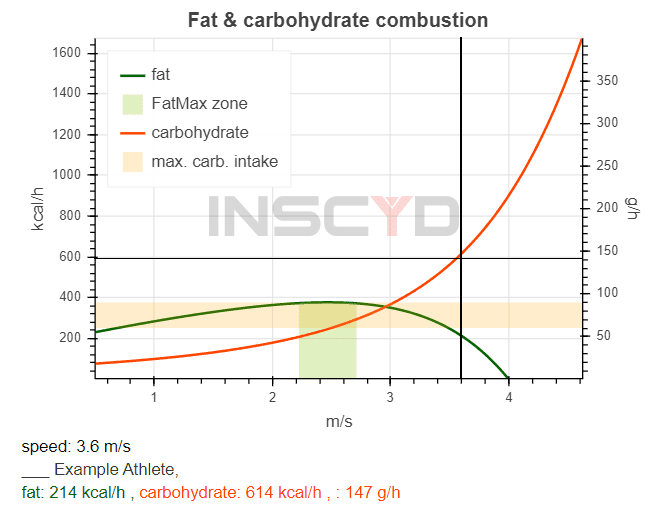
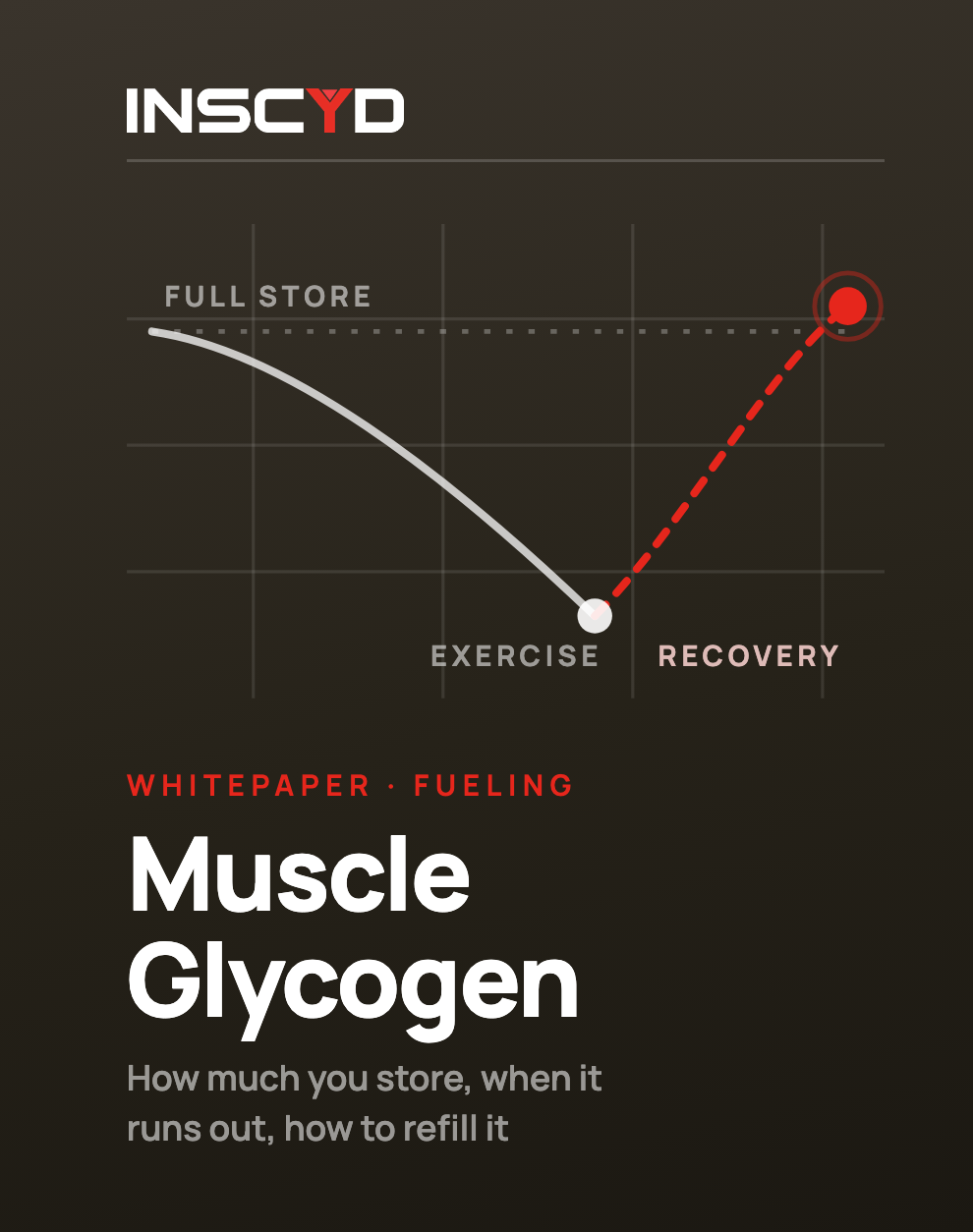
As said, one of your biggest challenges is to prevent carbohydrates from depleting. Luckily you have some carbohydrates stored in the muscle already. These carbohydrates are called glycogen. The INSCYD report tells you exactly how much glycogen you have stored in the body. For this example, let’s assume you have 350 grams of glycogen stored in the body. Now you can calculate how much carbohydrates you should consume to not deplete them:
Minimal carbohydrate intake = carbohydrates burned (478) – carbohydrates stored in the active muscle (350) = 128 grams in total. Minimal carbohydrate intake per hour = 128 grams in total ÷ 3 hours and 15 minutes ≈ 40 grams per hour.
Get 3 tips on how to go faster (regardless of your sport), without burning more carbohydrates. Download our whitepaper by filling in the form.
As long as you know your desired exercise intensity, you can now calculate your fueling plan. The same is true in power-based sports like cycling. Here’s a triathlon pacing and fueling use case that shows how this can remove insecurity and boost performance.
Now I hear you thinking: but what if I don’t know my exercise intensity yet? Let’s look at the other side of the coin, and let carbohydrate combustion rates determine our race pace!
The previous example assumed that you know the exercise intensity (race pace). If this is not the case, then we can easily determine that using the carbohydrate combustion rates.
That is because we do not only know the carbohydrate combustion rate, but we also know what the maximal amount of carbohydrate intake is. Download our whitepaper to get the 5 steps to calculate your race pace!
When checking out the whitepaper, notice that your race pace is not limited by your anaerobic threshold (FTP). In other words: your race pace intensity is below your threshold, in long endurance events.

Founder of INSCYD and creator of the first test to measure glycolytic power (VLamax) in 2003. His work in exercise physiology and metabolic profiling has helped WorldTour cyclists win 9 World Championship titles, Olympic medals, and Tour de France victories. Consults for German Swimming and Skiing Federations and USA Triathlon.
Fill the short form and the whitepaper lands in your inbox a minute later.
VO₂max, VLamax, FatMax, thresholds, fuel use and training zones, from a single test in the lab, in the field or fully remote.