
Metric · Carbohydrate Combustion Rate

The Carbohydrate Cost of Performance

Carbohydrate Combustion Rate describes how much carbohydrate an athlete utilizes to produce energy at a given exercise intensity. It can be expressed as grams of carbohydrate per hour or as the corresponding energy turnover in kilocalories per hour.

Because carbohydrate demand increases exponentially with intensity, the metric is best understood as a curve: power output or running speed on the x-axis and carbohydrate combustion on the y-axis.

Carbohydrate combustion

carbohydrate
5210015020025030033803006009001200150001002003001673.04399.77kcal/hg/h
Intensity - power/speed
Carbohydrate combustion in grams per hour against power output or running speed, for this athlete, in the software’s own chart. Demand rises steeply with intensity, which is why the metric is a whole curve and CarbMax is a single point on it, the intensity at which demand reaches 90 g/h.

Trusted by the teams and federations behind the best in sport

From national federations and Olympic programmes to WorldTour teams and professional clubs worldwide.

Why Carbohydrate Combustion Is a Key Endurance Metric

Carbohydrate Combustion Rate is one of the most important metabolic metrics for endurance performance because carbohydrate availability is limited in two regards:

The athlete starts with a finite amount of stored carbohydrate in the working muscle as glycogen.

Exogenous carbohydrates can only be supplied at a limited rate during exercise.

Carbohydrate Combustion Rate describes the demand side of this equation: how quickly that limited resource is being consumed at a given power output or speed.

Stores, supply and demand

exogenous supply90 g/hglycogen stores486 gdemand150 g/h
carbohydrate deficit per hour60 g/h
time to deplete glycogen stores8 h 06 min
90 g/h
150 g/h
Glycogen stores are a fixed bucket of 486 g. Set the exogenous supply and the demand to see the carbohydrate deficit per hour and the time until the glycogen stores are depleted.

Fueling competition decisive moments

Race-defining situations usually occur at high intensities: attacks, climbs, surges, changes of pace, high-speed running and finishing efforts. All of these need carbohydrates as a fuel.

The goal of carbohydrate sparing is therefore not to avoid using carbohydrate. It is to avoid spending more of a limited resource than necessary before the moments in which high carbohydrate turnover becomes essential.

Knowing the carbohydrate-combustion rate at any intensity enables you to manage combustion and fueling rate to preserve fuel for the high-intensity efforts that decide the competition.

Carbohydrate sparing means preserving the fuel required when performance matters most.

The expensive end of the curve

carbohydraterace-deciding intensities
5210015020025030033803006009001200150001002003001673.04399.77kcal/hg/hfuel spared hereattackclimbsurgefinish
Intensity - power/speed
With higher intensity, more carbohydrate is needed. Many competitions are a mix of intensities and therefore a mix of carbohydrate burn rates per hour.

Why Conventional testing makes it difficult to measure standardized Carbohydrate Combustion

Conventionally, carbohydrate combustion is estimated by indirect calorimetry. A metabolic cart measures oxygen uptake and carbon dioxide production, and carbohydrate oxidation is calculated from respiratory gas exchange.

The measured substrate-utilization response is sensitive to the athlete’s acute metabolic state. Recent nutrition, carbohydrate availability, insulin, stress and other acute conditions alter the measured carbohydrate combustion rates. This makes pre-test standardization essential when assessments are compared over time.

Reliable substrate assessment also requires an appropriate submaximal protocol with sufficiently long stages. A protocol designed around stable substrate measurements is not the same as a short maximal protocol optimized for VO₂max, and it does not directly determine VLamax.

This creates a diagnostic limitation: one test can be used to estimate the carbohydrate-combustion rate, but the major physiological factors that help explain that curve are not necessarily determined in the same protocol.

Measurement error adds another problem: recent CPET-system validation studies have shown common absolute errors of up to 99% in calculated energy from carbohydrate across 15 commercially available systems.
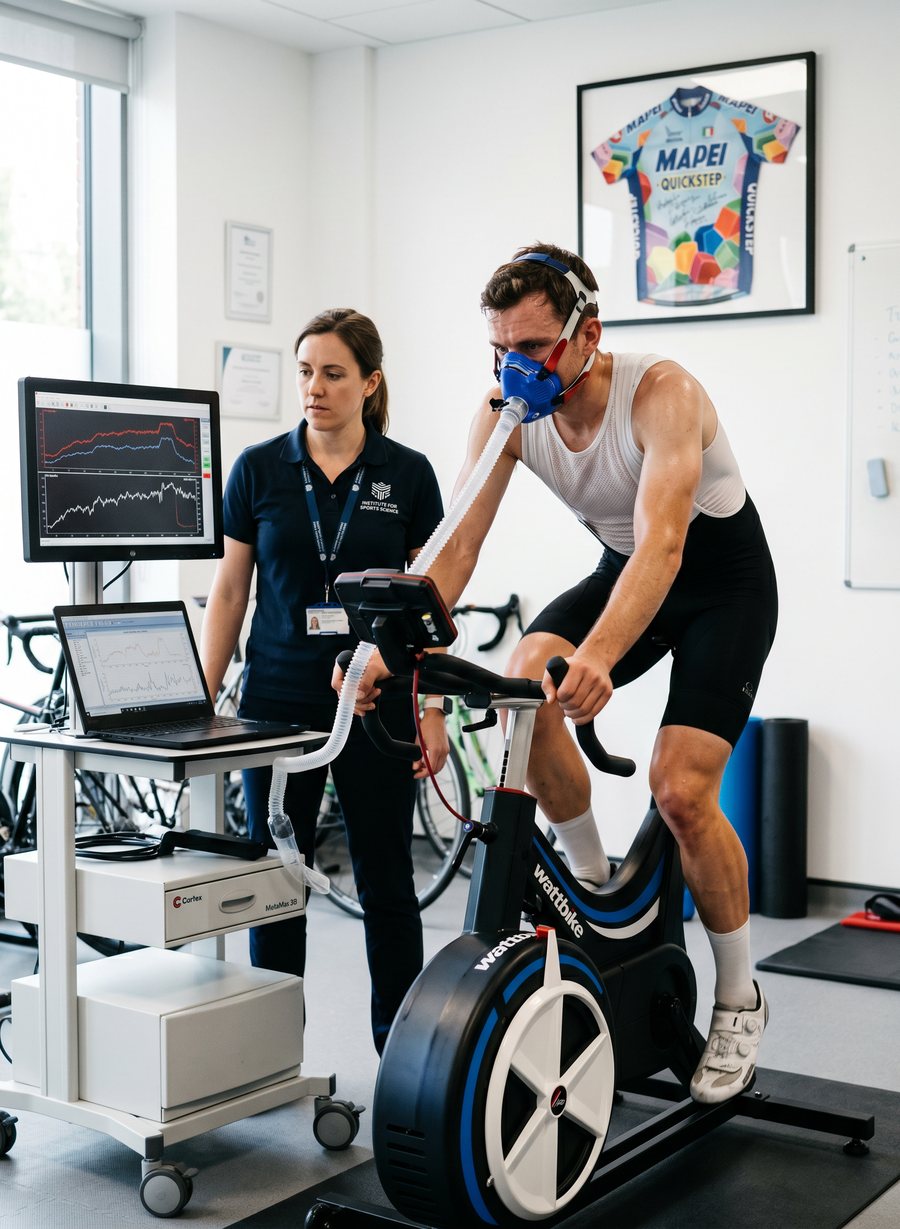
A conventional metabolic-cart test: athlete on a cycling ergometer wearing a metabolic mask connected to a gas analyzer
Calculated energy from carbohydrate5.52% – 99%absolute erroracross 15 CPET systems11 Van Hooren, Souren & Bongers, 2024
what the substrate protocol asks for
1
standardized nutrition
before the test
2
long submaximal stages
for stable gas exchange
3
respiratory exchange
carbohydrate calculated from it
not determined by this protocol
VO₂max and VLamax
a substrate protocol and a maximal protocol have different requirements, and VLamax needs separate information
A metabolic-cart substrate test asks for the three things in the first panel before carbohydrate can be calculated from gas exchange; the dashed panel underneath is what the same protocol does not determine. Standardization is the challenge rather than a proof that calorimetry is invalid, and the range on the photo is the reported spread across 15 systems.

Accurate Carbohydrate Combustion rates – but without a metabolic cart

INSCYD is known for its valid calculation of lactate production rates. As lactate production rate is proportional to carbohydrate combustion rates Rogatzki et al., 2015 it can therefore determine a carbohydrate combustion profile without making a metabolic cart a prerequisite.

Depending on the workflow, the assessment can be performed from a field or laboratory lactate test or from performance-based remote testing even without lactate sampling.

This removes the need for a dedicated gas-exchange substrate test and allows practitioners to integrate Carbohydrate Combustion Rate into testing workflows they already use.

Most importantly, the same assessment provides VO₂max and VLamax, the two metabolic characteristics needed to understand why carbohydrate demand is high or low and which mechanism may need to change through training.

One assessment only to measure how much carbohydrate the athlete burns, providing thresholds, VLamax and VO₂max at the same time, no metabolic cart required.

One assessment, the whole picture

what you already runwhat it returns
field lactate testlaboratory lactate testremote performance testoneassessmentcarbohydrate combustion curvefat combustion curveCarbMaxVO₂maxVLamaxAvailable Glycogen context
  • no spirometry prerequisite
  • no dedicated gas-exchange substrate protocol
  • multiple testing workflows
  • determinants in the same assessment
Any one of the three tests on the left feeds a single assessment, and the six results on the right all come out of it, including the two determinants that explain the curve. The defensible benefits are lower equipment dependency and workflow integration; this is not a claim of lower measurement error than indirect calorimetry.
Every metric that matters

One assessment. The complete picture of your athlete’s physiology.

VO₂max, VLamax, FatMax, thresholds, fuel use and training zones, from a single test in the lab, in the field or fully remote.