
Metric · Fat Combustion Rate

How Much Fat is burned?

Fat Combustion Rate describes the rate at which an athlete uses fat to produce energy at a given exercise intensity. It can be expressed as kilocalories per hour or per minute.

Because the rate changes with exercise intensity, Fat Combustion Rate is best understood as a curve: as power output or running speed increases, so does fat combustion rate. But when intensity increases further the fat combustion rate plateaus and then decreases.

Fat combustion across intensity

fat combustionFatMax
521001502002503003380300600900120015001673.04kcal/hMFO 459 kcal/hFatMax 186 W
Intensity - power/speed
Fat combustion in kilocalories per hour against power output or running speed, for this athlete, in the software’s own chart. The rate climbs, peaks at 459 kcal/h and then falls away, which is why the metric is the whole curve and FatMax is a single point on it, the intensity where that peak sits at 186 W.

Trusted by the teams and federations behind the best in sport

From national federations and Olympic programmes to WorldTour teams and professional clubs worldwide.

The other side of the Fat Combustion coin: Carbohydrate Sparing

Fat Combustion Rate is not primarily a direct performance metric. It tells you how much of the athlete’s energy demand can be supplied from fat and therefore how much carbohydrate does not have to be supplied at the same total energy demand.

This matters because fat stores are large, while available carbohydrate, both storage and consumption during exercise, is limited. At a given race intensity, a higher contribution from fat means a lower carbohydrate requirement and therefore saving glycogen for race decisive moments.

The performance value of fat combustion is carbohydrate sparing: fat combustion rates show how much of the energy bill can be paid without spending the athlete’s limited carbohydrate reserve.

Higher fat combustion, lower carbohydrate combustion

fat combustioncarbohydrate combustionat a higher fat combustion rate
5210015020025030033803006009001200150001002003001673.04399.77kcal/hg/hmore fatless carbohydrate
Intensity - power/speed

For a given glycogen store size, more fat combustion means sparing glycogen. Explore Available Glycogen

The result of a higher fat combustion rate is a lower carbohydrate combustion rate: the dotted curves are the same athlete burning more fat, and the shaded band is the carbohydrate this spares.

Training at High Fat Combustion Rates?

Training at intensities of high fat combustion gives coaches a physiological target for low-intensity endurance training rather than relying only on generic percentages of heart rate, thresholds or VO₂max.

The scientific evidence shows that training around FatMax can improve fat oxidation, body composition and reduce body fat through a reduction of fat mass.

There is also an important metabolic reason why high fat combustion is interesting for aerobic training: producing energy from fat requires more oxygen than producing the same amount of energy from carbohydrate. At the same external workload, a greater reliance on fat therefore comes with a higher oxygen requirement, providing a greater aerobic training stimulus.

More fat combustion, more oxygen uptake

fat combustion rateoxygen uptakeat a higher fat combustion rate
521001502002503003380300600900120015001673.04kcal/h015304560ml/min/kgtraining intensity at FatMaxoxygen uptake12× magnified36.136.4
Intensity - power/speed
fat combustion at that intensity459 to 535 kcal/h
oxygen uptake at that intensity36.1 to 36.4 ml/min/kg
At the same training intensity, a higher fat combustion rate comes with a higher oxygen uptake. The difference is small against the scale of the chart, so the circle shows that one point magnified.

Conventional Measurement: Why Fat Combustion Is Difficult to Test

Conventionally, the fat-combustion curve is estimated with indirect calorimetry. A metabolic cart measures oxygen uptake and carbon dioxide production during a graded exercise test, and substrate oxidation is calculated from these respiratory measurements.

The problem is that fat combustion is highly sensitive to recent nutrition and carbohydrate availability, insulin, stress hormones and other factors. This makes pre-test standardization of pinnacle importance. Furthermore the protocol also requires sufficiently long submaximal stages of at least five-minute load increments.

That creates a diagnostic trade-off. A protocol optimized for stable substrate measurements is not suitable to measure a valid VO₂max, leave alone VLamax. As a result, conventional diagnostics do require different tests or additional testing time to measure the fat-combustion curve and the physiological factors that determine it.

There is also a measurement-accuracy problem: latest scientific findings indicate that measuring fat combustion rates in labs using metabolic carts has absolute errors of up to 133 per cent across 15 commercially available CPET systems.

A mask and a metabolic cart do not automatically make fat-combustion data precise. Nutrition, protocol design and measurement accuracy all affect the result.
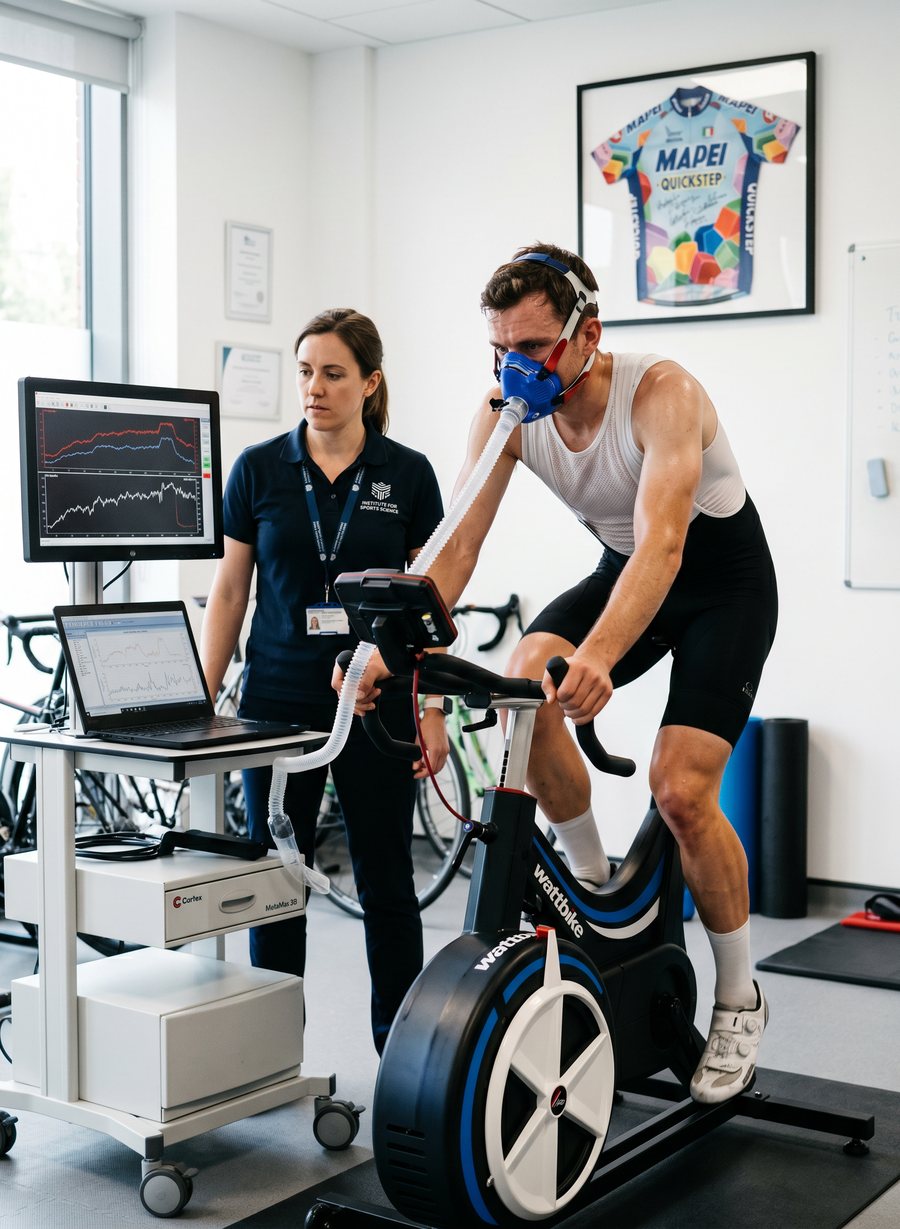
A conventional metabolic-cart test: an athlete on a cycling ergometer wearing a metabolic mask connected to a gas analyzer
Calculated energy from fat5.13% – 133%absolute erroracross 15 CPET systems11 Van Hooren, Souren & Bongers, 2024
what each measurement asks of the protocolfat combustion ratethe substrate protocolfive-minute stages or longerstandardized nutrition before the testsubmaximal throughoutVO₂maxa different protocola maximal effort, short stages or a rampVLamaxa different protocol againa short all-out sprint, with recovery before it
The mask and the cart are the measurement; the callout is the reported spread for calculated energy from fat across 15 systems. Below it, the same test asked three ways: the substrate protocol wants long submaximal stages and a standardized meal beforehand, VO₂max wants a maximal effort, and VLamax wants a short sprint. One session cannot be optimal for all three, which is what turns into extra testing time.

Fat Combustion - Without a metabolic cart

As explained above, the fat combustion rate is directly influenced by the carbohydrate combustion rates and vice versa. Carbohydrate utilization is proportional to lactate production. Therefore it is possible to calculate fat combustion rates from total energy and deducting the energy derived from carbohydrates.

As this can be done using simple field or lab lactate testing, or even tests done remotely just using GPS or power data, this removes the need for a dedicated indirect-calorimetry protocol and the equipment overhead associated with a metabolic cart. Instead of buying and maintaining a spirometry system solely to obtain substrate-utilization data, practitioners can integrate Fat Combustion Rate into testing workflows they already use.

Most importantly, the same assessment also provides the physiological context behind the curve, including VO₂max and VLamax. Instead of receiving only the result, how much fat the athlete burns, the practitioner can also see which part of the metabolic profile may need to change to improve it.

One assessment. The fat-combustion curve, its major metabolic determinants and the related performance metrics, without requiring a separate spirometry test.

One assessment, the whole picture

what you already runwhat it returns
field lactate testlaboratory lactate testremote performance testoneassessmentfat combustion curvecarbohydrate combustion curveFatMaxVO₂maxVLamax
  • no spirometry prerequisite
  • lower equipment overhead
  • no dedicated gas-exchange FatMax protocol
  • metabolic determinants in the same assessment
Any one of the three tests on the left feeds a single assessment, and the five results on the right all come out of it, including the two determinants that explain the curve. The defensible benefits are lower equipment dependency and workflow integration; this is not a claim of lower measurement error than indirect calorimetry.

From Measurement to Action

A fat-combustion curve is useful. Knowing why the curve looks the way it does is more useful.

By combining Fat Combustion Rate with VO₂max, VLamax, FatMax, Carbohydrate Combustion Rate, CarbMax and Available Glycogen, the assessment moves from description to intervention: it shows the current metabolic outcome and provides the context needed to decide what to train.

This is the difference between measuring fat combustion and understanding it.

What moves the fat combustion curve

fat combustionas measured
521001502002503003380300600900120015001673.04kcal/hpeak 459 kcal/h at 186 W
Intensity - power/speed
0.52 mmol/l/s
60.2 ml/min/kg
12.8 ml/min/W
Change VLamax, VO₂max or economy and the fat combustion curve changes with it. The dotted line is the curve as measured.
Every metric that matters

One assessment. The complete picture of your athlete’s physiology.

VO₂max, VLamax, FatMax, thresholds, fuel use and training zones, from a single test in the lab, in the field or fully remote.