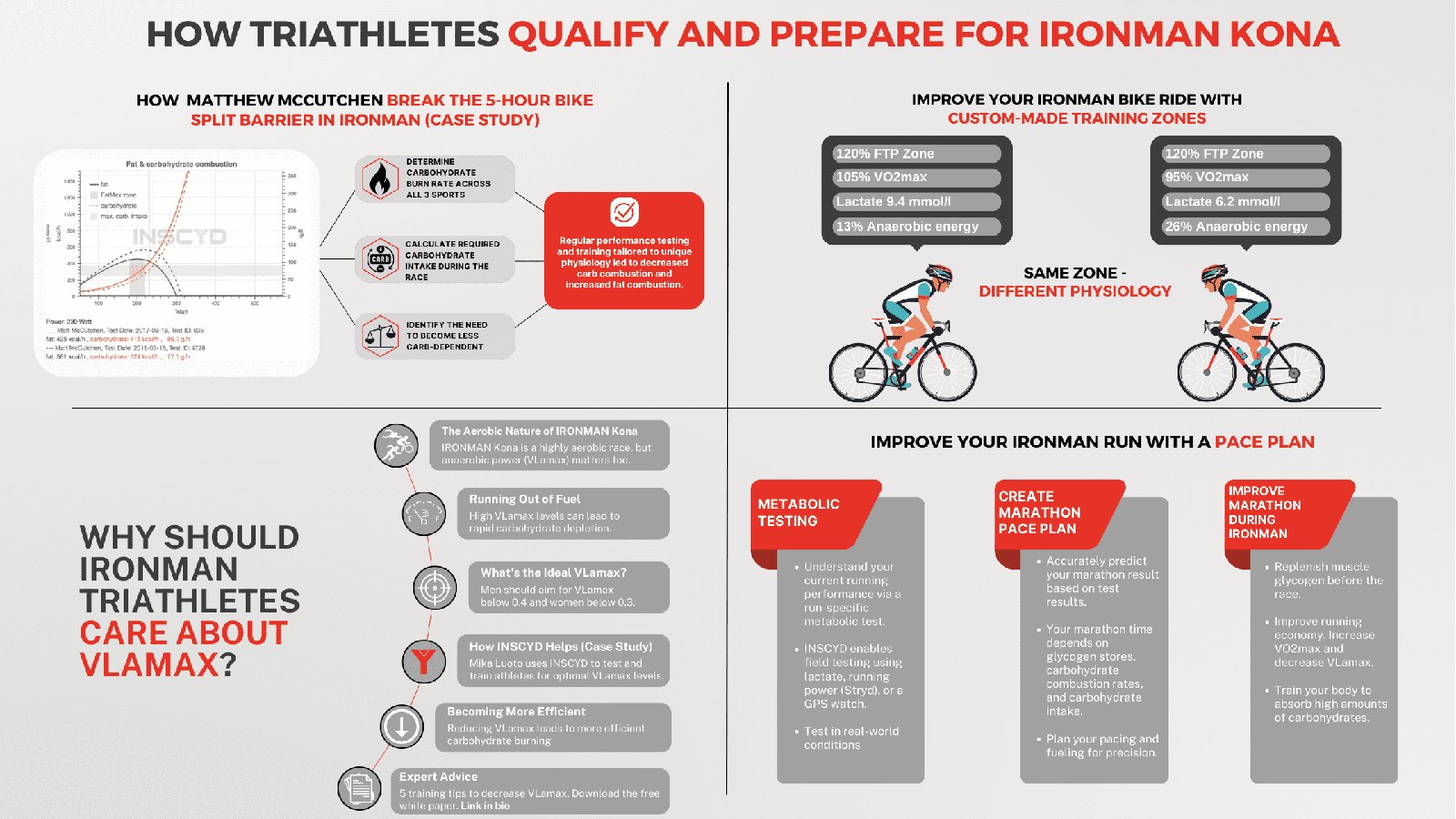
Training tips and metabolic strategies from INSCYD athletes and coaches who qualified for IRONMAN Kona, covering swim, bike, and run preparation, pacing, fueling, and how to use physiological testing for race-day execution.
Many INSCYD athletes and coaches qualified and prepared for IRONMAN Kona, Hawaii. In this article we bundle their tips and tricks.
Let’s start with training tips that increase the performance in all 3 disciplines. We then look at sport specific tips and finish with proven training methods to qualify and prepare for IRONMAN Kona, Hawaii.
Triathletes who consume more carbohydrates during IRONMAN Kona (Hawaii), finish significantly faster. That is because fuel or energy intake is an important performance limiting factor in all sport events that last several hours.

Correlation between finishing time and carbohydrate intake rate during IRONMAN Kona, Hawaii (r = -0.55, P < 0.001). The more carbohydrates you consume, the faster you finish. (source).
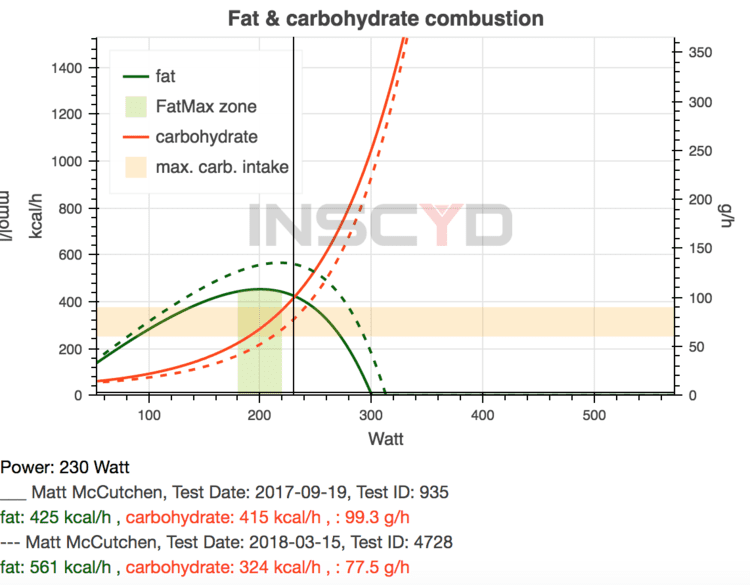
Seeing the importance of balancing energy demand and energy intake, is exactly what helped INSCYD athlete Matthew McCutchen to break the 5-hour bike split barrier during his previous IRONMAN.

With the INSCYD fat & carbohydrate combustion graph, he and his coach learned:
With regular performance testing and effective training based on his unique physiology, he managed to decrease his carb combustion and increase his fat combustion.
Read the full user story from IRONMAN triathlete McCutchen or learn more about how carbohydrate combustion determines your fueling and pacing during IRONMAN Kona.
Want some advice from a coach who helped 8 athletes to qualify and prepare for the IRONMAN World Championships in Kona, Hawaii? Jean-Christophe says, almost all age-groupers need to work on increasing their VO2max and FatMax.
This makes total sense, if you acknowledge that an increase in VO2max:
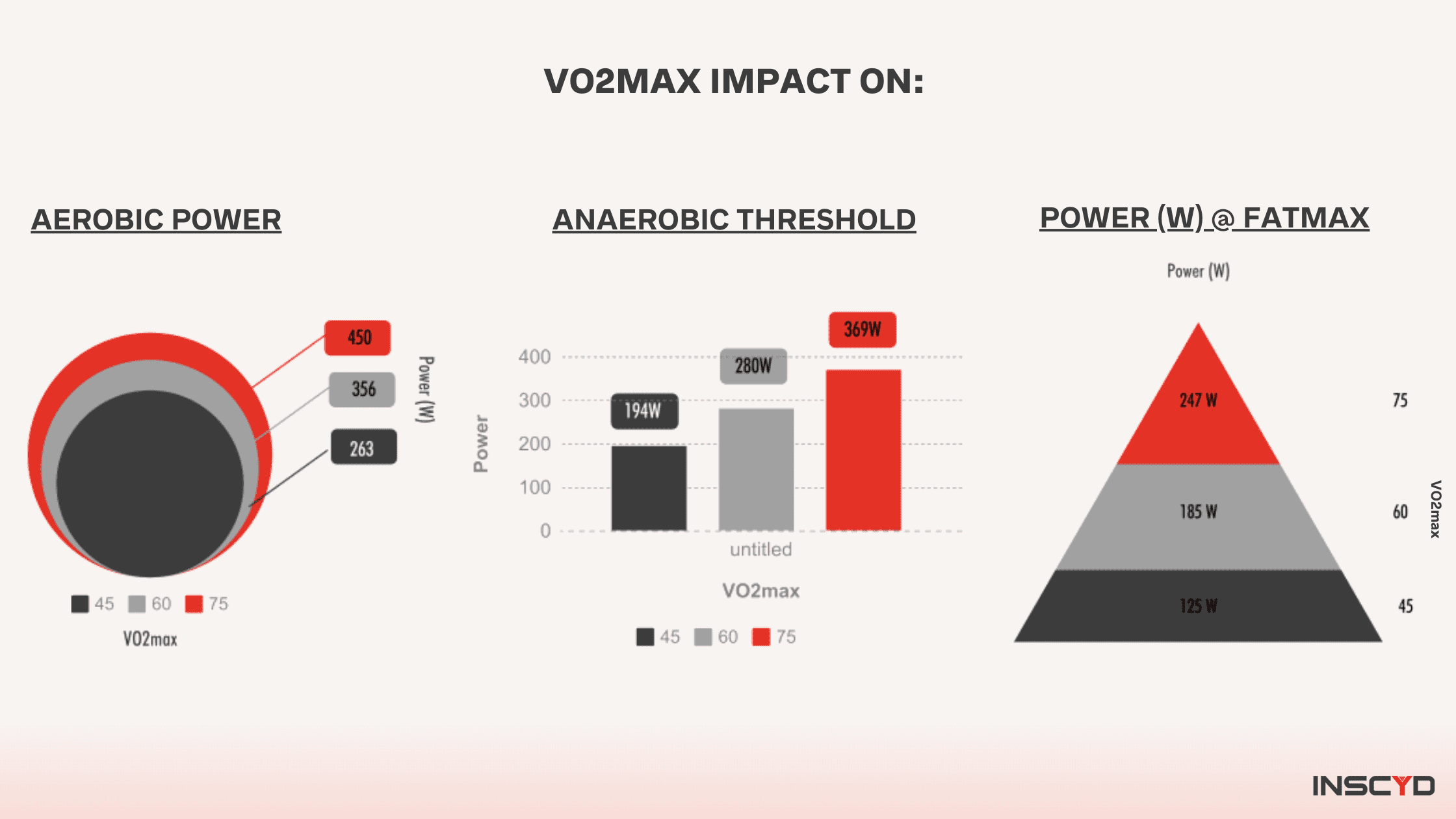
All these parameters play a huge role in your IRONMAN Kona race.
For INSCYD coach Jo Spindler this is why he emphasises on increasing VO2max so much. His athlete, Salim Mohammed, increased VO2max from 49 to 55.5 ml/kg/min, which almost proportionally increased his age group ranking. The result? A 4th position in his age group and a slot for the IRONMAN World Championships in Kona, Hawaii.
Here’s how every small increase in VO2max increases your performance:
In the book Der KONA Code, Sebastian Weber shares that men who participate in IRONMAN Kona (age: 30-55) probably range between 70-55 ml/min/kg VO2max, while women have values that are 10-15 ml/min/kg lower.
A popular way to increase VO2max is VO2max intervals. But most athletes use the wrong intensity for these intervals. Receive the steps to determine your individual VO2max interval intensity via the form below. And don’t forget to regularly do performance test for your VO2max to check whether your training program is effective.

The IRONMAN Kona is a highly aerobic race, so why care about your anaerobic power (VLamax)? Well, because you’re going to run out of fuel if your VLamax is too high. Here’s why:
In the book Der KONA Code, Sebastian Weber shares that ideally, men have a VLamax below 0.4 and women have a VLamax below 0.3.
As soon as Mika Luoto – coach at the Finnish Triathlon Association and 5 time IRONMAN Kona professional participant – learned about VLamax, he started using INSCYD to test his athletes. He found that some triathletes had a VLamax that was way too high, especially if they participated in longer half IRONMAN or full IRONMAN races.
Mika Luoto:
“If they have a high VLamax, we have to try to reduce it so they become more efficient by burning less carbohydrate.”
Read the full user story of Mika Luoto: Finnish triathlon association coach Mika Luoto talks INSCYD.
Given the importance of VLamax in long distance triathlons, it is no surprise that one of the most popular articles among triathletes is: 5 training tips to decrease VLamax.
INSCYD revolutionizes the way coaches prepare athletes for IRONMAN Kona and other events. INSCYD offers actionable insights that can be game-changers for your coaching strategy, leading to better athlete performance.
Fueling Strategies: With INSCYD’s fat & carbohydrate combustion graph, you can tailor nutrition and training down to the last detail, ensuring peak performance when it matters most.
Data-Driven Decisions: Make your coaching decisions based on science, not gut feeling. INSCYD’s comprehensive analytics give you the confidence to make the right call every time.
Precision Training: Understand crucial performance metrics to tailor training programs that work.
Monitor Improvements: Keep track of your athletes’ progress and make data-driven decisions to ensure they are on the right path to success.
Personalized Training Plans: Every athlete is unique. INSCYD allows you to customize training based on individual physiology, just like Matthew McCutchen did to break his 5-hour bike split barrier.
But that's just the tip of the iceberg. Don't let your athletes settle for anything less than their absolute best. Book a Free Demo with INSCYD today and experience firsthand how you can elevate your coaching game.
The IRONMAN Kona swim must be finished by 2 hours and 20 minutes to finish under the cut-off time. However, many triathletes want to break the one hour in the IRONMAN swim.
To increase your swimming performance, you should first understand your current swim performance and the limiting factors. A swim specific performance test is the best way to gain these insights. INSCYD allows you to easily perform such a test with either lactate samples or a (mobile) VO2 analyzer. Learn more about the swim specific performance test.

This swimming case study walks you through some interesting insights that you’ll get from such a test. It also shows the importance of knowing your swim VLamax.
One of the metrics of your metabolic profile is your swimming economy.
Improving your swim economy is an effective way to improve your swim performance. It enables you to swim faster with the same amount of energy. For many age groupers, this is a more effective way to improve swim performance than trying to increase VO2max.
Fun fact: the lower your VO2max, the more effective an increase in swimming economy becomes.
The IRONMAN Kona swim is rarely a wetsuit-legal swim, due to the warm water. As a result, you need to improve your swimming technique to improve economy. The only way to do that is by regularly testing your swimming economy, while trying to increase it with training.
In the book Der KONA Code, Sebastian Weber says that the goal should be to have an oxygen demand below 38 ml/min/kg per m/s swimming speed.
Learn more about measuring swimming performance via our webinar:
If you have a power meter on your bike, you’re able to train very precisely.
However, many triathletes who try to qualify for IRONMAN Kona, still base their training (zones) on a percentage of Functional Threshold Power (FTP). This leaves room for improvement, because what happens in the body at say 120% FTP is not the same for two athletes. Hence, the training stimulus is different.
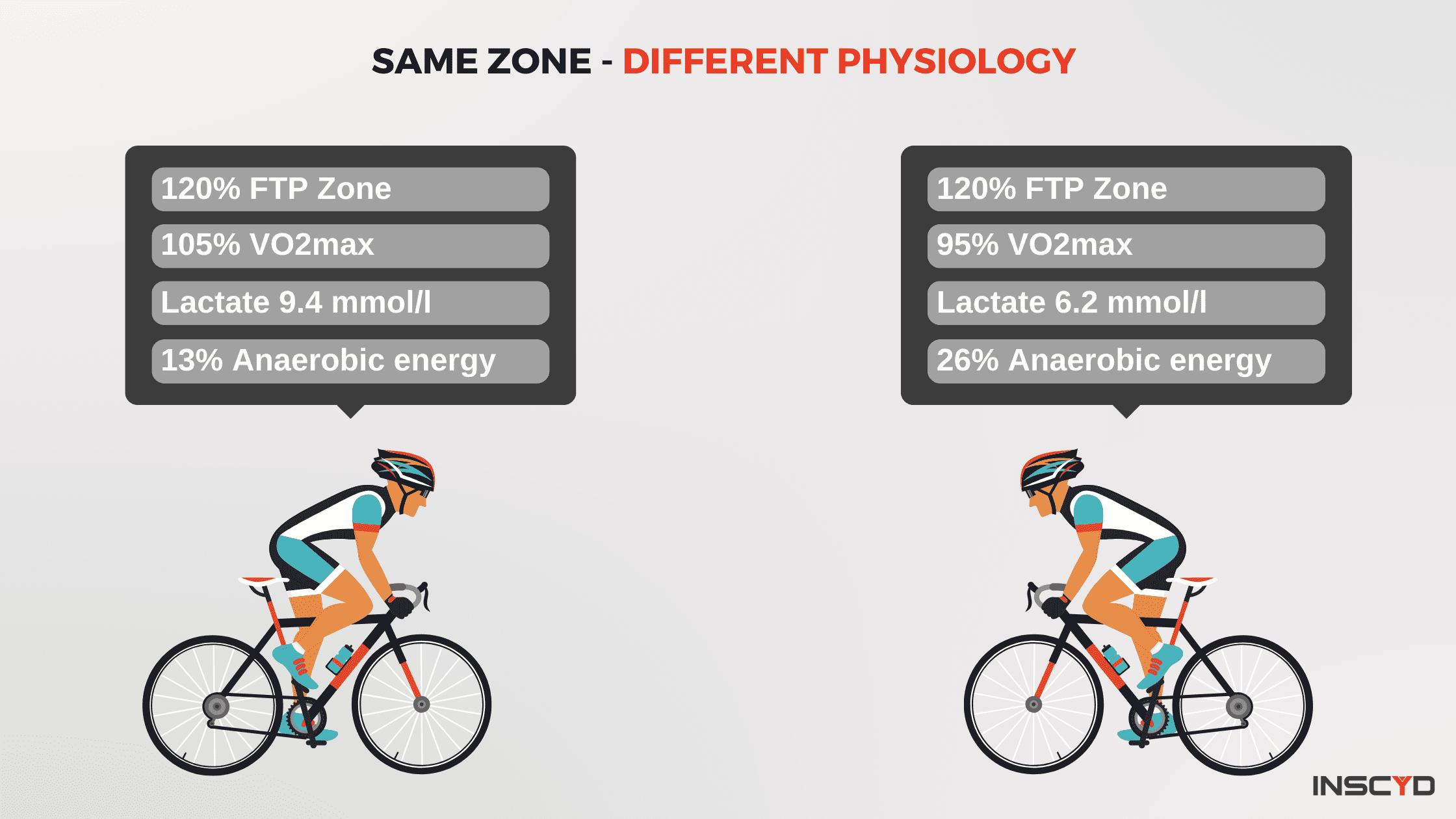
If you switch from %FTP training zones to training zones that are based on physiological metrics, you’re able to train more effectively. This enabled INSCYD athlete Ralf Schön to qualify for KONA multiple times, with only 12 hours of training per week in total.
Ralf uses INSCYD’s highly individual training zones, that are based on physiological metrics.
For instance:
For each zone, you can add additional physiological metrics like fat and carbohydrate combustion rates (g/h and kcal/h) and energy distribution (%aerobic vs %anaerobic).
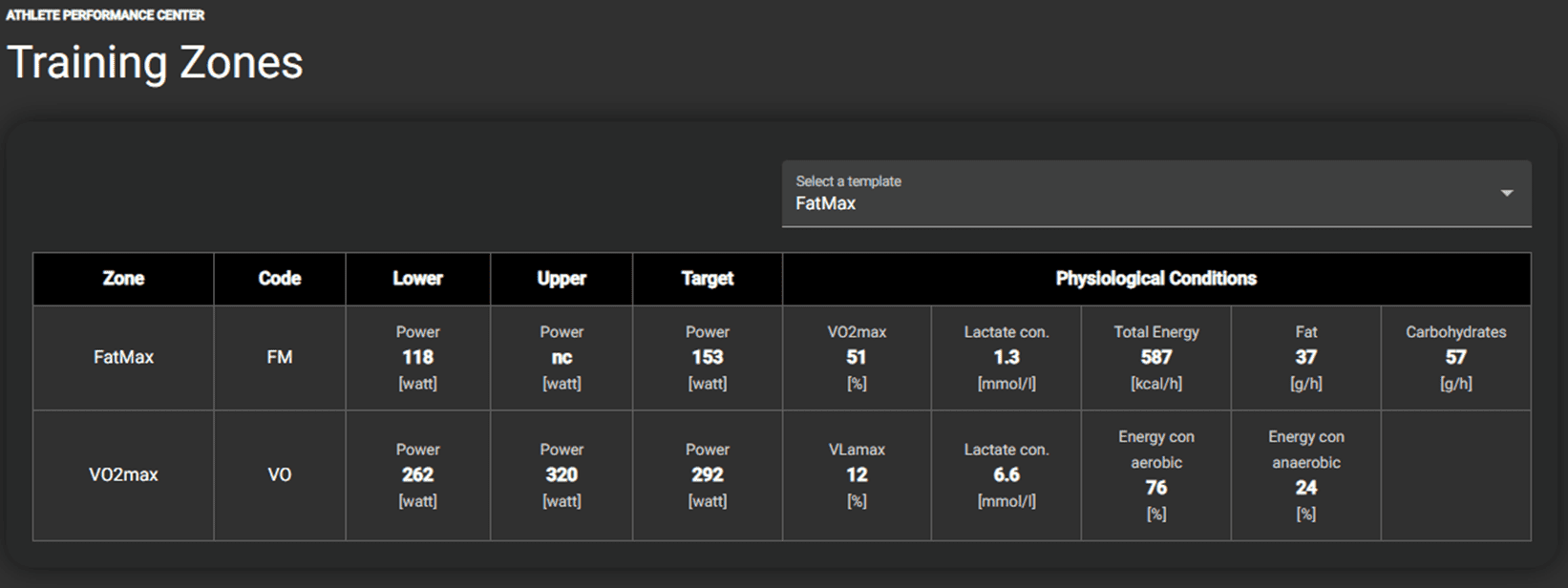
Ralf says that these spot-on training zones ensured he never got overtrained and always peaked right at the day of the IRONMAN Kona qualification. “This can only be done if you know exactly your zones”, says Ralf. Read his full story.
Getting these training zones, based on your metabolic profile, is easy. It doesn’t require a lab test. You only need your power meter. That’s why the coach of the Finnish Triathlon Association and 5 time IRONMAN Kona professional participant – Mika Luoto – uses these INSCYD power-only tests with his athletes.
Mika Luoto:
“When comparing to traditional lab tests, the cycling power-only test is much easier to do. You don’t have to book the lab weeks before and therefore you can do the test when you feel that you have to do it. As a result, we can do this test more often and easier.”
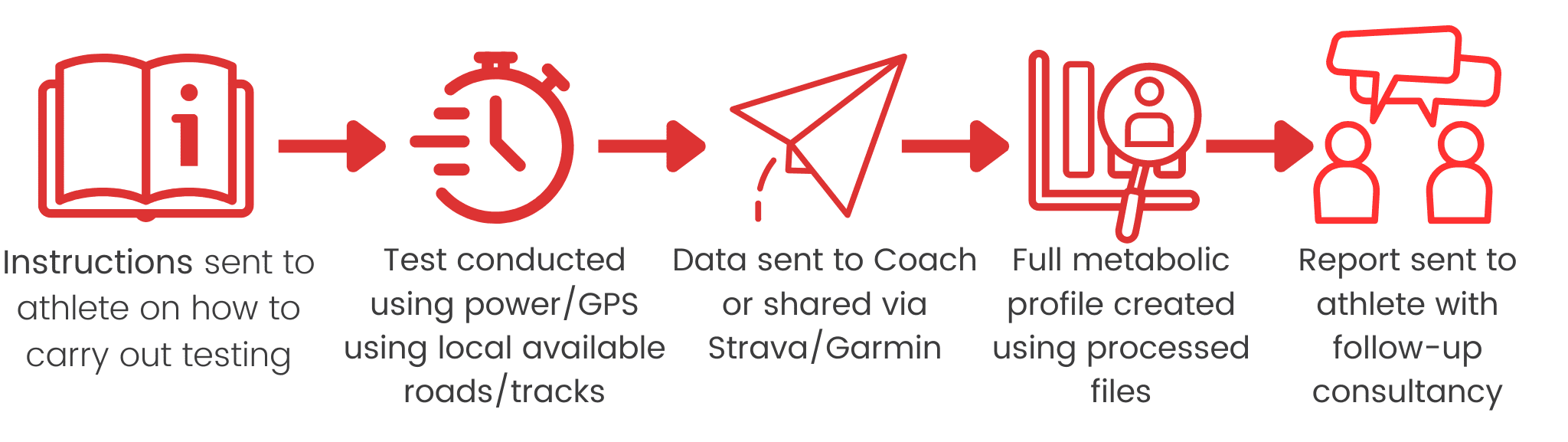
Learn more about the power-only bike test or dive into the possibilities of highly individual training zones.

If you want to finish your IRONMAN Kona strong, you need an ambitious but realistic running pace. The marathon is obviously too long to just pick a pace and “see where it takes you”.
Runner Bernat Xamena learned that the hard way. He started his marathon too fast, didn’t have a proper nutrition plan and blew up after km 30. Luckily he met INSCYD triathlon coach Joseph Spindler afterwards, and came back much stronger.
Here’s a quick overview of the steps previous IRONMAN Kona participants took to run their best marathon during IRONMAN Kona:
Understand your current running performance via a run-specific metabolic test. INSCYD enables you to do field testing, using lactate, running power (Stryd) or a GPS watch only. Similar to the power-only bike test, it’s easy to perform these tests on a regular basis to track progress.
You can also choose to do a lab test with spiroergometry.
INSCYD coach Jo Spindler about the INSCYD test:
“With the INSCYD test results I was able to say at what pace Bernat Xamena was able to run the marathon without running out of energy. We did the test on a track. That’s the beauty of INSCYD: you can test in real-world conditions.”
With the test results you can accurately predict your marathon result during IRONMAN Kona. Your marathon time depends on:
INSCYD coach Jo Spindler about the marathon of Bernat Xamena after doing an INSCYD test:
“I looked at how many carbs Bernat would burn to sustain a certain speed according to the INSCYD Fat and Carbohydrate chart. We planned his pacing and fueling based on this information. He then ran a marathon with the precision of a Swiss clock.”
Learn more about pacing and fueling during a marathon:
You can watch the full webinar Break your marathon PR – using science based pacing & fueling here:
Now if you’re happy with your predicted IRONMAN marathon time and fueling plan, you’re done. If not, here’s how to improve it:
We’ve learned the 3 factors that predict your marathon time. Successful IRONMAN Kona triathletes improve their marathon by working on these 3 factors.
Carb intake: train your body to absorb high amounts of carbohydrates and make sure you consume enough carbs during training and racing.
Continue learning via our free webinar about uncommon ways to improve your triathlon performance:
From swim-specific tests that help you break the one-hour barrier to custom-made bike training zones that let you qualify for KONA on just 12 hours of training per week, INSCYD offers a holistic, science-based approach to triathlon training.
Swim Smarter: Understand your athletes swim economy and VLamax to optimize their swim performance.
Bike More Effectively: Use power-only tests to get highly individualized training zones based on athlete’s physiological metrics.
Run with Precision: Create a marathon pace plan that ensures your athlete’s finish strong, without running out of energy.
Coaches and labs don't miss out on the game-changing insights that have already helped countless coaches. Secure your competitive edge now—spots for our FREE INSCYD demo are filling up fast!
We talked about some specific goals every IRONMAN triathlete should aim for. Eventually you put these methods into a training plan.
It’s never a good idea to simply copy paste someone else’s training program. All successful IRONMAN triathletes base their training program on their individual athletic profile.
However, it can still be educational and inspiring to look at the training methods used by elite IRONMAN Kona participants. Here are 3 well known training methods for triathletes:
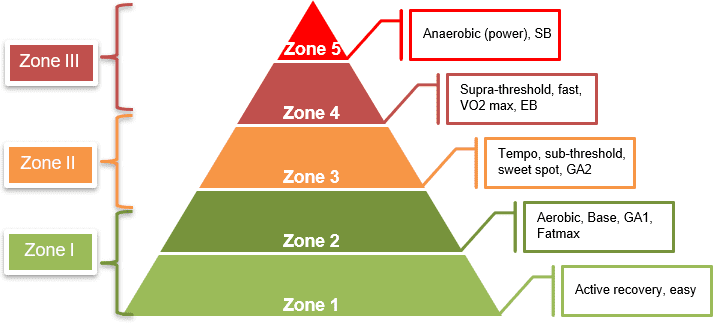
Pyramidal training is a good example of a training method that is often used by long distance triathletes. You spend most of the time at low intensities, a significant amount at medium intensities, and only a small portion at high intensities.
Learn more about pyramidal training for endurance athletes.

Polarized training became very popular when science showed that most endurance athletes use this training method. Contrary to pyramidal training, polarized training “skips” training at medium intensities. This leaves you with a big portion of low intensity training (roughly 80%) and a small portion of high intensity training (roughly 20%).
Learn more about polarized training and its training zones.
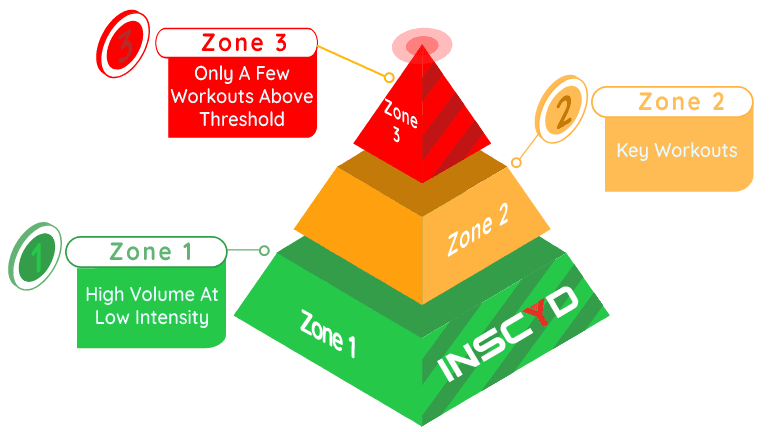
The Norwegian Method is a triathlon specific training method, used by IRONMAN Kona (Hawaii) winners Kristian Blummenfelt and Gustav Iden.
It’s a training method that highly relies on the athlete’s individual metabolic profile. By controlling training intensity in a very precise way, the Norwegian Method aims for specific training adaptations.
IRONMAN Hawaii winner Gustav Iden about the Norwegian Method:
“If Kristian Blummenfelt and I train exactly the same, I get more explosive while Kristian trends into a different direction. So we do metabolic tests to see where we are at.”
Learn more about the theory and application of the Norwegian training method.
You’ve just delved deep into the science and strategies that have propelled athletes to the pinnacle of IRONMAN Kona success. This isn’t just theory; it’s a proven roadmap.
“INSCYD enables coaches to find that missing piece in training, to understand what is going on in the athlete's body and get the best out of them.”
“INSCYD goes beyond power analysis and allows us to see what happens in the body on metabolic level at every type of intensity.”
“I am convinced by the effectiveness of INSCYD to improve performance – it has proven to be a very powerful tool for us.”
“INSCYD enables us to take real-world data from testing & training. This saves us time and effort, and refines the quality of our job.”
“INSCYD helps me to make sure that we make the best possible training program.”
“INSCYD enables us to precisely capture key performance metrics of the energy metabolism of our swimmers”

“Thanks to INSCYD, my trainer and I always know where I currently stand and where I can improve my performance.”
“The INSCYD test opened my mind to an entirely new world of training and racing.”
“INSCYD testing helps my coaches to create the best training programs for us.”
“The more we can understand how an athlete does what they are capable of doing, the better we can focus on what they need to do to get better. This is why I am happy to partner with INSCYD.”

“INSCYD looks inside the muscle and body in order to understand what’s happening based on a very limited number of measurements.”
Now, it’s your turn to join the elite circle of coaches who are transforming the world of triathlon training. This is your exclusive invitation to experience the game-changing power of INSCYD.
Why INSCYD is the Ultimate Game-Changer for Coaches and Labs:
Your competitors are already levelling up their coaching strategies. Can you afford to be left behind?
Don’t Miss Out! Our Free Demo Spots Are Filling Up Fast—Secure Yours Now and Transform Your Coaching Forever.
Learn more about the details from INSCYD athletes and coaches who participated in IRONMANs.
VO₂max, VLamax, FatMax, thresholds, fuel use and training zones, from a single test in the lab, in the field or fully remote.

