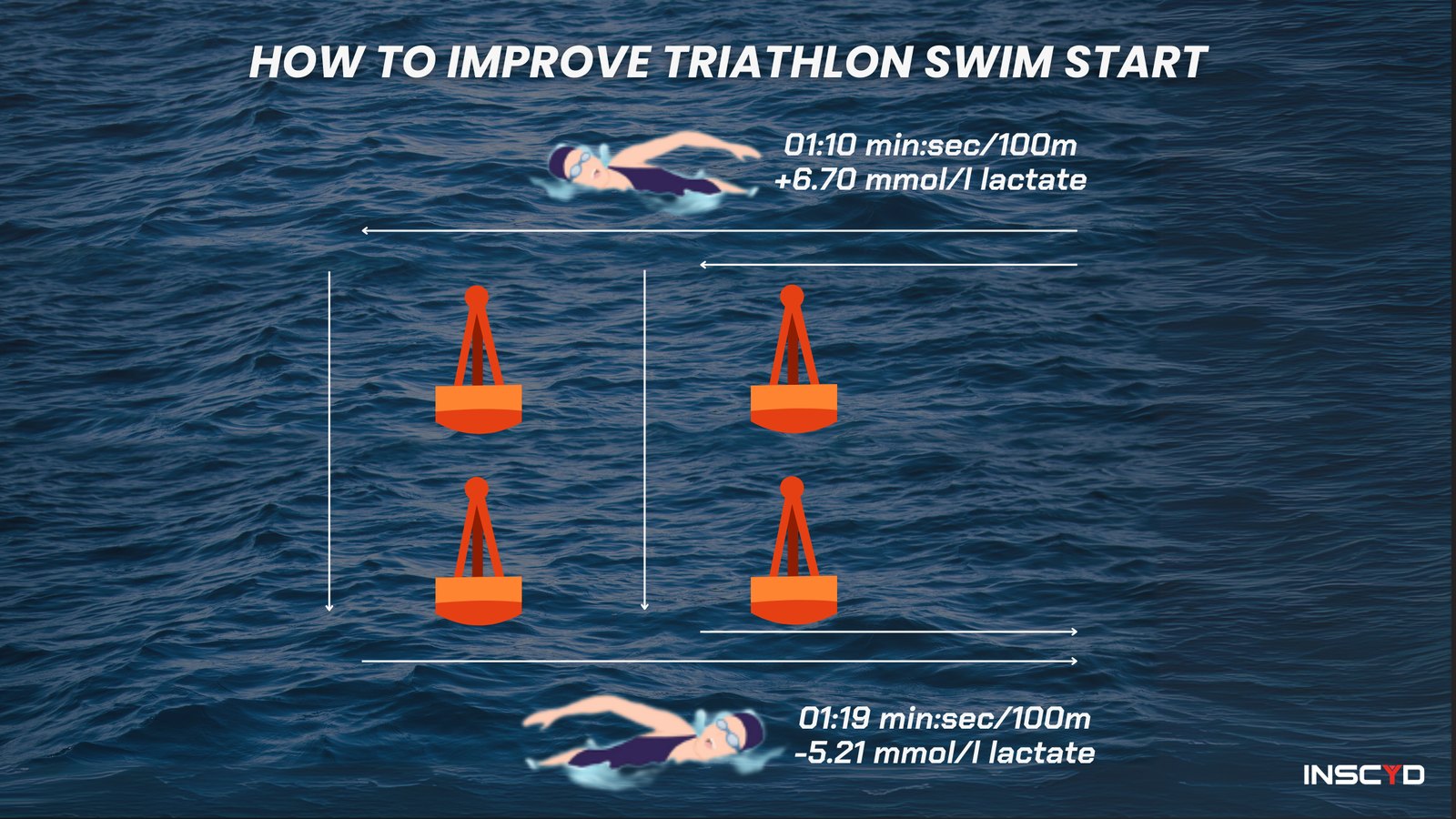
The triathlon swim start triggers a glycolytic surge that depletes carbohydrates and sets lactate levels for the entire race. Understanding each athlete's metabolic response enables better pacing and race-day performance.
Triathlons are not won while swimming, but can easily be lost in the swim. By understanding your athlete’s physiological response, you learn how to tackle the swim and what to do in training. This boosts confidence and performance, which unlocks race benefits you and your athletes never knew existed. BONUS: Olympic Triathlon Paris use case.
Are your athletes looking forward to the swim, or would they rather skip it?
Many triathletes are unnecessarily insecure about the swim. They hope to find the right pace and start strong, but fear to have a bad swim performance and play catch-up all day. This results in pre-race anxiety. After all, a bad start can ruin the race fun, confidence and performance for the rest of the day (and beyond).
You’ve completed many training hours, some at the expense of social and family life. You’ve invested money in a wetsuit, running shoes and a time trial bike upgrade. You carefully tracked your training progress with a power meter and looked at your smart watch data a little more often than your friends and family would prefer. After listening to several podcasts and reading multiple articles, you experimented with sports nutrition brands to see what works best for you.
An easy to perform metabolic swim profile can solve many issues.
This metabolic profile shows how your athlete’s body generates energy during the swim. It answers questions like:
As we’ll discover in the use case below, this information allows us to rely on their strengths.
As we’ve seen during the women’s Olympic triathlon in Paris, podium triathletes often come from the first or second swim pack and swim in the top 15 at the first buoy. By doing so, they enjoy benefits which you never knew existed:
With these benefits, you set the stage for a successful triathlon. Here’s what you need to do to gain them:
In this first step, we are determining the metabolic (physiologic) behavior of an athlete in the swim. It’s the result of the athlete’s metabolic profile and the pacing strategy in the swim course.
In our use case, we explore how the coach of an elite female triathlete prepared her for the Olympic triathlon in Paris 2024.
Our elite female triathlete’s coach created a swim specific metabolic profile, using the INSCYD performance software. One part of the metabolic profile reveals her Physiological Performance Benchmarks, like VO2max (aerobic power), VLamax (anaerobic power) and Anaerobic Threshold. It also includes body composition metrics.
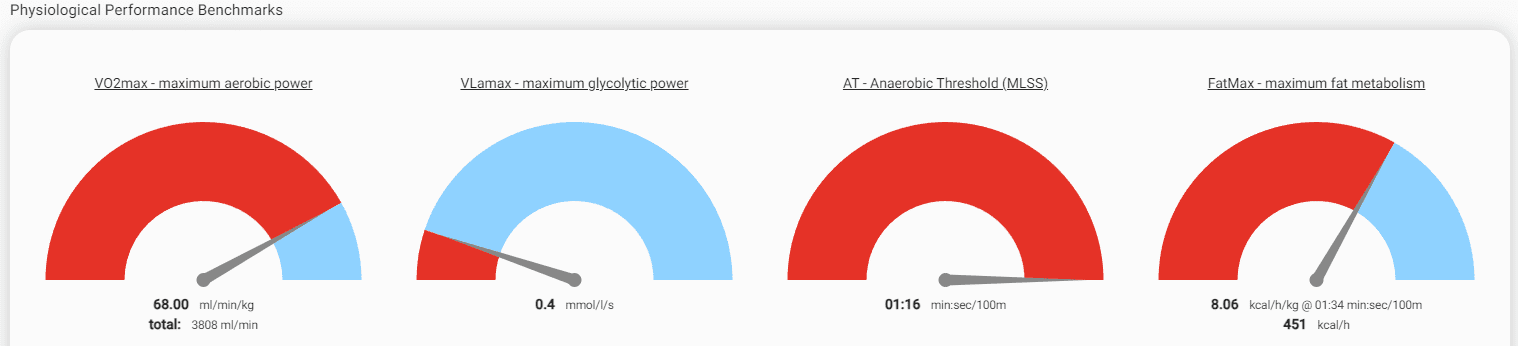
Our athlete had:
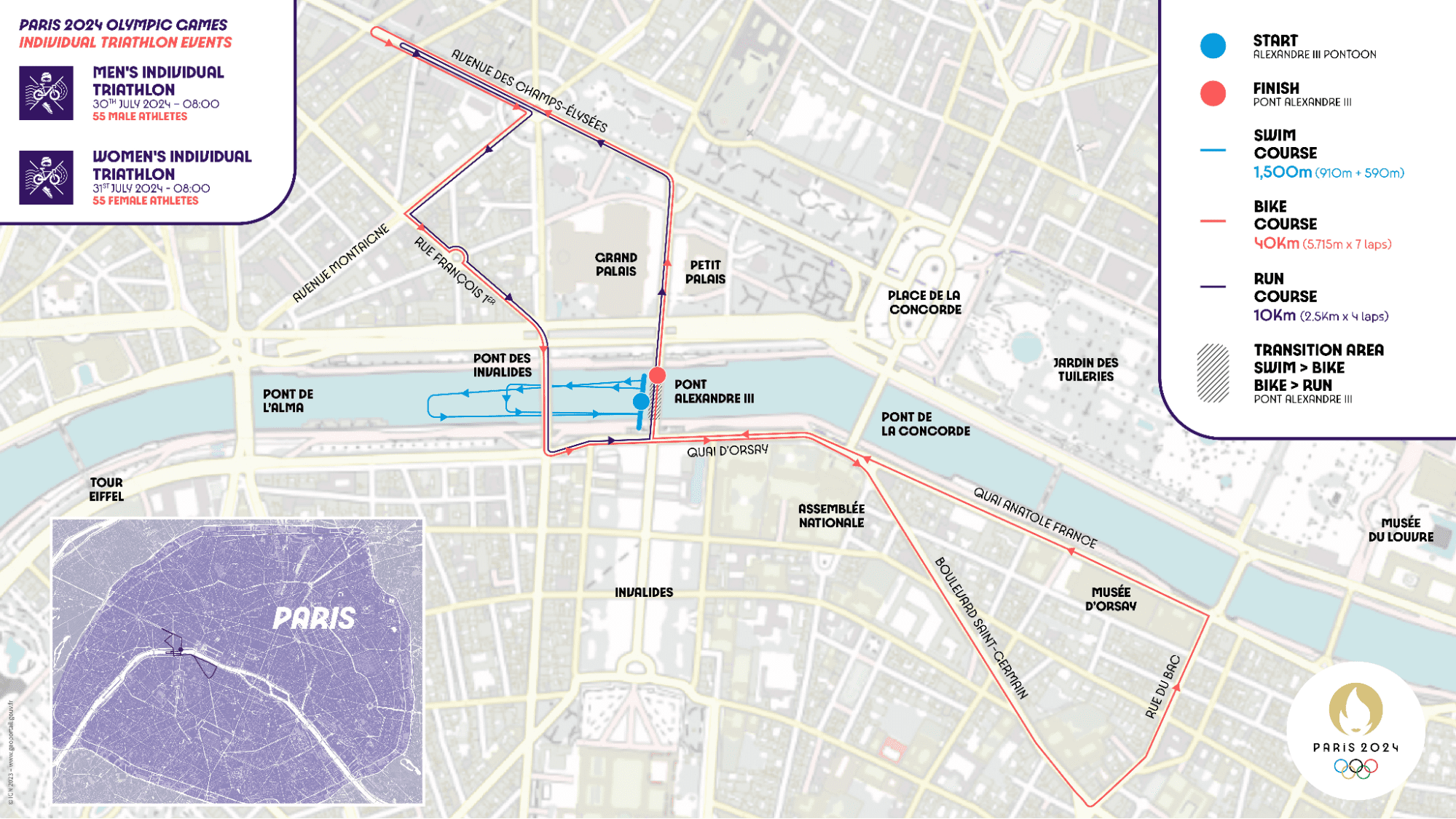
The Olympic triathlon swim course started at the Pont Alexandre III bridge in Paris. The swim course consisted of 2 laps of 910m and 590m. The first buoy was after approx 400m.
We’ve seen that Cassandre Beaugrand, who won gold at the women’s triathlon in Paris, was in 8th position after the first lap. This emphasizes what we’ve learned earlier in this article:
Being in the front during the swim gives triathletes a serious benefit over the competition.
As the positions in the swim are largely determined at the first buoy, it is of utmost importance to be in the front at the first buoy and still have some energy left in the tank to sustain a solid pace to continue the swim course.
That’s why our elite swimmer and her coach planned to start fast for the first 200m (01:10 min:sec/100m). Next, she would keep the pace relatively high until the first buoy at 400m (01:15 min:sec/100m). Finally she and her coach planned to swim slightly below threshold (01:19 min:sec/100m) until she finishes the 1500m swim.
We can now use the INSCYD Lactate recovery & accumulation graph, to see how the body responds to this Olympic race plan. The graph shows how fast lactate accumulates above threshold (purple) and how fast lactate is cleared below threshold (gray).
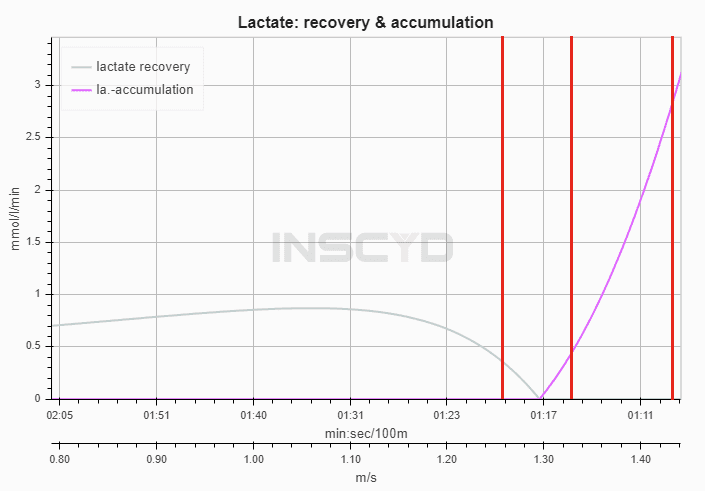
By hovering over the graph in the INSCYD software, we can discover the lactate accumulation- or recovery rate. This leads to the following data:
| Distance | Pace | Duration | Lactate rate | La rate * duration | Lactate concentration |
|---|---|---|---|---|---|
| 0 | 1.00 mmol/l | ||||
| 0-200m | 01:10 min:sec/100m | 02:20 min:sec | + 2.87 mmol/l/min | + 6.70 mmol/l | 7.70 mmol/l |
| 200-400m | 01:15 min:sec/100m | 02:30 min:sec | + 0.46 mmol/l/min | + 1.15 mmol/l | 8.85 mmol/l |
| 400-1500m | 01:19 min:sec/100m | 14:29 min:sec | - 0.36 mmol/l/min | - 5.21 mmol/l | 3.64 mmol/l |
| Finish | 19:19 min:sec | 3.64 mmol/l |
In other words: the blood lactate concentration will accumulate quickly in the first 200m. In the next 200 meters, swimming towards the first buoy, lactate will slowly increase even further. During the last part of the swim, the pace will drop below threshold, which allows our swimmer to clear a fair amount of lactate.
This data showed our athlete that the race strategy was doable: lactate concentrations are within an acceptable range and even decrease towards the swim finish. This makes sense, since she still needed to bike and run afterwards.
Having a metabolic based race plan brings confidence and clarity: you know what to do and how you’ll perform.
Take the guesswork out of triathlon swim training.
With INSCYD metabolic profile, you won't just understand how your athletes perform in the water—you'll know exactly how to improve it. Get precise data on energy systems, lactate accumulation, and pacing strategies to help your athletes start strong, swim efficiently, and stay ahead of the competition.
But what if you’re not happy with the outcome?
Continue reading to see how the metabolic profile shows you exactly what to improve in training.
If you want to improve your athlete’s swim performance, you have many ways to do so. You can improve swimming technique, increase aerobic power, decrease lactate production, change body composition etc. But which one (or combination) is most effective?
INSCYD allows you to project your athletes future performance, by showing how much better your athlete would perform on race day if his or her swim economy was 1% better, or VO2max 1% higher, or lactate production 1% lower, etc.
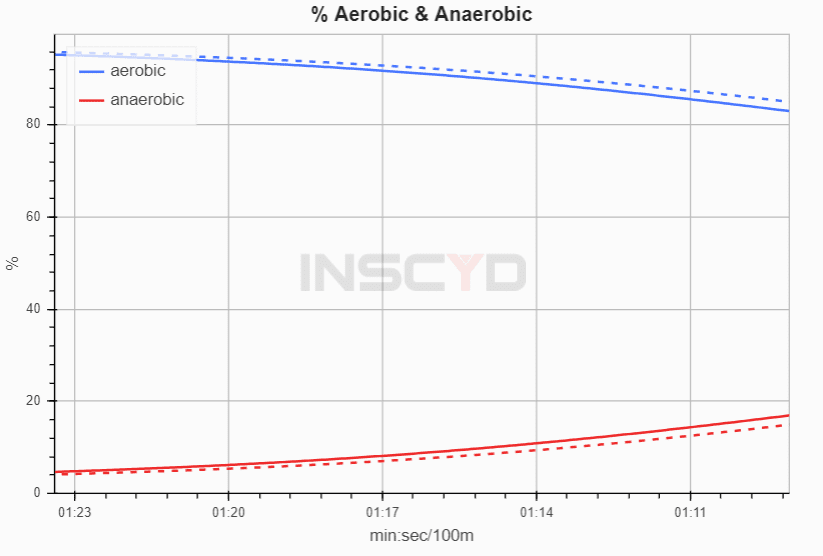
While preparing for the Olympic swim, our elite female swimmer and her coach wondered how her performance would change, if she would increase her VO2max by +2.5 ml/kg/min.
The INSCYD Performance Projection shows that this would increase her aerobic energy contribution during the race by 1.4%pt (dashed blue line) compared to her current metabolic profile (solid blue line).
The lactate recovery & accumulation graph below shows how lactate dynamics would change with a +2.5 ml/kg/min increase in VO2max (dashed line).
During the Olympic triathlon swim in Paris, she would accumulate less lactate towards the first buoy (purple), and clear more lactate in the final part of the swim (gray).
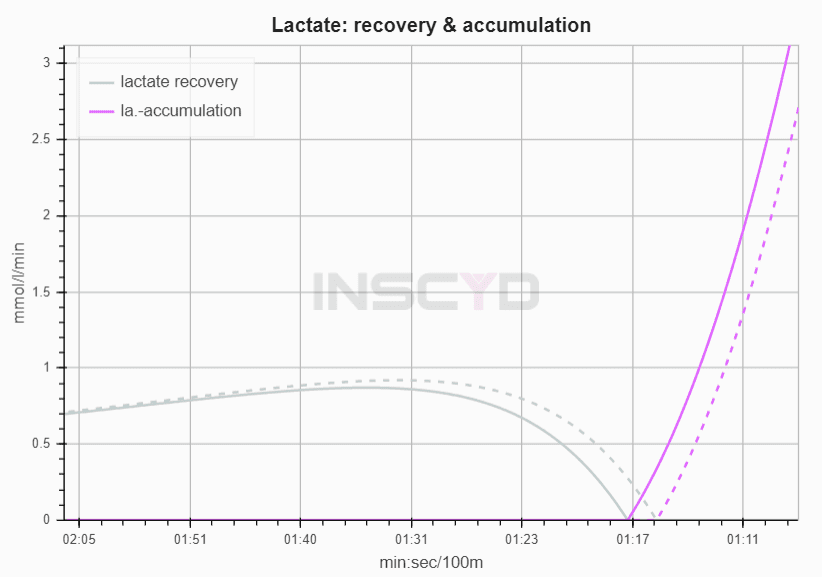
Her coach could decide to stick to the original race pace plan. Instead of peaking to 8.85 mmol/l lactate, her maximum lactate concentration would be 6.55 mmol/l. Due to the increase in VO2max, she would be able to completely clear the accumulated lactate levels in the final part of the swim, and start cycling more fresh.
If instead her coach chose to stick to the original lactate values and adjust the pacing, she could shave off 15 seconds from her swim.
Although there are many strategies to increase VO2max, our elite swimmer already has a VO2max of 68 ml/min/kg. Room for further improvement might be limited.
This raises the question: could increasing her anaerobic power help as well?
Let’s find out.
What if our elite female swimmer would have increased her VLamax from 0.4 to 0.5 mmol/l/s? Would that improve her performance during the Olympic triathlon swim in Paris?
The INSCYD Performance Projection shows that an increase in VLamax increases the anaerobic energy contribution at all swim intensities.
As a result, the INSCYD lactate production graph below shows that the lactate production from the anaerobic (glycolytic) energy system is higher (dashed red line) compared to her current lactate production curve (solid red line).
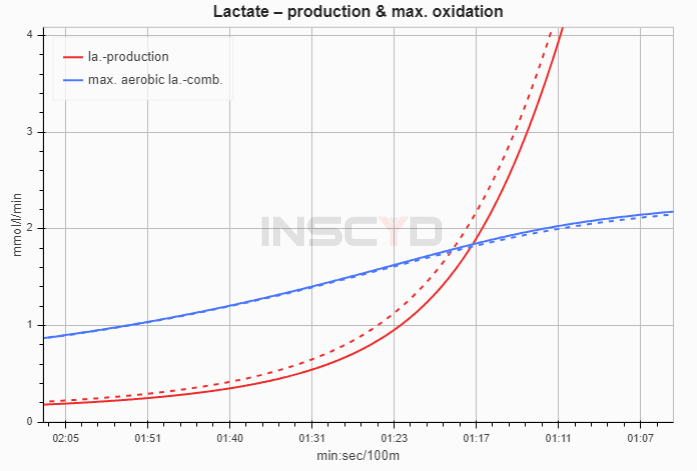
During the Olympic triathlon swim in Paris, our female swimmer would accumulate more lactate towards the first buoy, and hardly clear any lactate in the final part of the swim. If her coach and she would stick to the original race plan, lactate concentrations would peak at 10.7 mmol/l. She would finish the swim with a lactate concentration of 9.11 mmol/l, which is far from ideal.
It might feel counterintuitive that increasing anaerobic power is not helping to improve the swim in a triathlon. However, the INSCYD performance software shows it will impact performance in a negative way. Her coach and she now knew beforehand that a training program which increases anaerobic power would have been a waste of time and energy.
Besides aiming for maintaining and improving her VO2max, her coach ran some additional performance projections to see how for example changes in swimming economy would help improve her race results.
Here are some more swim and triathlon specific blog posts:
INSCYD Performance Projections help to understand what your athletes should do in training and how much this will improve their race. Coaches use it to prevent their athletes from spending time on the wrong things, which leads to disappointments and drop-outs.
This shows that INSCYD performance software is not only the preferred tool to quantify the metabolic profile of an athlete. It also allows you to identify the optimal training objective to achieve the desired result on race day. Performance projections can be made and visualized with the virtual testing feature.
With INSCYD you are able to confidently plan race strategies, avoid wasted efforts in training, and pinpoint the exact areas where improvements will lead to results.
Whether it’s enhancing VO2max, improving swim economy, or refining pacing strategies—INSCYD gives you the data and insights you need to make informed decisions that elevate your athletes’ performance on race day.
Coaches and labs can book a free demo today to see how INSCYD can help you guide your athletes to their best results.
Triathletes can create their metabolic profile and performance projections together with an INSCYD coach.
Gain deep insights into your athletes’ unique physiology with 360° metabolic profiling. Tailor training programs precisely, optimize performance, and accelerate results using accurate data collected remotely or in field or in lab setting without additional equipment.
VO₂max, VLamax, FatMax, thresholds, fuel use and training zones, from a single test in the lab, in the field or fully remote.

