VLamax is the maximum lactate production rate of the glycolytic system. It sets your threshold, your fueling needs and your sprint, and it responds to training within weeks. The whitepaper adds the test protocols and ten training tips.
Fill a short form, we email you the PDF right away.
What glycolytic power is
Glycolysis produces energy from glucose without oxygen, less energy per unit of fuel than the aerobic system but at a much faster rate. VLamax, the maximum lactate production rate, is the measure of that power.
How a high VLamax lowers your threshold
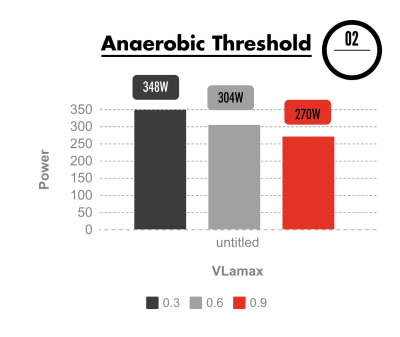
At identical VO₂max, a higher VLamax produces more lactate at every submaximal intensity, so production meets clearance at a lower power. It also burns more carbohydrate and leaves less room for fat combustion.
Measuring and tracking it
A direct sprint test validated against glycolytic enzyme activity from muscle biopsies, or a reverse calculation from submaximal lactate concentrations once oxygen uptake is known. Tracked over a season, it explains changes that threshold alone hides.
Ten training tips
Five to lower VLamax: regular mid-intensity work at high torque, no sprints, controlled glycogen. Five to raise it: gym sets of 12 to 30 seconds, short sprints with full recovery, constant fueling. First changes appear after 6 to 8 weeks.
About this whitepaper
Are you a cyclist looking to sprint faster than Wout van Aert? Or a triathlete dreaming of racing with Jan Frodeno at the next Ironman World Championships? These may be hard goals, but a good way to start working towards them is to understand a very important metric of human performance: VLamax (also: glycolytic power). During both a sprint and a triathlon, VLamax plays a crucial role.
Never heard of VLamax and this all sounds like blasphemy to you? Read on and you’ll understand.
What is VLamax
Before we start, let’s first talk about the definition. VLamax stands for the maximum production rate of lactate in your muscles. Let’s break it down:
V̇ is volume over time. Just like in VO2max it’s about the flux rate
La is an abbreviation of lactate
Max is an abbreviation of maximum
Since lactate is produced in the muscle, we say VLamax is the maximum (max) production rate (V̇) of lactate (La) in the muscles.
“I use VLamax as the main parameter to prepare the training.”
Why should you care
You probably wonder why you should care about the maximum lactate production. And that’s a good question! To answer that question, let’s look at the 3 energy systems of the human body:
Phosphocreatine (PCr) energy system
Glycolytic (anaerobic) energy system
Aerobic energy system
If you want to better understand your sports performance, you need to know how well those energy systems are performing. Especially because they are almost always working together, whether you are sprinting or running a marathon.
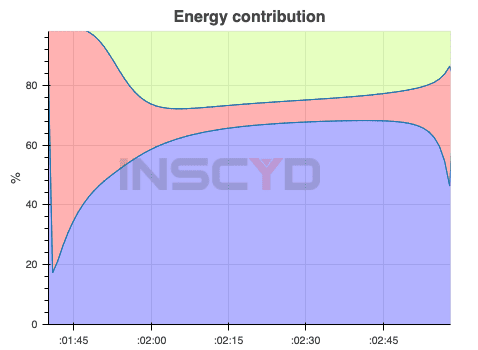
Example: energy contribution of a 800m run in 1:43: blue = aerobic, red = creatine phosphate, green = glycolytic
Performance Aerobic energy system
Let’s first talk about the VO2max because often the VLamax is best understood by comparing it with its well–known brother: VO2max.
We all measure the aerobic performance, using the VO2max. VO2 max is about the maximum (max) oxygen (O2) volume uptake over time (V̇). This is proportional to the amount of energy (or power) produced aerobically. Therefore, VO2max is a valid marker of the aerobic energy system’s performance.
Performance Glycolytic energy system
VLa max is about the maximum lactate production rate. This is proportional to the amount of energy (or power) produced via the glycolysis. Therefore, VLamax is a valid marker of the glycolytic (anaerobic) energy system’s performance.
Do you see the similarities between VO2max as a performance metric for the aerobic energy system, and VLamax as a performance metric for the anaerobic (glycolytic) energy system?
As some call the VO2max, the aerobic capacity or aerobic power – you can also call the VLamax , the glycolytic capacity, or better: glycolytic power.
Watch the summary of this article via this video:
To answer the question “why should you care?”. Because it tells you how well the glycolytic energy system is performing. Unlike the VO2max (which is the higher the better), having a high VLamax can be an advantage or a disadvantage. This depends on the type of sports performance you want to be good at. Let’s learn more about that.
There are two sides of VLamax
The glycolytic energy system produces energy fast. Therefore:
On the one hand, a high VLamax increases the energy available for short efforts: a 200m swimming race, a 400m run, an attack, a sprint.
However, the glycolytic energy system also produces lactate and burns a precious fuel: carbohydrates. Therefore:
On the other hand, a high VLamax decreases the anaerobic threshold and fat combustion and lengthens recovery time from hard efforts.
This should make clear that all athletes benefit from knowing their glycolytic power, so they can adjust it to their race demands! But how do you know what your VLamax is?
VLamax test: how to measure it
There is no such thing as a VLamax calculator based on certain efforts. To get an accurate value, there are two VLamax test protocols: one that includes a 15 second sprint and one that includes several sub-maximal tests.
INSCYD is the only tool that provides you a scientifically validated VLamax . Even more important: it also allows you to understand how it influences your performance and what your optimal VLamax is.
VLamax training
Once you know your glycolytic power, it’s time to start training. The question about “how to train VLamax” is a bit more difficult than “how to train VO2max”. Why? Because, as mentioned, a highly active anaerobic energy systemhas both advantages and disadvantages. However, once you know your VLamax and your goal, you know whether to increase or decrease VLamax. Here’s how you can start doing that.
“You really know what you need to work on if you know your VLamax.”
How to increase VLamax
If you want to increase your VLamax, start by making sure you do nothing that decreases it. Next, think about short intervals like sprint training with a lot of recovery in between intervals. Strength training could also be a part of your trainingplan. Get 5 training tips on how to increase glycolytic power via our free whitepaper
How to decrease VLamax
Even though it’s a marker for the performance of an energy system, we often receive questions about “how to lower VLamax“. Reducing VLamax often comes down to making sure glycolytic muscle fibers fatigue, and therefore become more aerobic. Get 5 training tips on how to decrease glycolytic power via our free whitepaper
VLamax normative data
As said: some athletes benefit from reducing their glycolytic power while others will benefit from increasing it. That depends on the sport you perform: cycling, running, triathlon, swimming, XC skiing etc. It also depends on the type of athlete that you want to be. A sprint runner needs a different VLamax than a marathon runner.Interested in whether you should increase VLamax or decrease VLamax? National Champion coach Ben Tilus shares how you can find out whether you should increase or decrease VLamax.
Here’s an example of somevalues:
VLamax values typically range from 0.2 mmol/l/s to 1.0 mmol/l/s.
For comparison: world class marathon runners have a VLamax in the ballpark of 0.3 mmol/l/s. But if you want to run 100m in sub 10sec it needs to be more in the ballpark of 1.0 mmol/l/s.
Scientific literature showed that a female world record marathon runner had a VLamax of 0.31 mmol/l/s.
In the book DER KONA CODE, Sebastian Weber recommends (KONA) triathletes to aim for a VLamax below 0.3 mmol/l/s for women and below 0.4 mmol/l/s for men.
“It’s interesting to know my VLamax, whether that’s an area of strength, or an aspect I need to train more.”
The ideal VLamax for sprinters
Sprinters need a lot of energy very quickly. For such short, hard efforts, a high-energy production in a small amount of time is needed.
The glycolytic energy system is the solution, because it produces energy much faster than the aerobic energy system.
With VLamax being a measure of performance of the glycolytic/anaerobic energy system, it will come as no surprise that a high VLamax increases glycolytic power and therefore the possible sprint power.
Here’s an example of how the VLamax determines glycolytic power and 12 second sprint power in cycling:
However, always keep in mind that in some sports, the sprint takes place after a long endurance race. For instance in cycling. That’s why some sprinters – like Wout van Aert – still feel the need to decrease their VLamax for better performance. Watch the video to hear what Wout van Aert has to say about it:
The ideal VLamax for endurance athletes
Endurance athletes need a good amount of energy for a long time. Examples of endurance events are: long distance triathlons (half and full-distance Ironman), marathons and also bike races. In these kind of events, the key is to go as fast as possible without:
Running out of energy. You rather burn fat (“infinite” source of fuel) than carbohydrates (scarce source of fuel).
Building up lactate and fatigue early in the race.
Having a high VLamax does quite the opposite. Even at sub-maximal intensities.
Wrap up
Finally, it doesn’t matter if you’re Wout van Aert or Jan Frodeno. In both cases – but especially in your case – basing your training on VLamax will bring your performances to peaks they’ve never reached before.
Dr. Hellard of the french swimming federation on the importance of VLamax in swimming.
Dan Lorang – coach of Jan Frodeno – on the importance of VLamax in Ironman races.
VLamax podcasts
Is there any INSCYD podcast that does not mention VLamax? Probably not. But if you want to learn everything about itvia a podcast, we highly recommend starting with these two.
Want to learn more? Get our FREE whitepaper full of practical tips:
Written by
Sebastian Weber
Founder and Sport Scientist
Founder of INSCYD and creator of the first test to measure glycolytic power (VLamax) in 2003. His work in exercise physiology and metabolic profiling has helped WorldTour cyclists win 9 World Championship titles, Olympic medals, and Tour de France victories. Consults for German Swimming and Skiing Federations and USA Triathlon.