Muscle Glycogen and Exercise: all you need to know
Glycogen is the preferred fuel at race intensity, and only the stores in the active muscle count. How much you store, how fast it runs out at your pace, and what it takes to refill it. The whitepaper adds the calculations behind each answer.
Fill a short form, we email you the PDF right away.
Only the active muscle counts
Glycogen cannot pass cell membranes, so stores in other muscles are unavailable during exercise. What matters is the content of the muscles doing the work, not the total in the body.
What sets the size of the store
Body composition, sport, fitness level and diet. A fully recovered untrained athlete stores about 15 g per kilo of muscle mass, a professional about 25 g. The INSCYD calculator turns those variables into an individual number.
When the store runs out
Carbohydrate combustion rises exponentially with intensity, and after roughly 80 minutes at maximum lactate steady state the store is empty. Running out ends every high intensity effort.
Keeping it and refilling it
Intake during exercise spares glycogen but cannot replace it, because glycogen stays the preferred fuel. Full replenishment takes at least 48 hours on a high carbohydrate diet, with a slight overshoot above the starting level possible.
About this whitepaper
Glycogen is the most important energy substrate during exercise, especially at higher intensities. Since most races require such high intensities, glycogen is important to every athlete who wants to be strong, fast and become a winner.
In short, glycogen is the storage form of carbohydrates in humans. Glycogen is stored in the muscle and in the liver. Replenishing glycogen is all about consuming enough carbohydrates in the hours/days after exercise.
Regardless of the intensity at which you exercise, at some point muscle glycogen storage will deplete when you don’t consume enough carbohydrates. This is because glycogen is preferred over blood glucose as a fuel, which we’ll talk about later. As a result, fatigue will develop quickly.
This blog covers all you need to know about glycogen, so you can leverage this knowledge – as provided by INSCYD – to your advantage.
What Is Glycogen
In short, glycogen is the storage form of carbohydrates in humans. When you eat carbohydrates, they eventually enter the blood as glucose. Blood glucose can be used as an acute energy source – for instance for the working muscle – or it can be stored in the body for later use. When blood glucose is moved to the body’s energy storage, it is called glycogen.
How Much Glycogen Is Stored In The Body
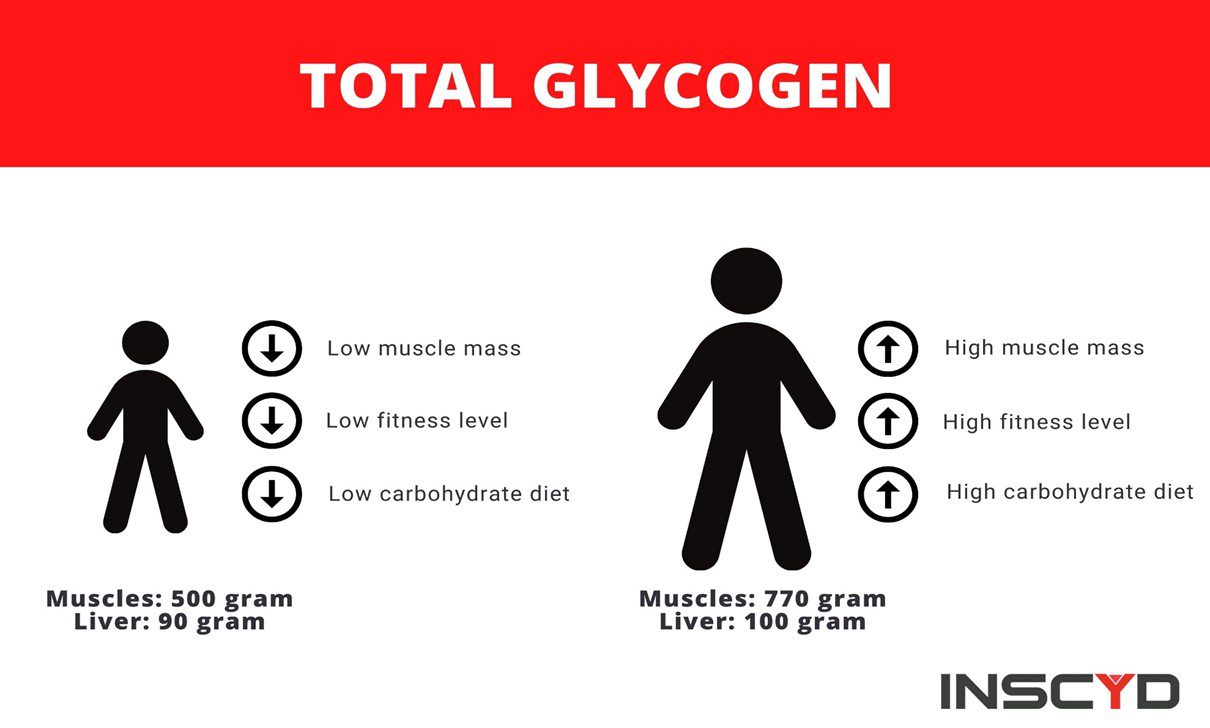
Glycogen is stored in the muscle and in the liver. Although some settle for rough estimates (e.g. 500 gram glycogen stored in the muscles and 100 gram glycogen stored in the liver), the truth is that the amount of glycogen stored in the body was unknown for most athletes (except for athletes getting muscle biopsies) – until using INSCYD. INSCYD offers the first and only tool that can calculate individual glycogen stores.
Example of how the total glycogen content differs per athlete
We’ll have a closer look at how much glycogen is stored in your muscles, but first we would like to note that: the total amount of glycogen content in the muscles and in the liver is not that interesting for athletes. Why?
“The total amount of glycogen content in the muscles and in the liver is not that interesting for athletes.”
Glycogen is a relatively big molecule. Because of its size it cannot pass cell membranes. Easier said: glycogen cannot go from one muscle to another. This might sound very scientific and theoretical to you, but it is of utmost importance in sports performance.
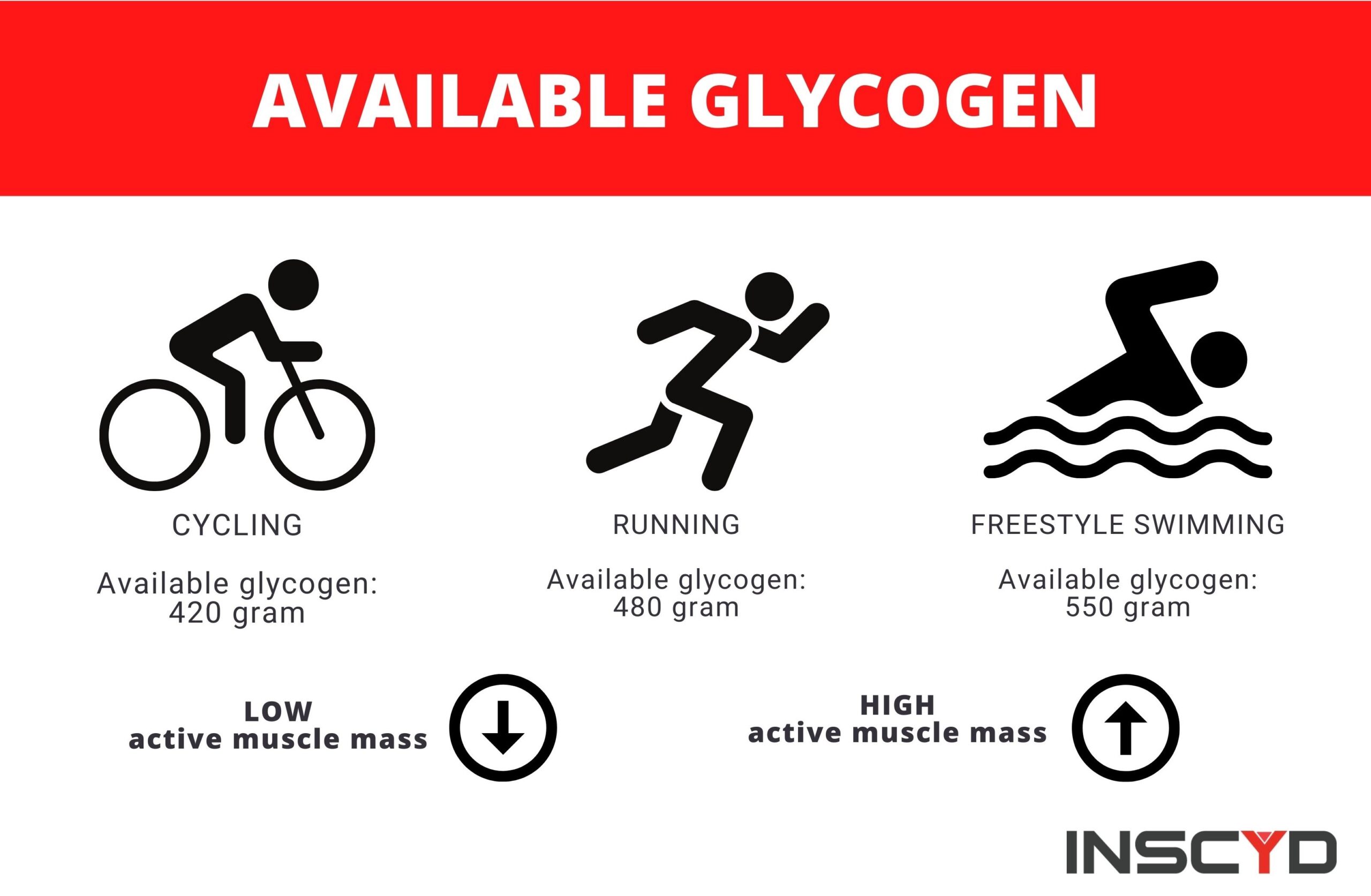
Because glycogen cannot pass cells, what matters to you is the glycogen content in the muscles which are active during your exercise – not the total glycogen stored in other muscles or organs. Muscle glycogen content in your triceps might be interesting when doing push-ups, but not when running.
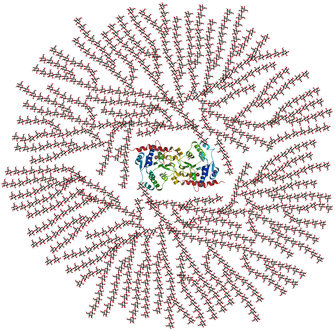
Glycogen: a core protein surrounded by thousands of glucose branches.
How Much Glycogen Is Stored In The Active Muscle
Hopefully you understand the importance of looking at the glycogen content in the muscles that are active rather than looking at the total glycogen content. But how do you know how much glycogen is stored in the active muscle?
Example of how the available glycogen content differs per sport
To better understand this question, we did a meta-analysis that combines the results of multiple peer reviewed scientific studies. What we found is that the amount of glycogen content in the active muscle depends on:
INSCYD – Muscle Glycogen Calculator
To calculate the exact amount of glycogen in the active muscle, INSCYD users can utilize our new feature: an algorithm that calculates the glycogen content in your athlete based on:
Gender
Body Weight
Body Composition
Sport
Fitness level
Diet
You can find this new feature in the advanced body composition section when you create a test. You may leave the setting to automatic or manually enter a glycogen content that you want to use (per kg muscle mass).
The results are also presented in the metabolic profile report.
How Glycogen Is Broken Down To Glucose
Both glycogen and glucose need to be broken down before they can deliver energy to the muscle. The breakdown of glycogen is easy. That is because glycogen is a chain of glucose molecules, that has multiple places to start the breakdown. Also, glycogen is already located in the muscle.
The breakdown of glucose however, costs a little bit of energy. It needs to be transported from the blood into the muscle. As a result, while glycogen generates a net gain of 3 units of energy (ATP), glucose “only” generates a net gain of 2 units of energy.
When Do You Need Muscle Glycogen
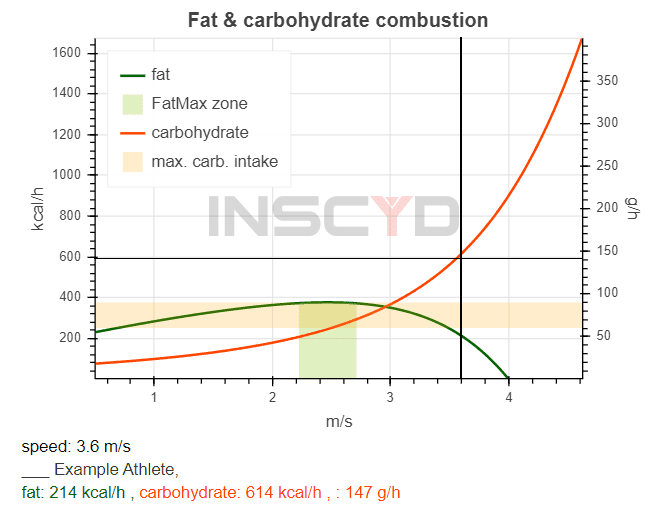
Contrary to fat combustion, carbohydrate combustion increases exponentially with intensity. The faster you swim, run, ski, bike, … the more carbohydrates you burn. The exact amount of carbohydrates that an athlete burns at a certain intensity, depends among others on the individual metabolic profile. INSCYD does not only accurately provide you those metabolic parameters, it also shows you exactly how much fat and carbohydrates you burn at any intensity (e.g., pace for runners, power for cyclists). Learn more about carbohydrate utilization via this blog.
The carbohydrates that will be combusted come from two sources: carbohydrate stored in the muscle (glycogen) and carbohydrates located in the blood, as a result of carbohydrate food intake (blood glucose).
In conclusion: the higher the intensity the more glycogen is needed. By consuming additional carbohydrates during exercise, you can decrease the amount of glycogen needed. However, since glycogen is preferred over blood glucose as a fuel, and because the amount of exogenous carbohydrate intake is limited, you can never exercise at a high intensity and not burn any glycogen.
We know glycogen storage can be depleted rapidly. We also know this will cause fatigue to develop quickly. But how long does it take before glycogen stores are empty? To give you a rule of thumb: after approximately 80 minutes of exercise at a maximum lactate steady state, glycogen stores are depleted.
Although this rule of thumb gives you an idea, a ballpark number, it does not help the individual athlete to train and perform better. This is exactly why we built the INSCYD muscle glycogen calculator! It takes into account all the variables that affect glycogen availability and lets you know exactly how much glycogen is stored in your active muscles.
Combine this knowledge with the carbohydrate combustion rate we showed in the previous graph, and you know how long glycogen stores will last.
“Know exactly how long glycogen stores last by looking at the individual glycogen store and carbohydrate combustion rate.”
Of course you can extent the time glycogen stores last. Read along to learn how to maintain glycogen stores during exercise. But let’s first have a look at why running out of glycogen is something to avoid.
What Happens When You Run Out Of Glycogen
Knowing the importance of glycogen, it should come as no surprise that running out of glycogen will seriously hamper exercise performance. It will cause a fatigue that many endurance athletes know as “bonking”.
As the carbohydrate combustion graph clarifies, it is impossible to exercise at higher intensities when there are no carbohydrates available.
In short: running out of glycogen is the end of every high performance effort. That is why you want to know exactly how much glycogen is available in an individual athlete, instead of having some rough estimates. INSCYD is the first and only tool that provides you this information.
How To Maintain Glycogen Stores During Exercise
Now you know the disastrous effects of running out of glycogen, you probably wonder how you can maintain glycogen stores during exercise.
The most obvious one is to decrease exercise intensity. This will decrease carbohydrate combustion, increase fat combustion, and as a result: maintain glycogen stores for a longer period of time.
Assuming you don’t want to slow down, the more interesting short term option is to consume carbohydrates during exercise. Examples are energy drinks, bars and gels.
Long-term, you can also maintain glycogen stores longer by increasing fitness level. As mentioned, a higher fitness level will increase the maximal amount of glycogen stored per kilo muscle mass. When an increase in fitness level comes from an increase in aerobic power, you will also rely less on carb combustion and more on fat combustion.
By playing around with the INSCYD glycogen availability calculator, you can see how changes in fitness level and aerobic power have an effect on how long an individual can maintain glycogen stores during exercise.
How To Replenish Muscle Glycogen
Experiencing low glycogen stores is of course not a big problem once you crossed the finish line. In fact, in most races or intense training sessions, this is inevitable. You should however make sure you replenish muscle glycogen stores afterwards, to make sure you have enough energy for the next race or training session.
Replenishing glycogen is all about consuming enough carbohydrates in the hours/days after exercise. It goes beyond the scope of this blog to talk about the exact nutritional strategies to replenish glycogen as fast as possible.
It is however good to know that it will take a minimum of 48 hours to fully replenish glycogen stores once they are depleted. This requires a high carbohydrate diet (60-70% of the energy coming from carbohydrates) and rest during the recovery time.
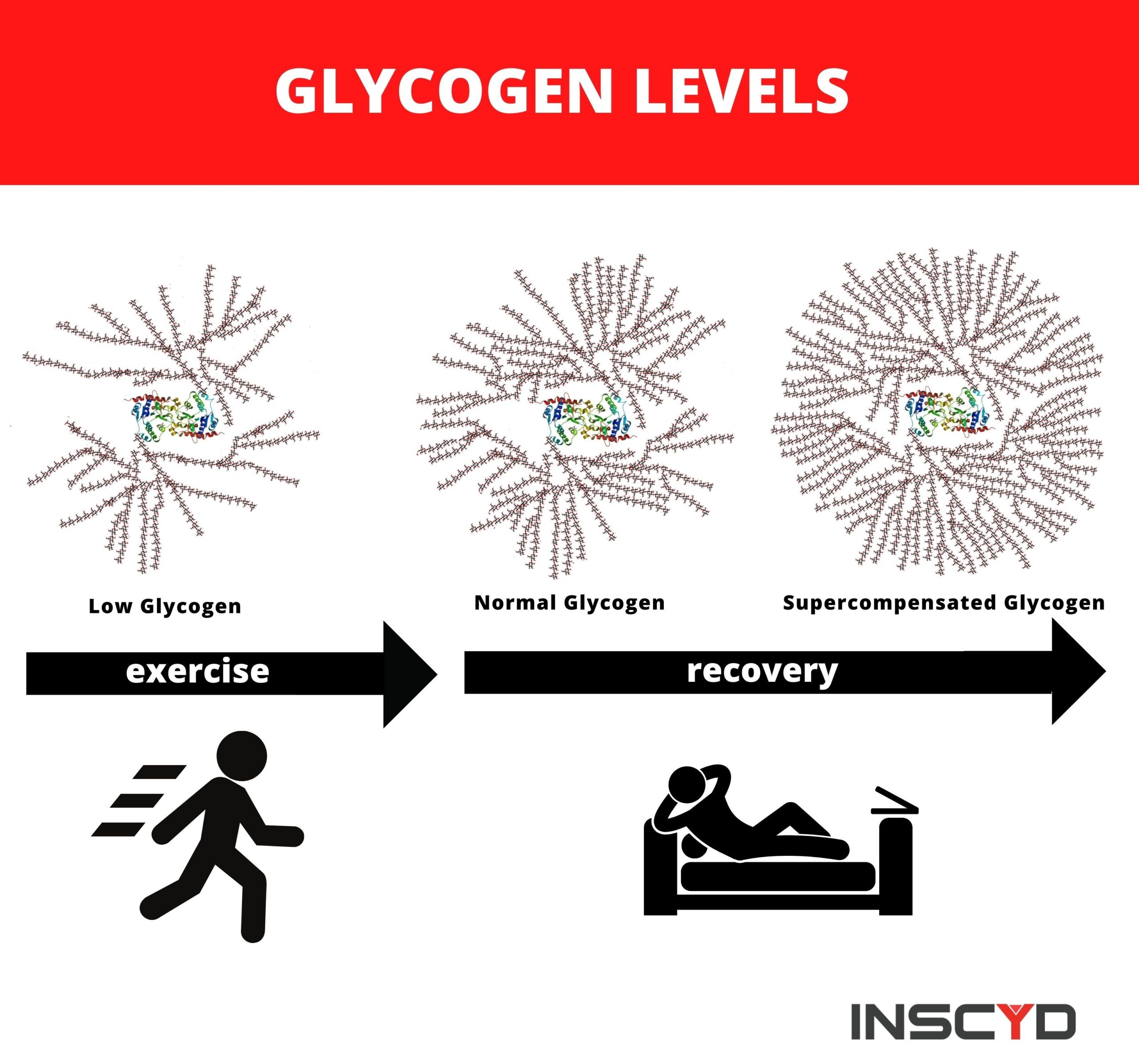
The good news is that when doing so, you can reach a slight overshoot effect in which you will have a higher glycogen store than before the race/training.
While exercise decreases glycogen content, recovery can create a slight overshoot in glycogen stores.
Conclusion
We talked about all the important aspects of muscle glycogen during exercise and hopefully gave you a better overall idea of how glycogen stores change during exercise. Now it’s time to bring the theory into practice. Calculate how much glycogen your athletes have in their active muscles. Learn how much they burn at any exercise intensity. Create a nutrition plan to make sure to never run out of glycogen again.
Written by
Sebastian Weber
Founder and Sport Scientist
Founder of INSCYD and creator of the first test to measure glycolytic power (VLamax) in 2003. His work in exercise physiology and metabolic profiling has helped WorldTour cyclists win 9 World Championship titles, Olympic medals, and Tour de France victories. Consults for German Swimming and Skiing Federations and USA Triathlon.