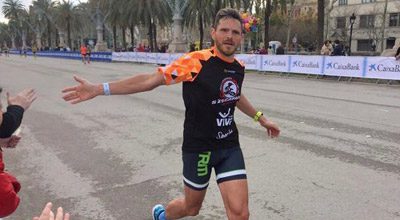
Coach Joseph Spindler used INSCYD carbohydrate combustion data to predict Bernat Xamena’s marathon pace with near-perfect accuracy, helping him run a 2:54 sub-3 hour marathon in Barcelona after a DNF the year before.

Do you want to run a marathon in under three hours? Easy: you only need to run those 42.195 km (26.2 miles) at an average pace of 4:15 per km and smash it in 2 hours and 59 minutes. Of course, it’s not quite that simple: your body needs to be fit to sustain that speed for that amount of time. To get there, you need to put in proper training — and understand how your physiological metrics and parameters cope with those requirements. In most cases, this is a learning process and means you need to learn how your body works.
Bernat Xamena, a professional trumpet player from Mallorca, learned that very well. At the Barcelona Marathon in 2017 he blew up after km 30 and had to pull out of the race. The sustained effort of playing trumpet six-to-eight hours a day couldn’t help him.
“Bernat had nutrition issues and also started too fast. And then he had very bad cramps and couldn’t carry on”, says his triathlon coach Joseph Spindler.
But after a lesson learned in the hardest way, both coach Spindler and Xamena were ready to do things properly this year. They chose to do an INSCYD test three weeks before the race.
“Based on the test results [a simple 4 phase test on the track with lactate sampling]”, says Spindler, “it was very clear that he had to run 4:08 per km, be fine and have a 2 hours 54 something for the whole marathon.”
After the nutrition issues of last year, Spindler and Xamena also worked on the nutrition strategy: Xamena didn’t take in anything for the first hour (except water) and then took 64 grams of carbohydrates per hour for the following two hours. “We didn’t go crazy with the amount of carbs because we knew this amount would work for him,” explains Spindler. “I just wanted to stay on the safe side because with gels you cannot go as high as with other products.”
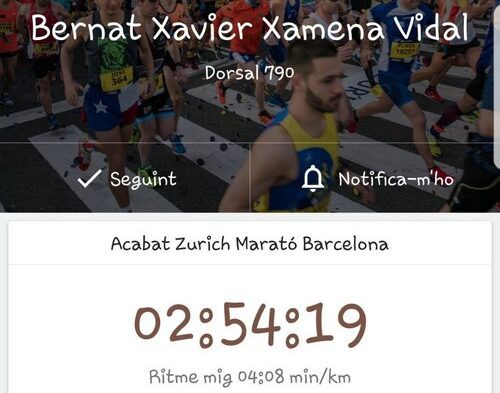
After the race, Xamena sent Spindler a pretty eloquent picture of his pace breakdown. Average pace: 4:08 per km. Total 2:54:19. Job done.
Spindler explains: “With the INSCYD tests I was able to say at what pace he was able to run without running out of energy. We did the test on a track, so the closest possible to a race scenario. And this is the beauty of INSCYD: you can test real-world conditions, you don’t need to go to a lab, you don’t need a treadmill where the athletes often don’t run that hard for the all-out effort and that is actually required. On the track, this is no problem: you are as close as you can get to real-world conditions.”
But how did Spindler really predicted the result so precisely using INSCYD? He firstly points out that he used a mixed approach: he firstly looked at what Xamena had run in the past in terms of % of anaerobic threshold. He then validated this finding with the fat and carbohydrate combustion chart on INSCYD. (
VO₂max, VLamax, FatMax, thresholds, fuel use and training zones, from a single test in the lab, in the field or fully remote.

