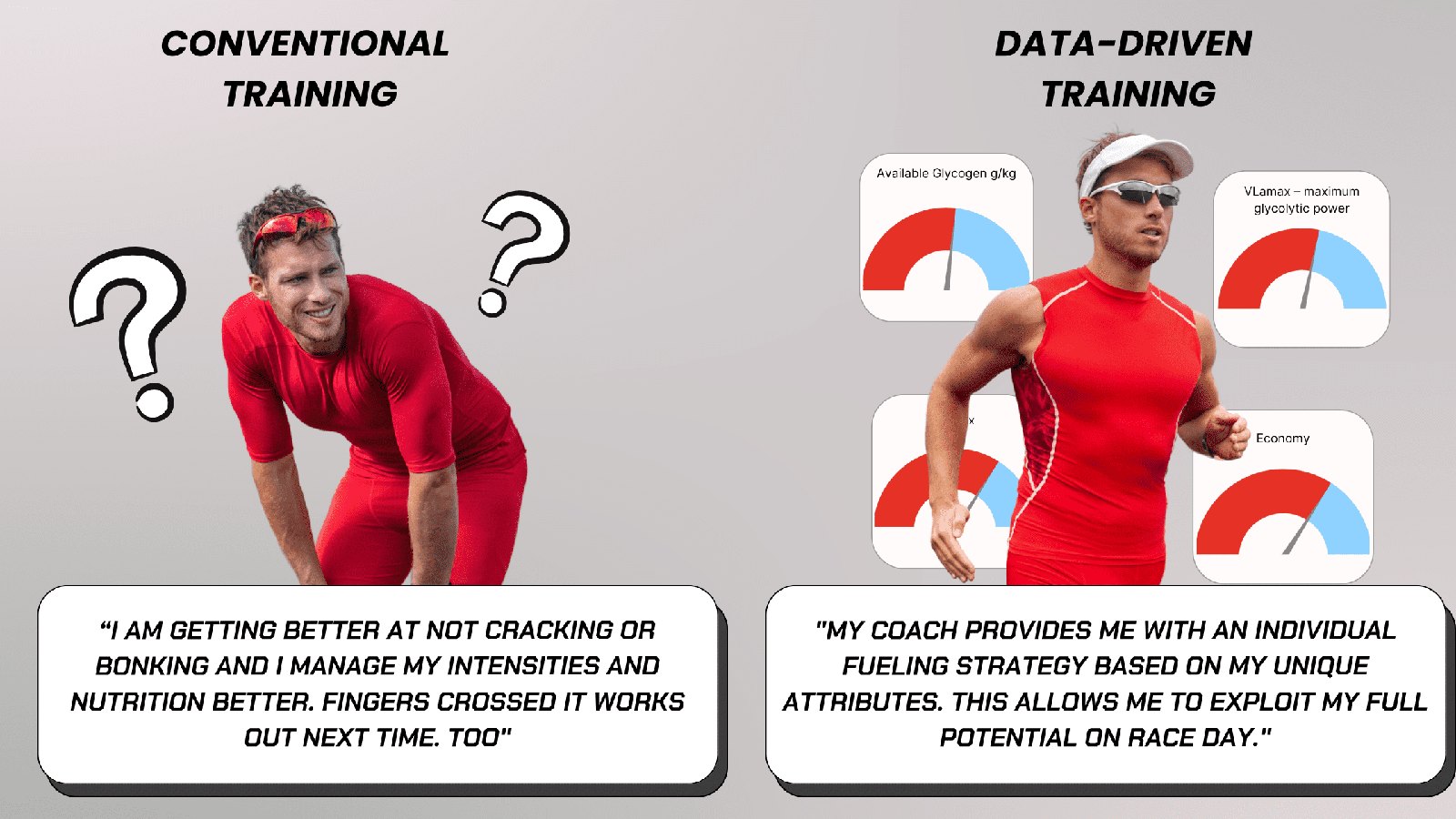
You invested many training hours and money in your next IRONMAN triathlon. You sacrificed social and family life. On race day, you hope all comes together. But how can you be sure? Read this article to prevent hitting the wall or underperform. Learn exactly when to accelerate, recover, eat and drink.
Too many triathletes underperform at race day, even though they are well trained.
Maybe this sounds familiar to you:
You’ve completed many training hours, some at the expense of social and family life. You’ve invested money in a wetsuit, running shoes and a time trial bike upgrade. You carefully tracked your training progress with a power meter and looked at your smart watch data a little more often than your friends and family would prefer. After listening to several podcasts and reading multiple articles, you experimented with sports nutrition brands to see what works best for you.
Luckily, you didn’t forget about race day preparations either. You know when to leave the house, where to pick up your number and what to do to warm up. Together with your coach you maybe even visualised the transition from swim to bike to run.
What could go wrong?!
Once the starting gun fires, adrenaline surges through your veins. It feels like you have way more power and energy than ever before. Finally the hard work seems to pay off!
It’s tempting – even for experienced athletes with a rough race plan – to go too fast.
The race chaos also makes you forget to eat and drink regularly. The combination of racing a bit faster and fueling a bit less will quickly become an irreversible mistake. Here’s why:
When you increase exercise intensity a little bit, carbohydrate combustion increases exponentially (red curve in the image below).
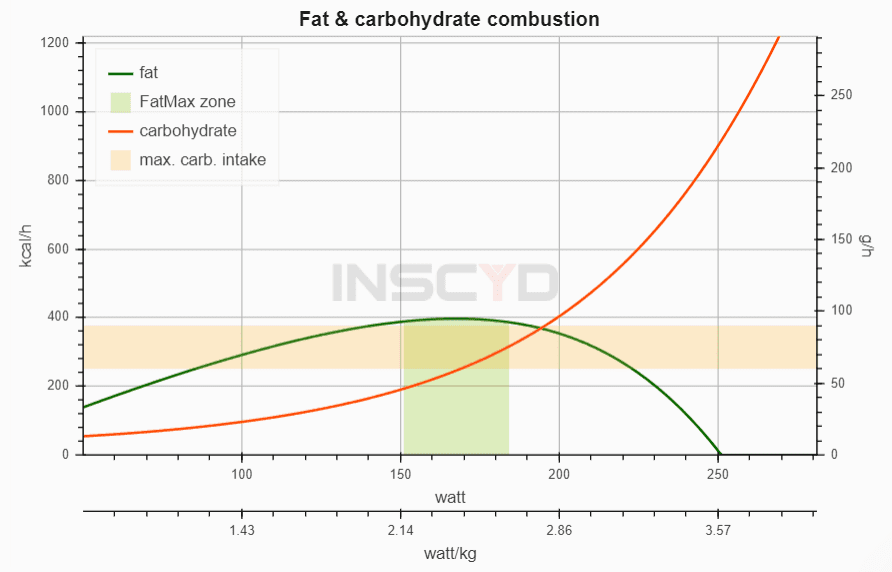
If the athlete from the image above increases bike power from 220W to 230W, carbohydrate combustion increases by 25 grams per hour (from 130 g/h to 155 g/h). Even though both intensities are below anaerobic threshold, the increased intensity requires the athlete to consume roughly 5 more gels or 3.5 more sports drink bottles during the bike split. That is on top of the planned energy intake.
Such additional food intake can cause stomach issues, and is often not realistic. The only alternative is to slow down substantially during the run, to prevent hitting the wall.
Clearly, deciding on your pacing plan on race day is a bad idea. But even a rough pacing plan will not do the trick. Say you aim for 220W during the bike ride. How will you compensate after a steep downhill section in which you didn’t pedal? Or what if you’re aiming for a 4.5h marathon, how will you pace yourself on a hilly course? Keep in mind that the carbohydrate combustion curve is not linear, but exponential.
The only way to be sure you’re not running out of energy while going as fast as possible, is by creating a specific pace and nutrition plan, for each section of the race. With this plan, you understand that it makes no sense to go any faster, despite the adrenaline in your body and the cheering fans.
The good news is that creating such a race plan is much easier than the hard work you’ve already invested in training. Continue reading for a practical example.
Our example triathlete is going to participate in his 3rd full distance IRONMAN. The race will take place in less than 2 weeks.
The previous triathlons were unforgettable experiences. Unfortunately he had to walk the last 7 km of his first IRONMAN. He simply started too enthusiastic and hit the wall during the marathon.
In the second IRONMAN he knew he had to hold back in the beginning to finish strong. The overall result was a bit disappointing though: he felt like he could have done much better.
This time our athlete is determined to race to his full potential. After all, he sacrificed time with friends and even worked a bit less, to make sure he had enough energy for training.
Our athlete created a generic pacing and fueling plan, but with the race taking place in less than 2 weeks, he starts to doubt. “How can I be sure my pacing is realistic and my fueling is optimal? I don’t want to bonk or underperform again!”
Continue reading the steps he takes to answer the question and gain confidence – or download the in-depth white paper.
Learn how to create fueling and pacing strategies, using carbohydrate combustion rates.

Together with his coach, he creates an INSCYD metabolic profile. Among others, this profile reveals his highly individual fat- and carbohydrate metabolism. He now knows his energy expenditure at any given exercise intensity, per sport.
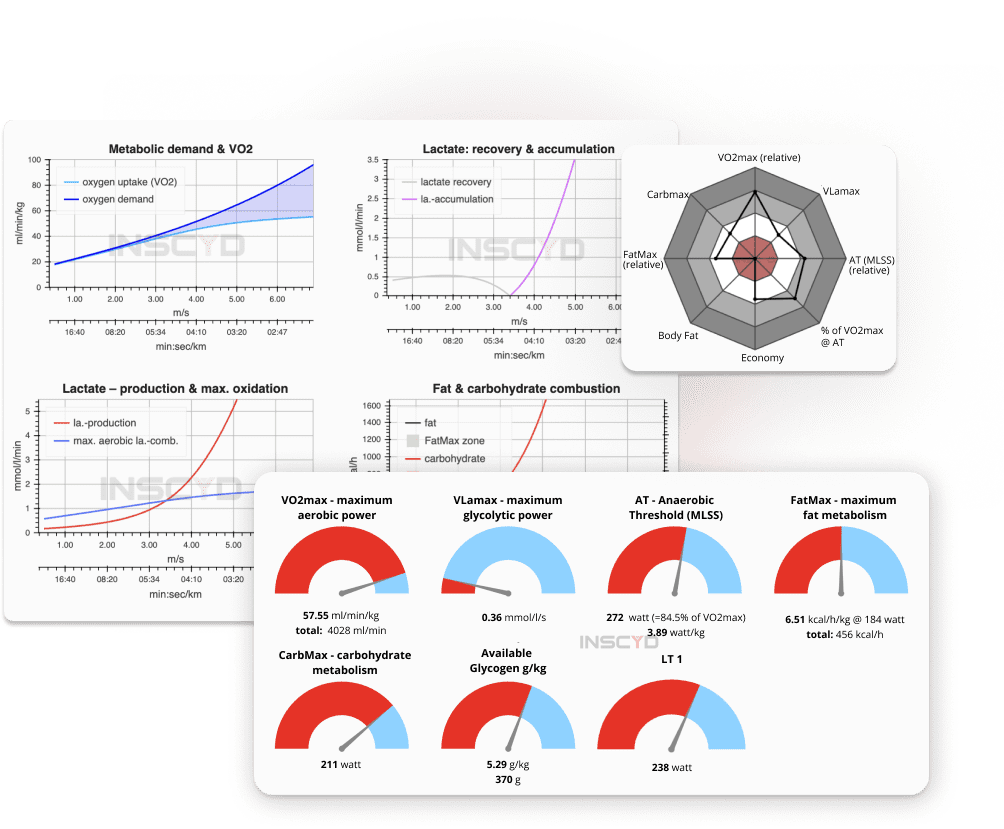
He divides the race into several sections. Swimming is one section. For the bike and run section he creates separate sections for flat/uphill/downhill.
For each section, he starts with a rough estimate of the race intensity (pace or power) and calculates the duration. He uses the INSCYD carbohydrate combustion graph to discover his carb combustion for each section. He sums up the total amount of carbohydrates burned.
Lastly he decides on a fueling plan. He trained his gut to absorb 90 grams of carbohydrates per hour during the bike ride and 60 grams of carbohydrates during the run. His INSCYD metabolic profile shows that he has another 560 grams of carbohydrates stored in his muscles as glycogen.
Here’s an example of how the fueling and pacing plan could look like:
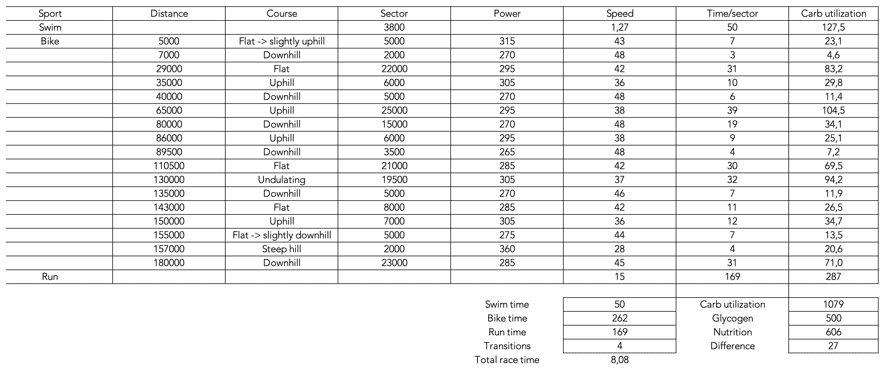
In step 3, our athlete found out the total amount of carbohydrates burned, using the INSCYD metabolic profile. In step 4, he found out the total amount of carbohydrates available, using the INSCYD glycogen metric. Based on this initial plan, he draws three conclusions:
Despite the adrenaline and cheering fans, our athlete sticks to the pacing and fueling plan. He sets a new personal record. Contrary to his previous IRONMANs, this time he concludes that it was worth all the training investments and social sacrifices.
With only 2 weeks before the start of the IRONMAN, our athlete was able to:
Learn more about creating pacing and fueling plans via our free white paper or schedule your metabolic profile test with a (remote) INSCYD coach or lab.
Although we’ve learned the value of creating a metabolic profile, only 2 weeks prior to the race, there’s even more benefit when you do it earlier. Our athlete would have been able to discover hidden potential for improvement and learn exactly how to unlock that. Next time he participates in a triathlon, he will compare his metabolic profile to the ideal metabolic profile for triathletes, to create a highly effective training program.
Take Your Coaching to the Next Level with INSCYD
Don’t leave race performance to chance. With INSCYD’s metabolic profiling, you can create personalized pacing and fueling strategies that eliminate guesswork and maximize results. Gain deep insights into your athletes’ physiological strengths and weaknesses, and tailor your training plans to ensure they perform at their best, fuel efficiently, and achieve personal records.
Book a free demo today and experience the future of performance analysis.
Gain deep insights into your athletes’ unique physiology with 360° metabolic profiling. Tailor training programs precisely, optimize performance, and accelerate results using accurate data collected remotely or in field or in lab setting without additional equipment.
VO₂max, VLamax, FatMax, thresholds, fuel use and training zones, from a single test in the lab, in the field or fully remote.

