Training at FatMax intensity isn't always the best endurance strategy, for athletes with high carbohydrate combustion at FatMax, sustained sessions at that intensity deplete glycogen and risk overtraining across a training block.
There are many reasons why endurance athletes should want to increase their fat combustion. Riding many hours at FatMax (intensity at which you burn the most fat) might seem like the best way to do this. However, this is not always the case. It can even harm you and cause overtraining. Here’s what you should consider, before using FatMax as the one and only intensity for long endurance training.
At FatMax intensity, you burn the most fat. This indeed means that all the enzymes involved in fat combustion are working as hard as they can. Therefore, if you believe that using/training a system will improve the system, training at FatMax should have a positive effect on the fat combustion.
But for now, we need to address an important reason why some of you should NOT use FatMax as their long endurance training intensity.
Let’s look at an example that makes clear that for some endurance athletes, riding many hours at FatMax is simply not possible, even though lactate concentrations at FatMax are low.
In this video, Wout van Aert mentions that his FatMax intensity is about 350 watts (!). Even though he is a high-level pro cyclist, you intuitively understand that this is not an intensity for a long endurance training. This becomes clear when looking at his race data.
According to VeloNews, Wout van Aert won Strade Bianche in 2020 with an average power of… 275w. We can all agree that your long endurance training intensity should probably not be higher than the intensity of one of the hardest (5 hour) races in the world.
In fact, as Van Aert mentions in the video, when he trains at FatMax, he usually does it for about 20 minutes before switching back to endurance intensity. Which is probably more in the ballpark of 230 – 240w.
This still doesn’t explain why some athletes should not use FatMax as their endurance training intensity. Let’s have a look at that.
To maintain an exercise intensity for multiple hours, you need to have enough energy in your muscles. The image below is an example of an athlete with a FatMax (green line) intensity of 290w. At this intensity, he/she also burns more than 90 grams of carbohydrates (red line, right y-axis).
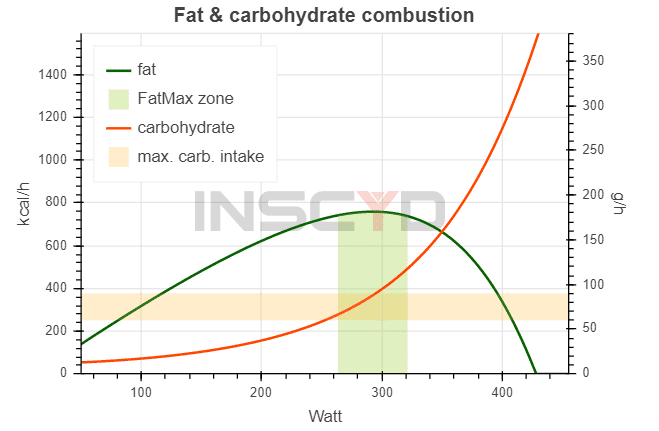
If this athlete eats 1 bar (15g carbs) per hour, there is a carbohydrate deficit of 300 grams after a 4 hour training. The carbohydrate storage in the body – also called glycogen – can cover a great portion, but over time and multiple training sessions, you’re accumulating an energy deficit. Especially when you take into account that there are also more demanding training sessions and races in a training program.
In the long term, this could lead to overtraining.
Let’s see how our INSCYD coach uses this information:
In endurance sports, a high FatMax is associated with better performance. Workouts around the intensity of FatMax are popular, but FatMax is not the universal intensity for all LSD (Long Slow Distance) workouts.
For many athletes, the amount of carbohydrates used at FatMax intensity can be (too) high to sustain the intensity for a long period of time. In those cases it’s advisable to individualize the intensity of certain workouts based on the personal use of carbohydrates.
For example: one of my athletes competes in ultra cycling competitions. In ultra cycling, the intensity at which FatMax occurs has a very strong correlation with performance. As a result, it’s very important to improve this.
FatMax can be improved in several ways. One important way is LSD training. As long as they are performed at the right intensity.
INSCYD showed me that my athlete’s glycogen content is about 236 grams. It also showed that he burns about 40 grams of carbohydrates per hour around the maximum fat combustion intensity.
Thanks to this and other information, I can customize the intensity of his workouts, making sure he gets the right training stimuli without “emptying himself”. As a result, he can recover faster and perform more LSD workouts in a row.
We can conclude that accumulating training hours at FatMax intensity makes sense when trying to improve fat combustion and the aerobic energy system.
However, some athletes may have a carbohydrate combustion rate at FatMax intensity that is too high to sustain this intensity for many hours and multiple training sessions. In those cases, endurance training intensity should be below Fatmax.
Use the FatMax intensity, corresponding carb combustion rate, and glycogen storage to determine which strategy is best for you. INSCYD provides all these metrics and more.
Get 3 more tips to increase fat combustion via the form:
With INSCYD, you can tailor training programs with unparalleled precision, ensuring your athletes achieve their peak performance faster and more efficiently.
Don’t let your athletes settle for anything less than their absolute best. Book a Free Demo with INSCYD today and experience firsthand how you can elevate your coaching game.

VO₂max, VLamax, FatMax, thresholds, fuel use and training zones, from a single test in the lab, in the field or fully remote.

