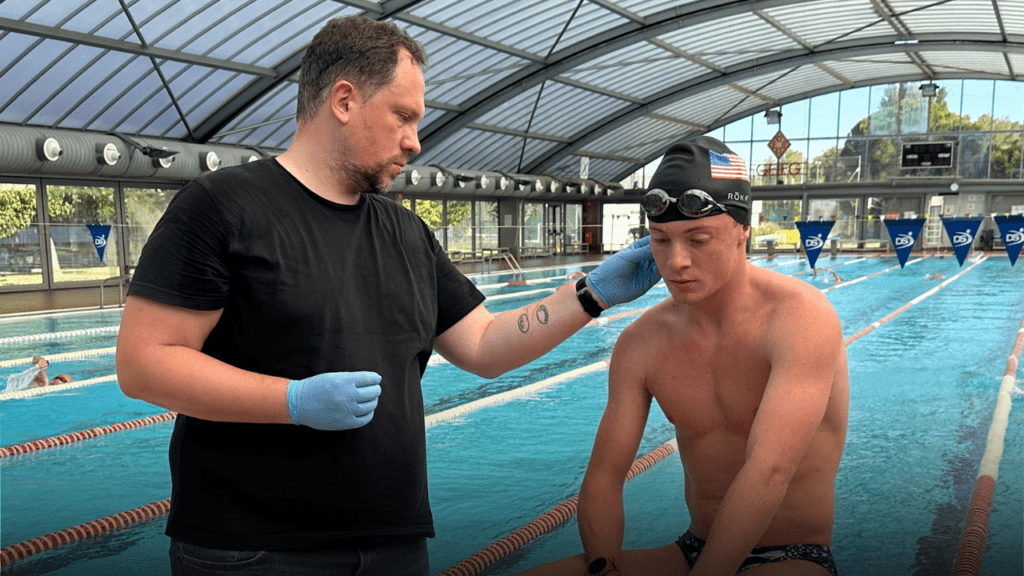
This article shows how to reverse-engineer a swim season with a simple, field-proven lactate protocol (easy submax sets plus one all-out) already used by elite programs such as the Swedish and German Swimming Federations and USA Triathlon. We explain, at a coach-friendly level, how INSCYD models lactate production vs. clearance, accounts for distribution/kinetics, and derives VLamax, VO₂max, aerobic/anaerobic energy split, race-pace energy cost, and lactate clearance vs. recovery speed—turning a classic-looking test into a modern decision engine.
Five practical applications previewed here:
Read on to replace habit with evidence, align training with race demands, and make adaptations more predictable.
Every great swim season starts long before the first hard set. It starts with a plan that’s grounded in reality—not habits. Too often we default to what worked last year, add a few new drills, and hope for different results. But if we prepare the same way, we shouldn’t be surprised when we speak the same way.
Performance testing changes that. It replaces assumptions with facts: what’s the athlete’s performance, what’s already a strength, and what will actually move the needle. Instead of guessing which sessions to stack, you can decide what to train—and why—based on objective data.
In this article, we’ll take a step-by-step, “start at the end” approach. We’ll reverse-engineer the season from the performances you want your athletes to to hit, translate those goals into concrete physiological targets, and then map those targets to training. No guilt, no lectures—just a clear path from evidence to execution.
Want to see this physiology-first approach in action? Join elite coaches from the German Swimming Federation and USA Triathlon’s Project Podium for a live deep-dive into making swim testing truly actionable.
On August 27th at 5:00 PM CEST, Sebastian Weber (INSCYD founder), Dr. Alexander Törpel (Head of Diagnostics, German Swimming Federation), and Parker Spencer (Head Coach, USA Triathlon Project Podium) will show you exactly how to screen complete physiological profiles, select optimal testing protocols, and build individualized training sets that balance aerobic and anaerobic contributions.
You’ll walk away with plug-and-play test sets, decision rules, and coaching cues you can implement immediately—no more guessing, just evidence-based training that moves the needle.
Register for “Make Swim Testing Great Again” →
The same methods these national federations use to develop world champions, delivered in a rapid-fire format designed for busy coaches who want results.
The real job of a training plan is simple to say and easy to miss: bridge the gap between what a race demands and where an athlete actually is today. To do that, we need a clear picture of both sides.
Race demands.
For most swim events, we already know the target: an approximate finishing time and a well-described metabolic blend. The latter is described in textbooks and scientific literature, which well describes energy demand and energy contribution for different events. Because races are minutes (not hours), they always mix aerobic and anaerobic energy systems. That means you can move performance by raising aerobic power, anaerobic power, or both.
Athlete status. In swimming, two pillars decide speed:
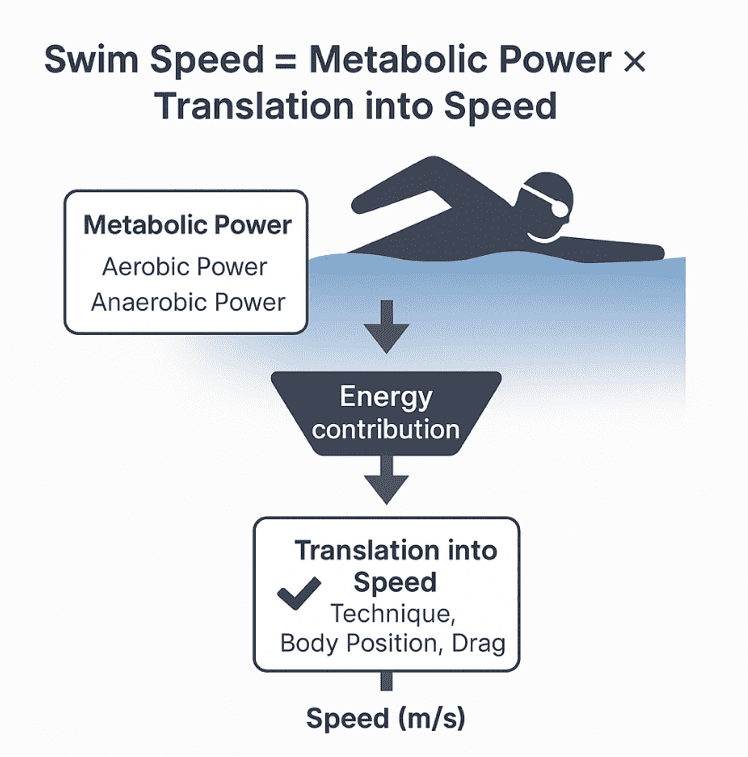
Here’s where many planning tools quietly blur the picture. Speed–duration curves show the outcome—the combined effect of power and its conversion to speed. If you only look at best speeds over various distances, you can’t tell whether the limiter is energy production (metabolic) or energy translation (technique and drag).
Let alone understanding where the energy is coming from – aerobic or anaerobic sources. The same 200 m time could come from high power with high drag, or modest power with excellent efficiency—and those athletes need very different training.
So in short: when it comes to reasoning, to understand what to focus on in training and why – a simple maximum speed over several distances leaves a coach pretty blind sighted.
So, if we want training that truly prepares athletes for their races, we must separate the questions:
Once we can answer those three questions, the gap becomes visible—and trainable.
When we don’t separate how much energy an athlete can produce from how that energy becomes speed, we risk pulling the wrong lever for months—adding volume when efficiency is the limiter, or chasing technique gains when metabolic power is the bottleneck. The result isn’t just slower progress; it’s noisy feedback. Sets feel hard, times inch forward, and we can’t tell whether we trained the right system or just got better at suffering.
The antidote is a performance testing procedure that makes the invisible visible. We need a pool-ready workflow that (1) quantifies aerobic and anaerobic energy contributions for the relevant race duration, and (2) gauges how effectively that energy translates into velocity—i.e., the drag/technique side. With that split in hand, training priorities stop being guesses and start being prescriptions.
That’s where we’re headed next. We’ll outline a practical testing flow you can run with your athletes—then show example profiles and how each one leads to different training decisions.
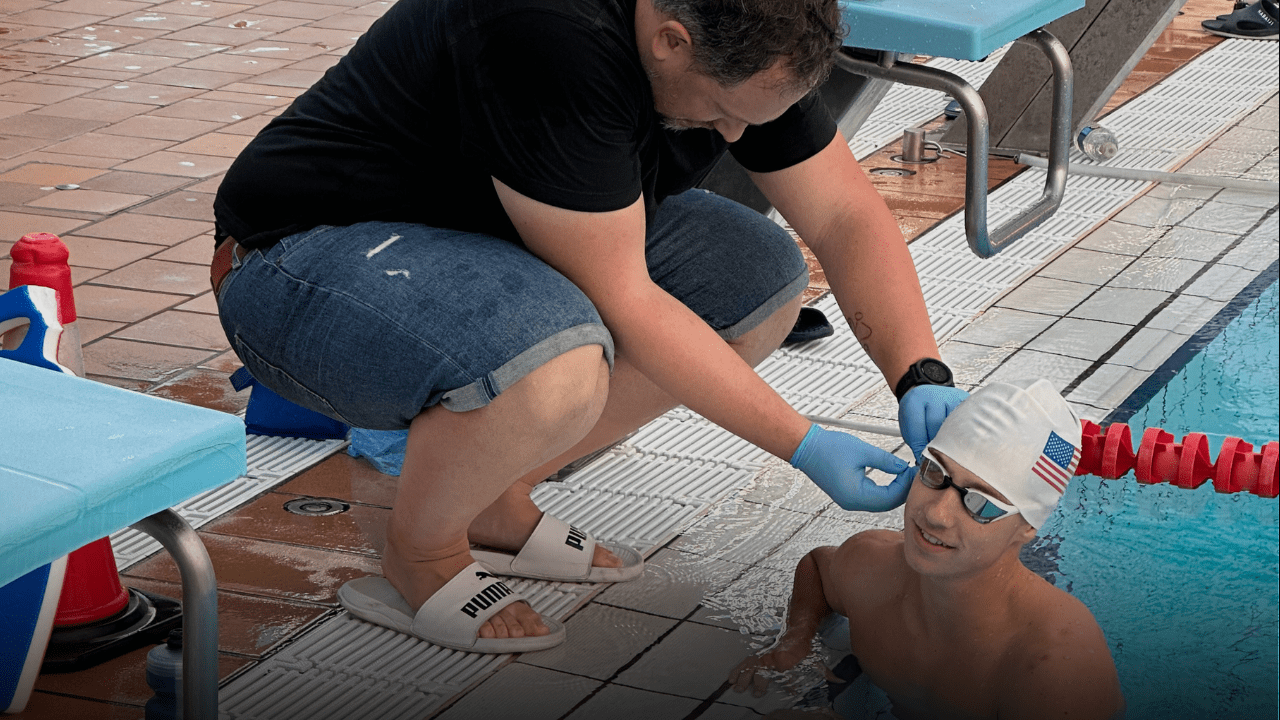
At first glance this can feel almost too simple—and not exactly new. That’s by design, and it’s field-proven. The protocol below is already used by programs including the German Swimming Federation, Swedish Swimming Federation, and USA Triathlon, underpinning substantial competitive success.
Where it works. Pool, flume, or open water—so long as distance and speed are measured precisely.
What it measures. It separates
(a) how much energy/power the athlete can produce,
(b) where that energy comes from (aerobic vs. anaerobic), and
(c) how well it converts into speed (technique/drag).
It does this with two simple pillars:
Pillar 1 — Submaximal (easy) efforts
Run a series of easy, steady efforts—ideally ≥3. These anchor the aerobic side and characterize efficiency.
Pillar 2 — All-out effort(s)
Do at least one maximal swim. This anchors anaerobic contribution and upper-end power.
Collect blood lactate:
That’s it: two pillars plus disciplined sampling. Everything else—set design, distances, strokes, recoveries—is flexible so you can tailor to your athletes and environment.
Each post-effort lactate value isn’t just a number—it’s the net result of two opposing processes happening at the same time:
On top of that, the distribution of lactate through the body (dilution volume) and the kinetics of appearance/disappearance shape the concentration you measure at the fingertip or ear. We account for those by collecting body composition data during the test and by modeling the time course of lactate.
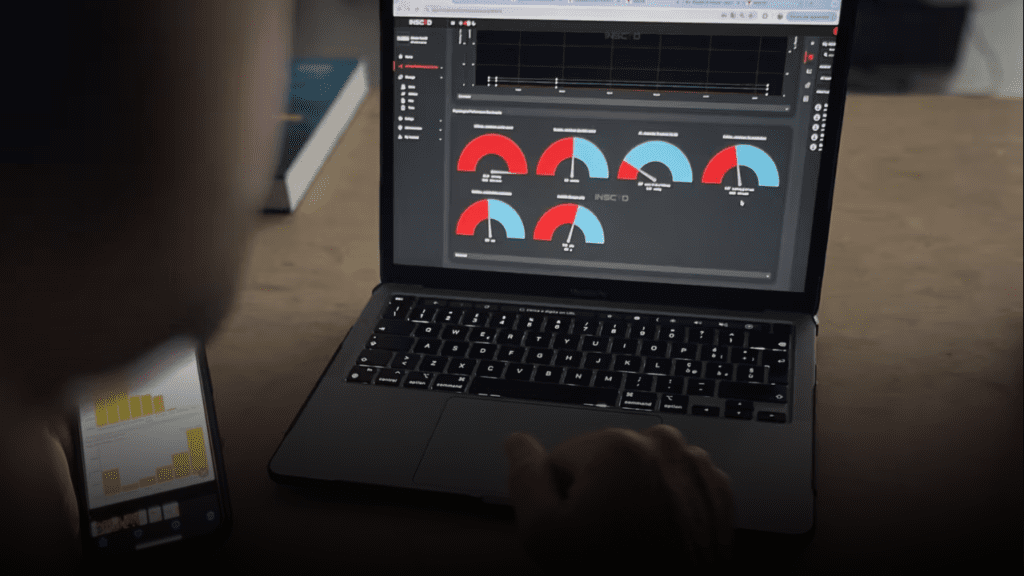
Here’s the practical outcome: INSCYD separates production from clearance. From your submax and all-out segments, the model estimates the lactate production rate (glycolytic flux) and the lactate clearance rate (oxidative usage). Once those are known, the rest unfolds:
We then use the all-out effort(s) to strengthen and verify the VLamax and VO₂max calculations against a “ceiling” performance. In validation work, VO₂max estimated from lactate data aligns closely with direct measurements from a metabolic cart—counterintuitive at first, but consistently observed.
The model can also recreate submaximal VO₂ and account for the additional oxygen cost of fat oxidation (β-oxidation), giving you a complete energy picture without needing a cart at poolside.
In short: by decoding lactate production vs. combustion, modeling their kinetics, and correcting for dilution via body composition, the test yields a suite of gold-standard physiological metrics—with a protocol that stays flexible as long as you keep to the two pillars.
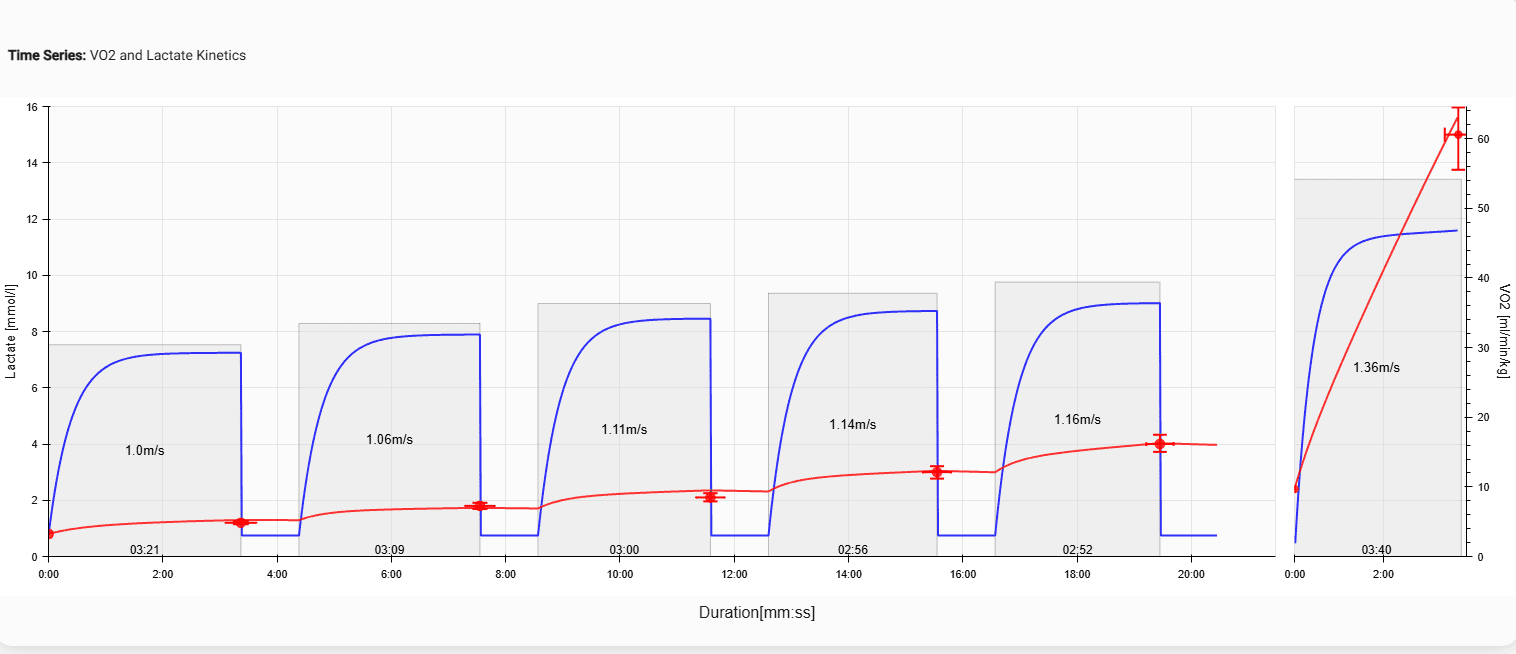
Next, we’ll show real-world example profiles and how each one translates into concrete training decisions.
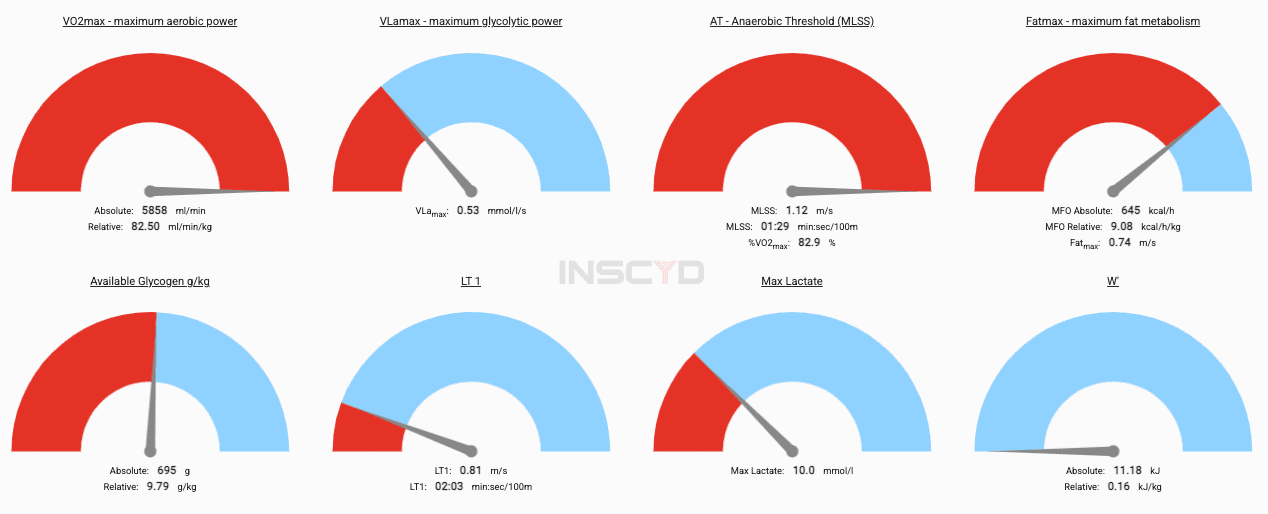
First things first: get the numbers. With this single pool session you can confirm the metrics most coaches already carry in their heads as targets—now in one place and with lab-level precision.
What you’ll have on the table:
The big takeaway: you get all of this from one protocol—not three different tests—so you can monitor it consistently. Re-test on a regular cadence (e.g., at the end of a block/mesocycle) using the same setup. Watching these metrics move—up or down—after a targeted phase tells you which adaptation you actually triggered for that athlete, not what “should” happen on paper.
Benchmarks give you a clear dashboard: set targets, track trends, and separate meaningful change from noise. Next, we’ll use the same data to move beyond “what are the numbers?” to “what’s the limiter—and what should we train now?”
Let’s be honest: training zones can feel like art, philosophy, or both.
Percent of best time? Simple—but what does that mean physiologically.
Fixed lactate ceilings? Useful—but lactate at the same speed changes with distance.
Percent of VO₂max? Powerful predictor of VO₂max gains—but only one slice of the picture.
None of these are “wrong”; they’re just partial.
INSCYD’s Training Zone Builder stitches the full picture together.
From your test, INSCYD builds a physiological model of the athlete—a kind of metabolic avatar. Like interpolating between two lactate points (but with far richer math), the model can predict the physiological response for any pace, distance, or duration you care about.
What you can ask it—instantly:
Outcome: you design intervals around the stressor you want—not just a pace label. Zones become evidence-based guardrails that match the athlete’s physiology today, and they update as the athlete adapts. It’s why the Zone Builder is a favorite among swim coaches: any set, any stroke, any metric—plus the predicted physiological reaction to confirm you’re training the right system.
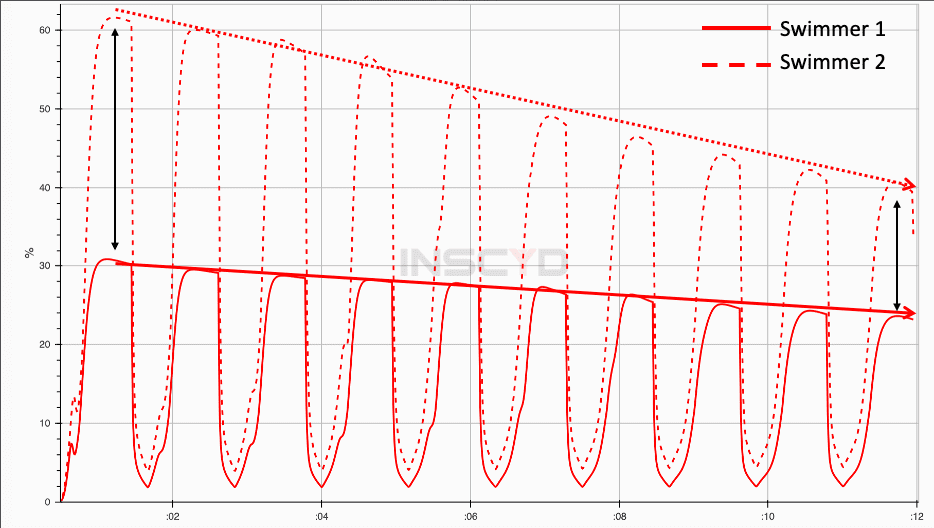
A zone defines the external load (pace, % of best time, “4 mmol/L after 400 m,” etc.). Hit the prescription and you’ll hit the number. But the internal response isn’t the same for every athlete at that external load.
Example: two swimmers both finish a 400 m at ~4 mmol/L.
And on the glycolytic side, the same pace can represent very different fractional utilization of VLamax, meaning the glycolytic training stress can be higher for one athlete and lower for another—despite identical “zone” labels. Same effort on paper → very different adaptations in reality.
Why this matters: blocks built on uniform external prescriptions can yield uneven adaptations. One athlete gets exactly the stimulus you intended; another gets a watered-down aerobic hit (or an overly strong glycolytic hit). Surprises show up at the re-test.
How INSCYD fixes it: with each athlete’s metabolic profile, you can design the set around the target internal stimulus, not just a pace tag.
Result: fewer surprises, cleaner cause→effect, and training that’s planable and (to a degree) predictable. You don’t just prescribe the same set—you engineer the same adaptation.
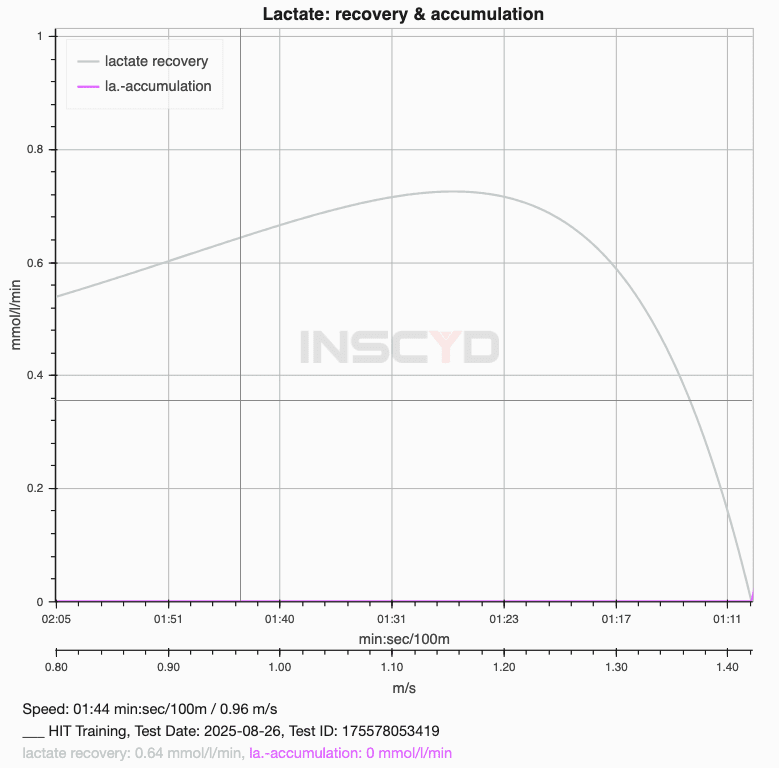
We obsess over the “on” part of intervals—and then guess the recovery. That guess can quietly reshape (or even override) the stimulus you intended. In many sets, the recovery choice has more impact on the metabolic response than the exact on-pace.
Example: 10×100 near race pace
Your test produces an athlete-specific lactate clearance curve: clearance rate as a function of recovery speed. Combine this with the Training Zone Builder and you can design recovery with intent.
Set recovery like a scientist:
Bottom line: Recovery stops being a shrug. With clearance-vs-speed in hand—and precise post-rep predictions—you can engineer the same physiological stimulus across athletes or purposefully create different ones, with no surprises at re-test.
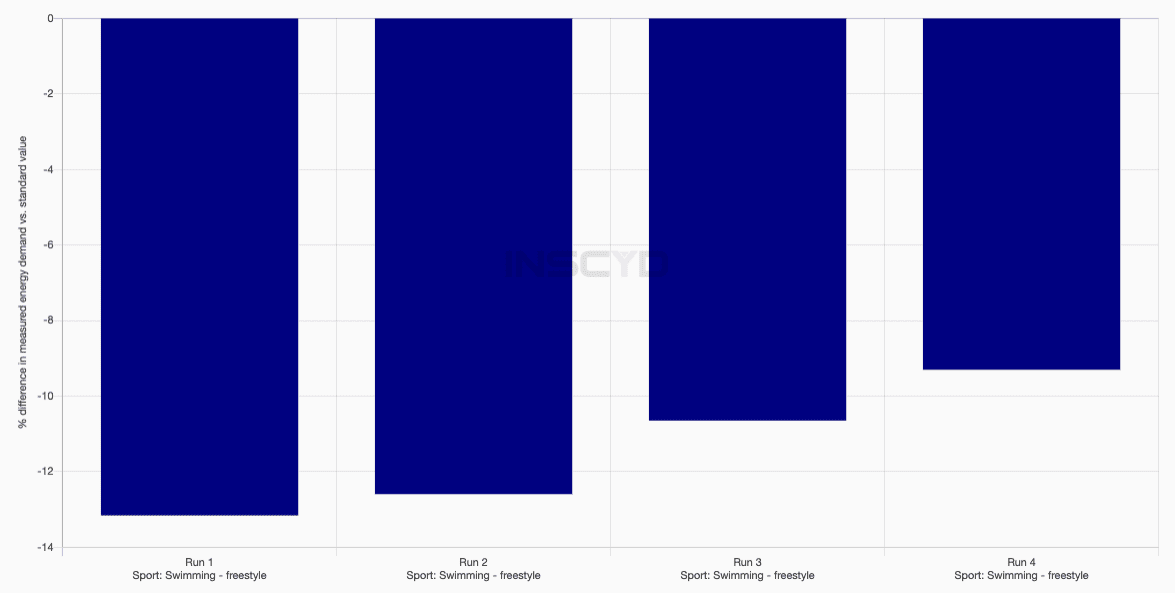
Two things set swim speed:
INSCYD quantifies total energy cost for every effort in your test and then models it across speeds. Three reasons this matters:
What you can do with it:
Bottom line: By quantifying total energy demand at race-relevant speeds—not just VO₂ at easy pace—INSCYD gives coaches a clear, comparable, and trackable view of swim economy where it matters most.
The problem: training should bridge the gap between race demands and athlete status. In swimming that means understanding (1) how much energy the athlete can produce (aerobic and anaerobic) and (2) how well that energy converts into speed (technique/drag). Looking only at speed–duration curves blurs those pieces.
The protocol (simple by design):
Two pillars + lactate sampling—run in a pool, flume, or open water.
This “old-school-looking” setup is already used by elite programs (e.g., German Swimming Federation, Swedish Swimming Federation, USA Triathlon) because the outputs are decisively modern.
What happens with the data (why it works):
INSCYD models the lactate you measure as the balance of production (glycolysis) and clearance (oxidative combustion)—while accounting for distribution/dilution (via body composition) and kinetics. From that, it deciphers:
The result is a physiological avatar of the athlete that predicts responses for any distance, pace, or marker you care about.
If you reverse-engineer the season with this test, you don’t just plan better sets—you make better bets on adaptation.
Ready to implement this physiology-first approach with your swimmers? Join elite coaches from the German Swimming Federation and USA Triathlon’s Project Podium for a live masterclass in making swim testing truly actionable.
On August 27th at 5:00 PM CEST, Sebastian Weber (INSCYD founder), Dr. Alexander Törpel (Head of Diagnostics, German Swimming Federation), and Parker Spencer (Head Coach, USA Triathlon Project Podium) will demonstrate exactly how to screen complete physiological profiles, select optimal testing protocols, and build individualized training sets that balance aerobic and anaerobic contributions.
You’ll walk away with plug-and-play test sets, decision rules, and coaching cues you can implement in your very next session—the same evidence-based methods these national federations use to develop world champions.
Register for “Make Swim Testing Great Again” →
Stop guessing. Start using real physiological data to individualize your swimmers training and drive consistent progress.
VO₂max, VLamax, FatMax, thresholds, fuel use and training zones, from a single test in the lab, in the field or fully remote.

