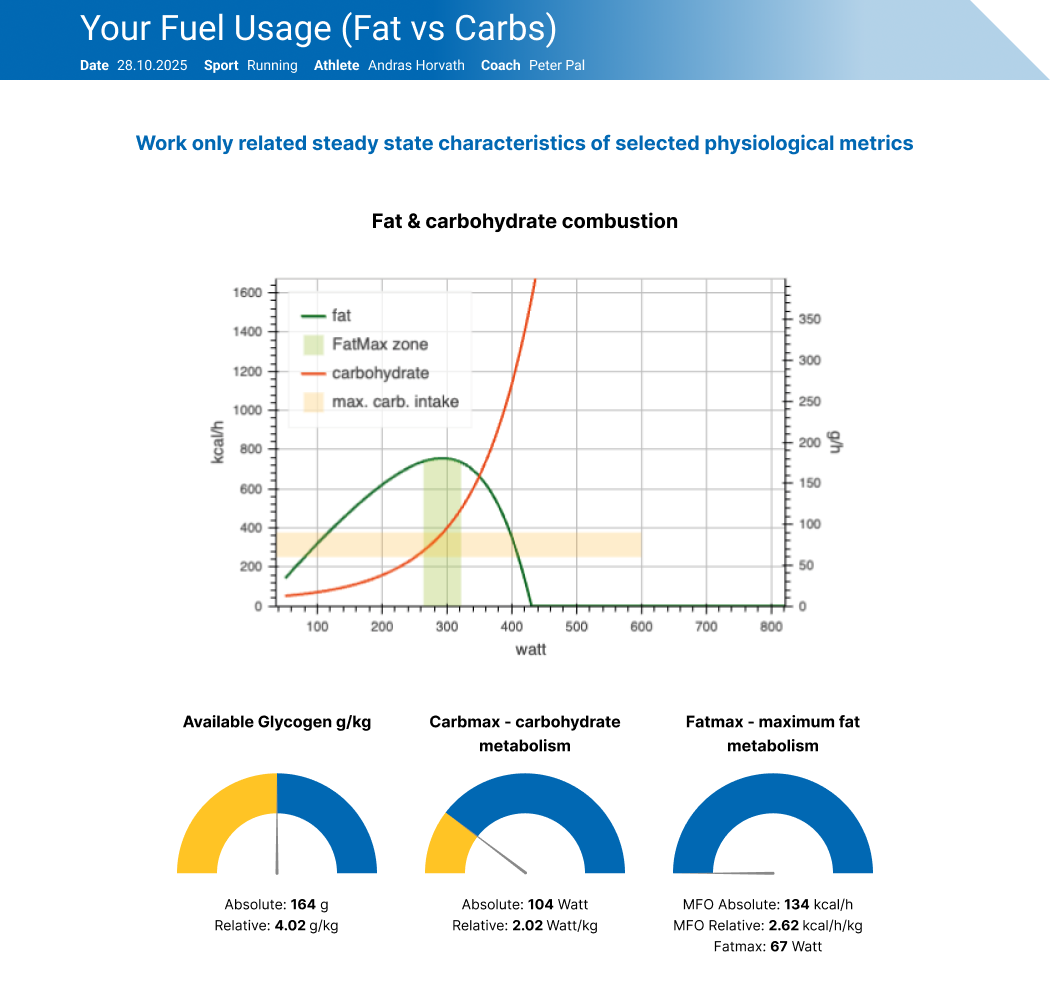
Glycogen. Available Glycogen.
Glycogen is the storage form of glucose in the body. Instead of storing large amounts of glucose directly, skeletal muscle stores glucose in the form of glycogen, which can then be broken down and used to provide energy during exercise.
Available Glycogen describes the amount of glycogen that is available for exercise in the muscles actively involved in that exercise, such as leg muscles in cycling or legs and arms in swimming.
Available Glycogen counts only the muscles doing the work: not total-body glycogen, and not liver glycogen.
Trusted by the teams and federations behind the best in sport
From national federations and Olympic programmes to WorldTour teams and professional clubs worldwide.
Glycogen in training. Maximizing specific training outcomes.
Glycogen availability is not only something to maximize. It can also be deliberately manipulated according to the goal of a training session.
For low-intensity endurance sessions, reduced carbohydrate and muscle glycogen availability increases fat oxidation and amplifies cellular signals for a higher aerobic adaptation.
The opposite applies when the objective is to perform high-intensity work. Threshold intervals, HIIT, repeated high-intensity efforts and sprint training require high rates of carbohydrate-derived energy production, and insufficient glycogen will reduce the power or speed and therefore training quality that the athlete can achieve.
The practical goal is therefore not simply to train with high or low glycogen, but to fuel for the work required.
The session objective sets the glycogen target
- ↑fat oxidation
- ↑adaptation signals, amplified
- ↑carbohydrate-derived energy
- ↑training quality, power and speed
Combining Available Glycogen with carbohydrate-combustion rates allows training and nutrition to be matched to the objective of specific training sessions.
Available Glycogen in every INSCYD assessment.
Because of its importance for both training and competing, the available Glycogen is included as a standard metric in INSCYD assessments. It is evaluated as part of any testing protocol or procedure and does not require a separate glycogen-specific laboratory test.
The glycogen storage metric is based on a physiological model derived from peer-reviewed research describing skeletal-muscle glycogen in relation to factors including muscle mass, training status, carbohydrate availability, exercise mode and the muscles involved in the activity. It has been used globally across practitioners and shown to provide precise prediction of race performances in endurance sport events.