Most swim coaches track times and lactate but miss three critical dimensions of performance testing: VLamax, substrate utilization, and individual metabolic profiling that reveal why two swimmers perform differently.
If you’re working with swimmers, you’re likely doing some kind of swimming performance testing on a regular basis?! (and if not you should consider starting it). Maybe you’re tracking swim times at set distances, using lactate strips poolside, or monitoring heart rate and RPE. Whatever your exact protocol, the goals are almost always the same:
That’s the foundation. But here’s the thing: swimming performance isn’t just about getting faster. It’s about understanding why a swimmer gets faster—or doesn’t. And that starts with understanding what physiologically drives performance in swimming.
Unlike a marathon, where energy is almost entirely derived from aerobic metabolism, or a 100-meter sprint, which is mostly anaerobic, swimming events nearly always sit in the middle. Whether it’s a 100m freestyle or a 400m IM, performance is powered by a mix of aerobic and anaerobic energy systems. And the tricky part? A swimmer can improve their performance by improving either one—or both.
That makes things more complicated. Because it’s not just about training hard—it’s about knowing which system to target. Focus too much on the aerobic system, and you might leave untapped anaerobic potential on the table. Focus too much on the anaerobic side, and you risk killing aerobic efficiency and long-term sustainability.
There’s another crucial factor that can’t be ignored: the swimming economy, also known as the energy cost of swimming. No matter how strong the engine, it matters how efficiently it moves through water. Swimming economy is influenced by technique, stroke mechanics, and body position. And it often plays a deciding role—especially when two swimmers have similar metabolic profiles.
Let’s align on this:
So before diving into 3 advanced performance testing strategies, lets watch the video to discover how to identify the physiological reasons behind a swimmer’s performance — including how to uncover their aerobic capacity, anaerobic power, and energy efficiency using a single smart protocol
Now, let’s take a closer look at what you can do in swim testing—that you likely don’t do yet.
Your performance testing in swimming might be simple and straightforward: swim a few set distances at maximum speed. And honestly—there’s a lot to like about that approach.
It’s close to racing, it feels sport-specific, and it’s easy to adapt the test set to the athlete’s target race distances. Best of all, it gives you one clear outcome: how fast is the swimmer?
Based on that, you might set training intensities as a percentage of best time over a given distance and use those splits to build interval sets. It’s easy, practical, and provides excellent comparability to actual race performance.
But here’s where this approach misses the mark: it doesn’t offer any insight into the physiology behind that performance.
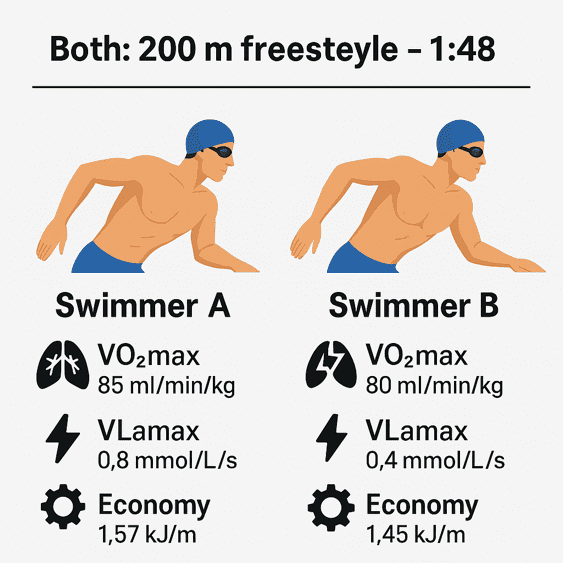
Let’s say your swimmer’s 400m time improves. That’s great—but why did it improve? Was it due to a better swimming economy? Improved aerobic capacity? Enhanced buffering ability? Increased anaerobic power? You don’t know.
Sure, you might try to guess. If the 50m time didn’t change, maybe it wasn’t anaerobic power. But even then, you can’t be sure—maybe technique improved, maybe glycolytic power did.
You’re still in the dark.
And when do you use those best times to set training intensities? Sure, you know the swimmer can hit the times—but what physiological stimulus does that training actually produce?
You have no idea:
So maybe you’ve moved beyond that. Maybe you’re doing some physiological testing—like lactate testing or even VO₂ measurements. That’s already a big step forward.
You might run an incremental test with lactate samples to build a lactate curve. In some setups, you might even get VO₂ data from an all-out effort and estimate the swimmer’s VO₂max.
That’s helpful. But even here, the picture remains incomplete.
Also, most incremental protocols don’t include true all-out efforts—so you miss out on data from the high-intensity end of the performance spectrum. If you want that information, you need to add separate time-trials or sprint tests, which many coaches don’t.
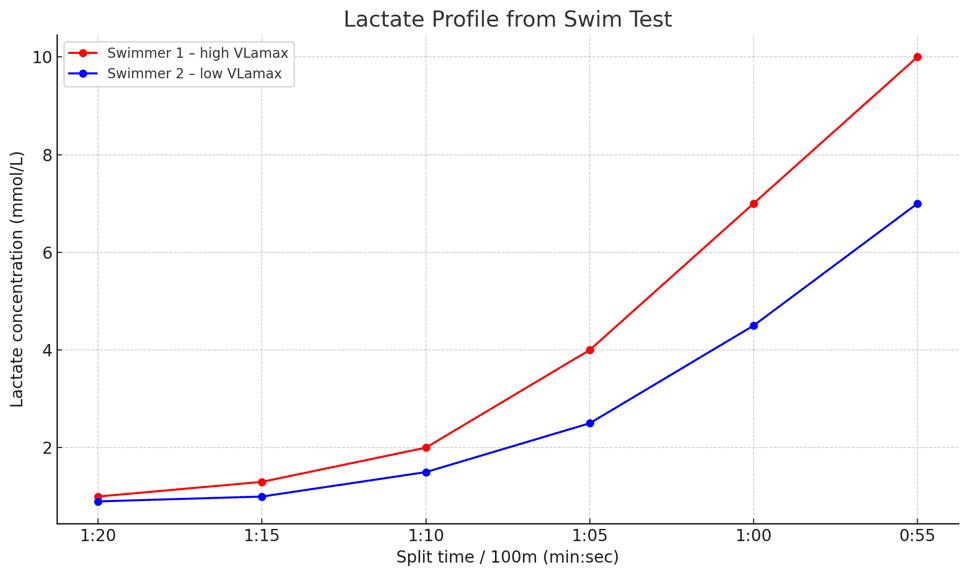
Then there’s the issue of training zones. When using lactate data, you might switch from % of best time to zones based on % of lactate threshold—or worse, fixed lactate values (e.g., 2 mmol/L or 4 mmol/L). But think about this: if your lactate test involved 200m or 400m intervals, the data you get only reflect lactate dynamics at that specific distance.
That means you’re blind when it comes to other distances. You can’t easily extrapolate to 50m, 100m, 600m, or 800m. And that’s a problem—because most swim training involves a mix of distances, each with different metabolic demands.
In short
Your current performance testing might be giving you some answers—but it’s also leaving a lot of important questions unanswered. Whether you’re using race-pace time trials, lactate step tests, or even VO₂ equipment, there’s a good chance you’re missing the full picture.
That’s exactly why we’re going to look at three powerful upgrades you can implement in your testing. These will help you close the gaps and finally get the insights you actually need to guide training and improve performance.
Let’s dive in.
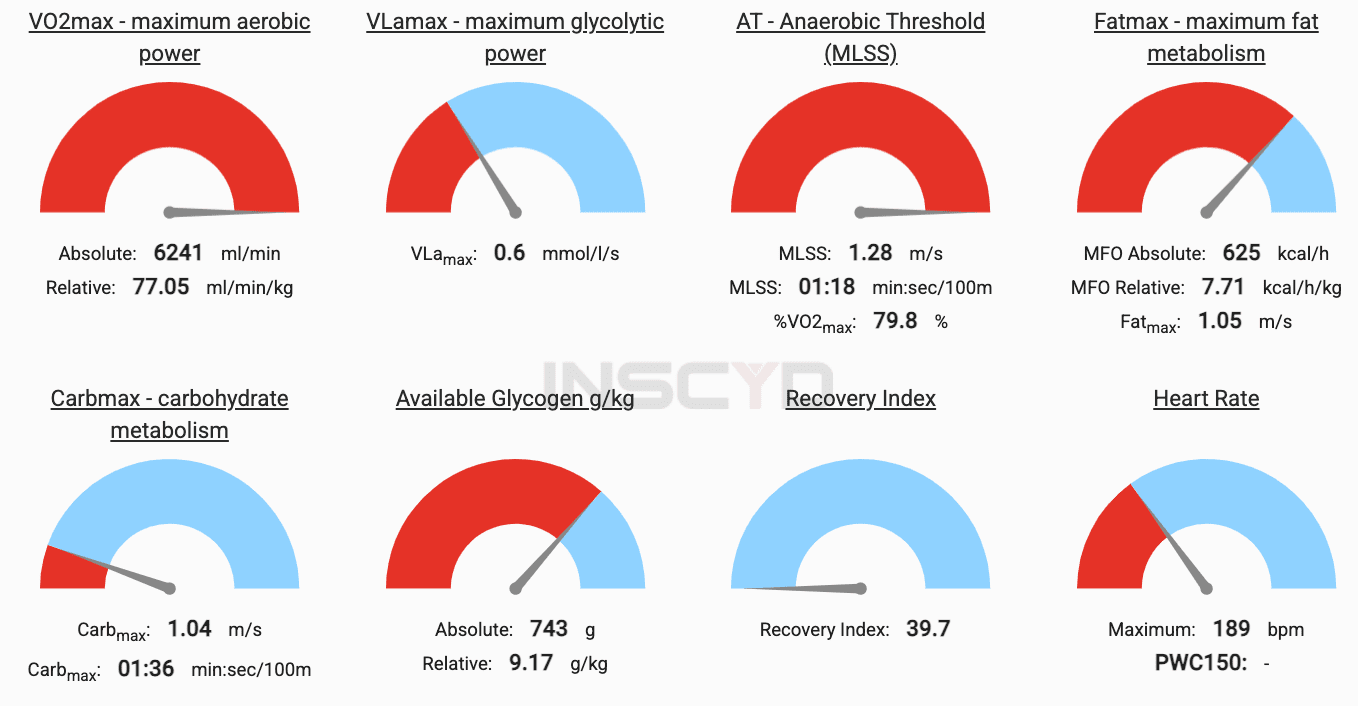
What if we told you that a single lactate test—designed the right way—can give you the swimmer’s VO2max, VLamax, thresholds, and even aerobic and anaerobic energy contribution?
No expensive lab setup. No gas exchange measurements. Just blood lactate. Sounds too good to be true? It’s not.
Here’s how it works: every measured lactate value is the result of two competing processes—
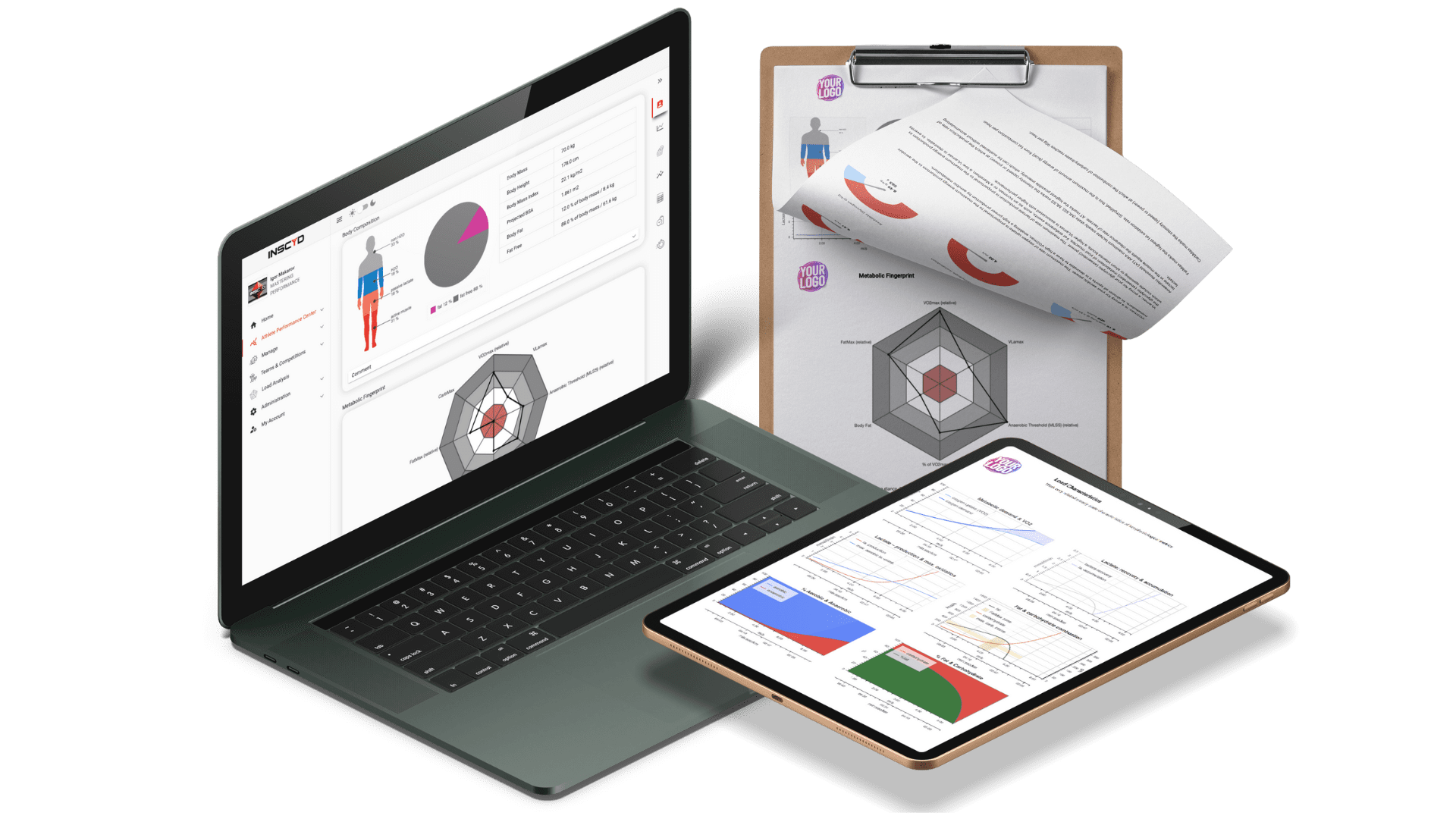
When you measure lactate at different intensities—especially when your protocol includes both submaximal and maximal efforts—you can extract both ends of this equation. That means you’re not just collecting lactate values—you’re uncovering the swimmer’s metabolic fingerprint.
“But wait,” you might ask, “didn’t we just say submax lactate testing misses race-specific speeds and distances?”
Yes—if you use a rigid, old school, incremental-only protocol. But here’s the upgrade: you don’t have to.
In this approach here, you can mix and match efforts however you want. Want to include 2 or 3 all-out swims at different distances or even different strokes? Go for it. Working with an open water athlete who needs longer, lower-speed steps? No problem. Testing younger swimmers where 200m is already a stretch? That works too.
You design the test to fit the swimmer—not the other way around.
And despite including multiple max efforts, you’re not necessarily extending the test time. Those all-out swims need a proper warm-up anyway—so why not measure lactate during warm-up steps? Those submax efforts already contain valuable physiological information.
So what you get from this kind of protocol is:
And for the all-out efforts: you will also have the aerobic vs anaerobic energy contribution, allowing you to decipher how the swimmers body delivered the needed energy and which of the two systems offers the biggest room for improvement via training.
All from a flexible, customizable lactate test. You don’t even need to abandon or change your current protocol—unless you want to give these new opportunities.
That’s the first big shift: stop testing for lactate levels and start using lactate to uncover the whole metabolic system.
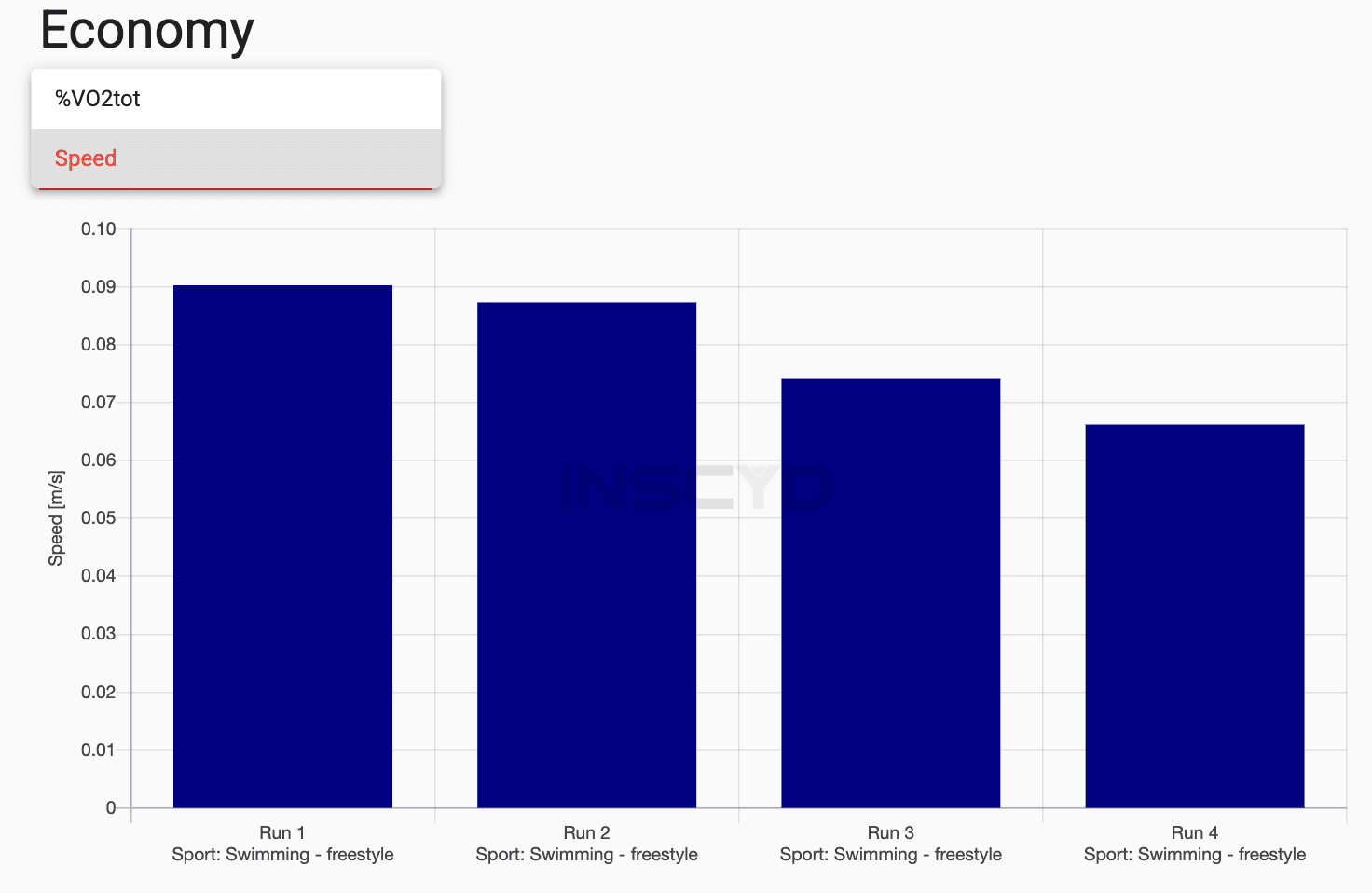
If you’ve ever done VO₂ testing in swimming, you’ve probably tried to use it to calculate swimming economy. After all, it seems straightforward: measure oxygen uptake at different speeds, then look at the ratio—VO₂ per meter swum. Maybe you even convert that into energy using the caloric equivalent.
That’s a step in the right direction—but here’s the problem:
VO₂ only reflects the aerobic part of the energy equation. And in swimming—especially over short to middle distances—a significant portion of energy doesn’t come from oxygen at all.
It comes from the anaerobic system. And VO₂ measurements miss that completely.
This becomes a major problem when:
Let’s look at some examples:
So relying on VO₂ alone gives you a misleading picture—especially when you care about race-specific intensities. In other words, you’re measuring the economy where it doesn’t matter, and ignoring where it does.
Now, let’s go back to what we introduced in Upgrade #1: a protocol designed by you around your swimmer that combines submax and max efforts—and includes lactate sampling.
That’s where the magic happens.
Lactate tells the story of the anaerobic energy contribution. And when you combine that with VO₂ data (which gives you the aerobic part), you get the total energy demand—even for short, intense, anaerobically driven efforts.
That means you can now calculate:
And here’s where it gets really practical:
Worried that VO₂ testing means snorkels, flumes, restricted breathing, and lab like artificial swimming?
Not anymore!
These days, VO₂ can be measured on the pool deck—post-exercise, without interfering with technique, flip turns, or breathing rhythm. It’s affordable, non-invasive, and available where it matters most: in real swimming, with real strokes, under real conditions.
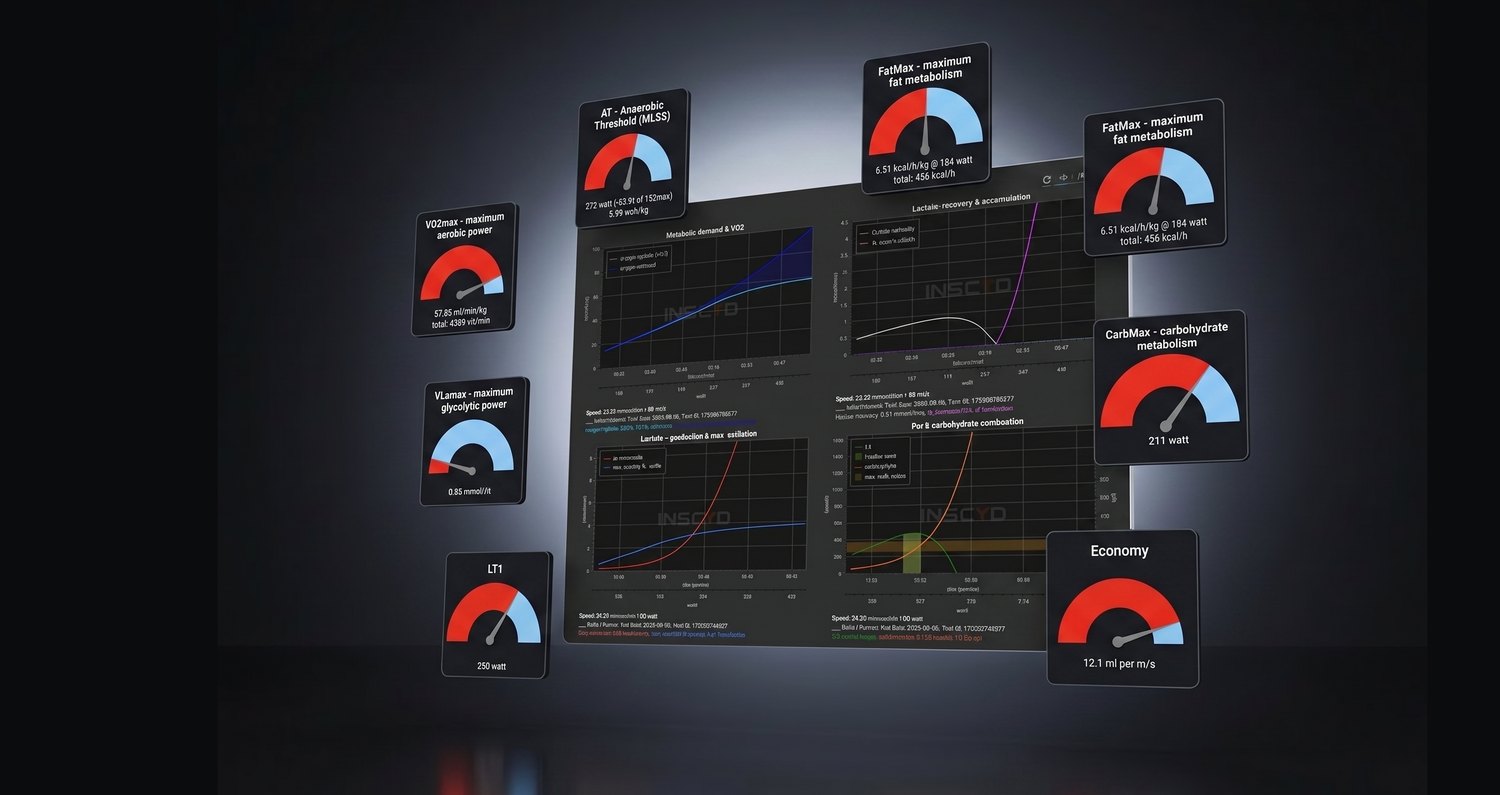
By now, we’ve seen how you can build a lactate test that fits the swimmer, not the other way around. You’ve learned that this flexible protocol can reveal a full metabolic profile—including VO2max, VLamax, thresholds, and race-pace economy.
But now comes the most important part: using that data to prescribe better training.
Earlier, we discussed that setting training intensities based purely on % of best times misses the physiology entirely. And we showed that conventional lactate profiles are limited—they only tell you what happens at the distances you tested, and they don’t reflect the actual energy systems behind performance.
So how do you bridge that gap between physiological insight and practical programming?
Enter the Training Zone Builder—a tool that acts more like a training effort configurator than a rigid zone chart.
It does two key things:
With the Training Zone Builder, you’re no longer stuck using fixed distances from a test or arbitrary thresholds. Instead, you can define zones based on:
Let’s say you’ve identified that your swimmer needs to improve aerobic capacity. The tool can calculate the exact speed required to hit that stimulus for a 100m or 300m interval. Want to prescribe work that pushes anaerobic lactate tolerance? Same idea—you get precise, individualized speeds based on the athlete’s own metabolic profile.
In other words: you can now build training from the physiological goal backward, not from arbitrary times forward.
But it doesn’t stop at prescribing effort. For every training set you define, the system can show you:
So even if you start by using your familiar zone framework—say, based on fixed lactate values—you can gradually expand. You’ll learn more about each athlete’s response in those zones, test new set ideas, and refine your plans with real data.
What this means for you as a coach:
And the confidence that your training is not just hard—but smart
If you’re ready to go beyond the theory and apply everything you’ve just read—Join us for 4 days of in-depth education and hands-on physiological testing designed to sharpen your coaching and testing skills. Work hands on with athletes, master nutrition strategies, and connect with a global, science-driven community—guided by the scientist and coach behind multiple Olympic champions.

Over four immersive days, you’ll:
👉 Secure your spot now — early bird pricing ends soon, and spaces are limited.
Everything you’ve read above isn’t theory. It’s not a wishlist for the future. It’s already here—and it’s called INSCYD.
INSCYD software allows you to:
Best of all, INSCYD is built on peer-reviewed science. Every model, every calculation, and every recommendation is based on validated, published research—not on AI gimmicks, not on anecdotal guesswork, and not on fuzzy “from experience we know…” statements. You get clarity and trust, not hype.

That’s why national federations, Olympic swim teams, and elite coaches rely on INSCYD. Athletes using INSCYD have gone on to win Olympic medals, break world records, and unlock new levels of performance—because they finally had access to the right data, at the right time, in the right way.
And what if you’ve never done lactate testing before? No problem. We’ve got you covered:
It’s more affordable than you might think—and once you try it, you’ll never want to go back to guessing.
Ready to begin? If you’re not yet using INSCYD, book a free demo and take the first step toward smarter testing, deeper insights, and better training—built specifically for swimming.
And if you’re an athlete, find an INSCYD-certified coach or lab to get your metabolic profile.
Stop guessing. Start using real physiological data to individualize your swimmers training and drive consistent progress.
Brooks, G. A. “Lactate: glycolytic end product and oxidative substrate during sustained exercise in mammals—the “lactate shuttle”.” Circulation, respiration, and metabolism: current comparative approaches. Berlin, Heidelberg: Springer Berlin Heidelberg, 1985. 208-218.
Rogatzki, M. J., Ferguson, B. S., Goodwin, M. L., & Gladden, L. B. (2015). Lactate is always the end product of glycolysis. Frontiers in neuroscience, 9, 22.
Brooks, George A. “Lactate as a fulcrum of metabolism.” Redox biology 35 (2020): 101454.
VO₂max, VLamax, FatMax, thresholds, fuel use and training zones, from a single test in the lab, in the field or fully remote.

