From cycling races to football matches: sparing carbohydrates and utilising fat as a fuel is of pinnacle importance in many sports competitions. Especially in competitions with non steady load patterns (cycling, basketball, soccer, olympic triathlon, XC skiing) the race decisive moments depend highly on anaerobic energy supply and therefore on the availability of glucose as a fuel. In contrast the assessment of substrate utilisation using coventional testing methods such as a metabolic cart is limited to quasi steady state and submaximum load patterns. Hence the typical laboratory assessment of fat and carbohydrate utilisation cannot be applied to analyse substrate utilisation in may sporting events.
Long description:
Experiments
Fifteen healthy trained males were recruited for this project. Each of them underwent a series of load tests on a cycling ergometer (Cyclus 2, RBM Electronic, Leizpzig Germany): 1) A series of three sub-maximum efforts including pre and post efforts lactate measurements. 2) An all out test with an intensity set to results in fatigue after 3 – 5min; including pre and post efforts lactate measurements as well as measuring of gas exchange using the mixing chamber technology (Cosmed K5, Rome Italy). During each test power, heart rate and cadence is recorded with 1Hz.
This data is used to create a metabolic profile in INSCYD (VLamax, VO2max, MLSS, MMSS, lactate production and combustion kinetics, etc.)
Afterwards each subject undergoes two different training sessions, on three different days in randomized order:
an interval training: The test consists of a 10-min warm up (1,5 W/kg) followed by a high intensity interval workout, as follows: 10min @ 85% power at maximal lactate steady state (MLSS)
10min@105 % MLSS
10min@ 65% MLSS
6x (4min@VO2max-power followed by 6min@FatMax recovery)
10min@75% MLSS
a 100min endurance training: The test consists of a 10-min warm up (1,5 W/kg) followed by an 80-min workout which incorporates stochastic load changes, as described below:
4 intervals of 20 min duration, each interval is composed of:
a. 15min work-interval composed of 6 workbouts of 1-5 min duration and 70-110% VO2max power intensity. The duration and the intensity of these efforts are randomly assigned by the computer (Microsoft Excel Rand-function), with following restrictions: (1) workbouts of 100-110% VO2max are limited to 1 min duration (2) a maximum of 2 workbouts of 100-110% VO2max can be programmed one after the other.
b. 5 min recovery-interval at fatmax-power
Power, heart rate and cadence are recorded with 1Hz. Pulmonary gas exchange is recorded breath-by breath. Capillary blood samples are taken from the earlobe and analyzed for blood lactate concentration. A patch-like biosensor is used to measure interstitial lactate concentration.
Analysis & Modelling
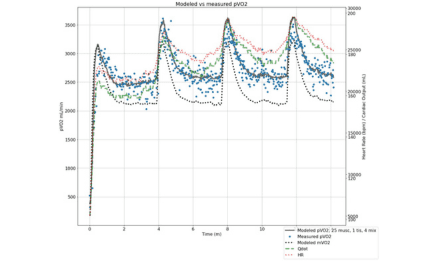
We created a computer model to simulate the dynamics of the muscular substrate utilization under non constant load. With this model it is also possible to calculate the VO2 and VCO2 and hence RER values. Those RER values are then compared to the RER values recorded by the metabolic cart.
Limitations: pulmonary RER, especially under non steady state conditions, is of limited accuracy as a proxy for substrate utilisation. Pulmonary gas exchange is not only a function of muscular gas exchange but of whole body. Furthermore the kinetics of VO2 and VCO2 are different, hence RER values under non steady state conditions can not represent the actual substrate utilizations at a given point in time. Especially high intensity exercise may result in acidosis and therefore in a utilization of buffering systems hence influencing the measured VCO2 values.
How cycling ergometer settings in all-out sprints change power output and calculated VLamax. An INSCYD research project with Zuyd University, KU Leuven and University Hildesheim.
Separating muscular from pulmonary oxygen uptake kinetics with a computer model of the cardiopulmonary system. An INSCYD research project with Prof. Dr. Aaron Baggish and CREPS Aquitaine.
Read the project
Every metric that matters
One assessment. The complete picture of your athlete’s physiology.
VO₂max, VLamax, FatMax, thresholds, fuel use and training zones, from a single test in the lab, in the field or fully remote.