
Coach and sport scientist Florian Heck shares how he and his trail runners benefit from combining INSCYD metabolic profiling with Stryd running power data, from test protocol to race pacing and interval prescription.
In this use case, coach and sport scientist Florian Heck shares how he and his runners benefit from combining INSCYD software with (STRYD) running power data.

Florian Heck, coach and managing director at KickAss Sports, shares his story about testing and coaching an experienced trail runner, using INSCYD and STRYD.
It all starts with a test, to better understand the physiology of the trail runner:
Although all INSCYD running tests (from VO2 lab tests to lactate field tests to GPS-only remote tests) give you the results we’re going to talk about, we focus on 2 commonly used tests:
When you want to test your runner where it matters, use a field test. By combining lactate and running power data, you can test anywhere. For some of Florian’s trail runners, that means the test is performed on an actual trail.
Florian Heck:
“We have some trails nearby where we can test. This allows us to test under the same conditions as in a race.
We know some athletes are better in trail running than street or track running. It can be very different, if only because of the different shoes. You want to capture those differences in a test.”
The protocol consists of 3 sub-maximal efforts and 1 all-out effort. Lactate is measured before and after the efforts. (Stryd) power is measured during the efforts. The test results are uploaded in the INSCYD software. More about the results and practical applications later in this article.
Sometimes it’s more convenient to test athletes remote. For instance when they are on training camp, don’t live nearby or simply want to be able to frequently test without spending to much time on it. With INSCYD that is possible, using only a Stryd or GPS watch. This test is also known as the Power-Performance Decoder (PPD).
From a business perspective, this enables coaches to broaden their target audience and help athletes who live all over the world.
Florian Heck:
“One of my trail runners, Josef, lives in Munich, which is not nearby for me. Even though we have never met in person, the PPD test worked very well for him.
Josef just performed the protocol that I shared with him.”
The protocol consists of 4 max efforts, and is best performed on a flat road or running track. Speed is the only thing you need to measure. This could be measured via a GPS watch or by using Stryd.
Simply upload the test file in the INSCYD software, and get a full metabolic profile.
As mentioned, all INSCYD running tests link running power to your individual physiology. It gives you access to your aerobic- and anaerobic energy contribution, your fat- and carb combustion, your lactate production- and recovery rate and many more important metrics.. based on running power.
Watch the webinar recording of INSCYD x STRYD to learn more about this.
Back to Florian’s trail runner, Josef, who performed a remote INSCYD (PPD) test. Josef is competing mostly in 50k races with 3000-4000m vertical gain (!). Florian:
“Josef mentioned that he is often not able to maintain his running power in the second half of a trail run race. He has no energy left to finish strong.
Because his next race was after 3 weeks already, I knew there was not enough time to solve this problem from a training progress perspective. To solve it anyway, I first took a look at his race pacing and nutrition. I assumed he started a race too fast or didn’t consume enough energy during the race. This was not really the case.
Then I looked at his race preparation in the last week before a race. At first it seemed quite normal, but then I linked his running power with the INSCYD report. Although his endurance runs were well below anaerobic threshold (or critical velocity), I noticed he did burn a lot of carbohydrates at this running power. Sometimes he ran even multiple hours at a carbohydrate combustion of 100 grams/hour. This emptied his tank, even before the race has started.
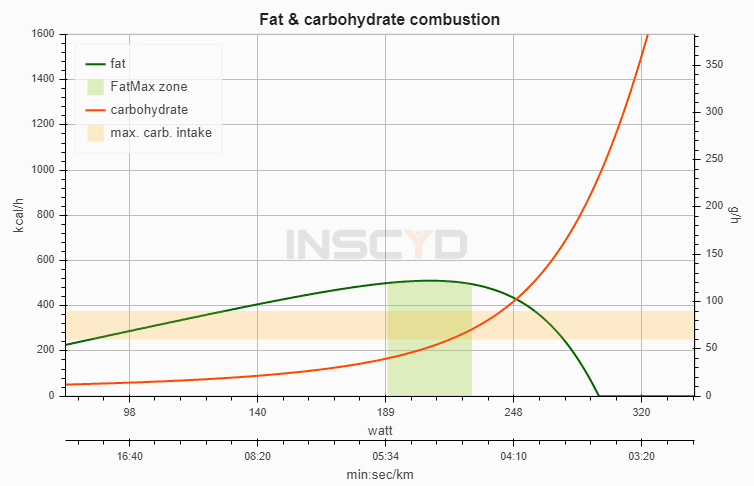
This insight made clear he had to run at a lower intensity in the week before a race. Probably closer to a running power that correlates with burning 50 grams/hour, which is easy to replenish. Changing this, and further improving pacing and fueling based on power, improved his race results, even before we could make some serious training progress.”
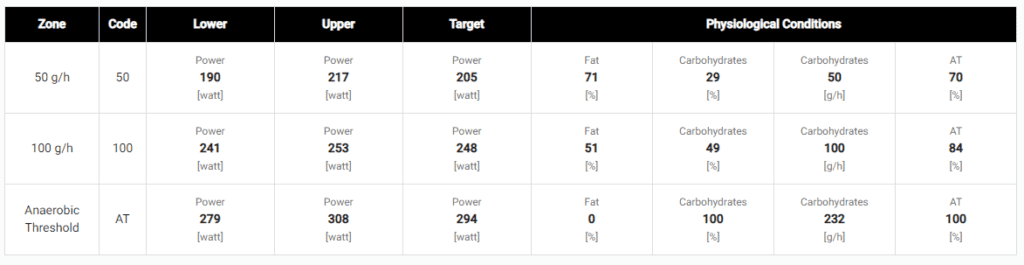
As so often the case, fundamental training and race tactics start with knowing what you actually want to trigger in the body. In the example of Florian and Josef, the carbohydrate combustion needed to decrease, to prevent having an empty tank before the race even started.
They chose to decrease training intensity from 100 grams of carbohydrates per hour to 50 grams/hour. INSCYD links these metabolic insights – like carb combustion, fat combustion, lactate accumulation etc. – with exercise intensity. Although this could be heart rate and speed, many running coaches prefer power. Florian explains why:
“Speed or pace was never really useful in trail running, since it depends too much on the surface and altimeters. Therefore, heart rate was the only solution before running power existed.
Even though my trail runner, Josef, is a very experienced runner and knows how to run based on how he feels and heart rate, power still gives us a way more objective measure for intensity.
It’s great to now have the connection between INSCYD and running data. Power data enables me to accurately show my athletes what the running intensity should be, INSCYD data enables me to find out and communicate why it should be that power number.”
"Power data enables me to accurately show my athletes what the running intensity should be, INSCYD data enables me to find out why it should be that power number.”

Florian HeckCoach and managing director at KickAss Sports
We’ve seen how carbohydrate combustion rates can determine the ideal running intensity during endurance runs and races. Florian shared one more training example that illustrates the benefit of the combination of INSCYD and (Stryd) running power in shorter interval training.
Florian Heck:
“In trail running, the intensity can easily fluctuate depending on the trail: uphill, downhill, surface etc. This means you could be accumulation lactate during a hilly section, and need to recover from that effort during an easier section. But sometimes it takes a while before there is an easier section.
That’s why I train my trail runners to be able to recover from a high lactate concentration, while maintaining a high pace. I do this by starting a longer interval with a 2 minute acceleration. I use INSCYD to determine both the intensity for the 2 min. acceleration and the following longer interval.
For instance: first run 2 minutes at 370 watt. The image below shows that this increases lactate concentration by 6 mmol/l (2 minutes * 3 mmol/l/min). Then continue the interval at 290 watt. This ensures that the lactate concentration remains the same.
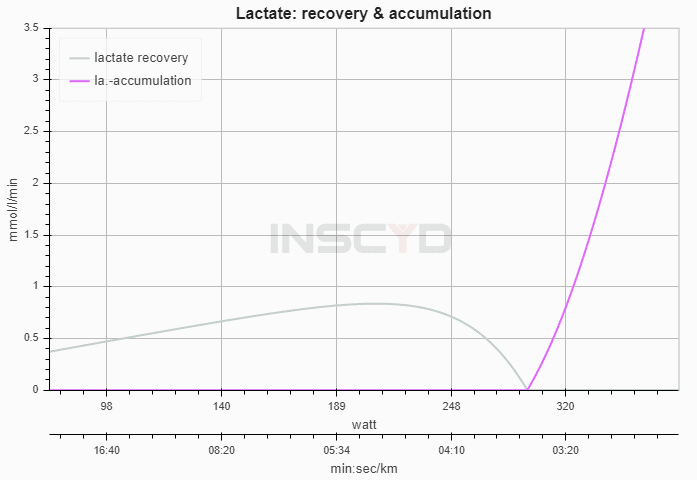
By knowing the exact lactate accumulation rates and power, I can make sure I don’t overcook the athlete, while keeping it challenging.
Without INSCYD I wouldn’t know which intensity I should chose to get the right lactate concentration. I’d easily pick an intensity that is too low or too high. Without power I’d have to describe this training based on heart rate, but that doesn’t work in short intervals, since heart rate reacts too slow.”
With a simple (remote) field test you can get all the INSCYD metrics and functions, based on running power. Learn more about combining INSCYD and running power via this article: Running power: how to add physiological meaning to it.
Ready to do an INSCYD test? Book your test with Florian Heck – KickAss sports via this link, or find your local INSCYD coach here: www.inscyd.com/for-athletes
Interested in using INSCYD as a coach, lab, team or federation? Let’s get in touch:

Florian Heck
Florian Heck is a sport scientist, coach and managing director at KickAss Sports. Learn more about Florian's own triathlon adventures via this article or follow him on Instagram.
VO₂max, VLamax, FatMax, thresholds, fuel use and training zones, from a single test in the lab, in the field or fully remote.

